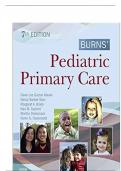
Burns’ Pediatric Primary Care (8th Ed.) — Complete Chapter-
by-Chapter Test Bank: Verified Answers & Detailed Rationales
(New Edition)
Pediatric Primary Care MCQ Test Bank
Question 1
• Chapter & Subtopic: Chapter 1 – Pediatric Primary Care,
Primary Care Versus Primary Prevention
• Stem: A nurse is orienting a new graduate to a pediatric
primary care clinic. Which statement by the new graduate
best demonstrates an understanding of the distinction
between primary care and primary prevention?
• Options:
A. "Primary care focuses on treating chronic illnesses,
while primary prevention focuses on treating acute
infections."
B. "Primary care involves the coordinated management of
a child's health, which includes the delivery of primary
prevention services like immunizations."
C. "Primary prevention is solely the responsibility of public
health nurses, while primary care is the responsibility of
the primary care provider."
D. "The terms are interchangeable; both refer to the first
point of contact a family has with the healthcare system."
, • Correct Answer: B
• Rationale:
o Correct: Primary care is a comprehensive, continuous,
and coordinated approach to health care. A core
component of this care is the provision of primary
prevention strategies, such as immunizations and
anticipatory guidance, to prevent disease before it
occurs. (Reference: Burns, Chapter 1, "Primary Care
Versus Primary Prevention")
o Incorrect A: This is incorrect. Primary care is not
limited to chronic illness management, and primary
prevention is not about treatment.
o Incorrect C: This is incorrect. Primary prevention is a
fundamental responsibility of the primary care
provider within the medical home.
o Incorrect D: This is incorrect. The terms have distinct
meanings, as outlined in the textbook.
• Teaching Point: Primary care is the encompassing model of
care that delivers primary prevention services.
Question 2
• Chapter & Subtopic: Chapter 1 – Pediatric Primary Care,
Unique Issues in Pediatrics
,• Stem: When providing care to a pediatric population, the
nurse understands that a fundamental principle
distinguishing it from adult care is:
• Options:
A. Children have a more predictable response to
medication than adults.
B. Children are legally and developmentally unable to
make autonomous healthcare decisions.
C. The focus of care is solely on the biological needs of the
child.
D. Pediatric care is primarily curative rather than
preventive.
• Correct Answer: B
• Rationale:
o Correct: A core unique issue in pediatrics is that
children are dependent on parents/guardians for
consent and care. The nurse must always consider the
child within the context of the family. (Reference:
Burns, Chapter 1, "Unique Issues in Pediatrics")
o Incorrect A: This is incorrect. Pediatric medication
dosing is highly variable based on weight and age,
making it less predictable.
o Incorrect C: This is incorrect. Pediatric care uses a
holistic approach, considering developmental,
emotional, and social needs.
, o Incorrect D: This is incorrect. Prevention (e.g.,
immunizations, safety) is a cornerstone of pediatric
primary care.
• Teaching Point: Pediatric care is family-centered,
recognizing the child's dependence on caregivers for
decision-making.
Question 3
• Chapter & Subtopic: Chapter 1 – Pediatric Primary Care,
Caring for Children and Youth With Special Healthcare
Needs (CYSHCN)
• Stem: The parents of a 5-year-old with spina bifida express
feeling overwhelmed by coordinating care with multiple
specialists. Which nursing action best reflects the principle
of the medical home for Children and Youth with Special
Healthcare Needs (CYSHCN)?
• Options:
A. Providing the family with a list of all local specialists and
instructing them to schedule the appointments.
B. Assuming full responsibility for all medical decisions to
relieve the parents' burden.
C. Acting as the central coordinator for care, ensuring
communication between specialists and facilitating a
comprehensive care plan.
D. Recommending the family focus on one health issue at a
time to avoid confusion.
by-Chapter Test Bank: Verified Answers & Detailed Rationales
(New Edition)
Pediatric Primary Care MCQ Test Bank
Question 1
• Chapter & Subtopic: Chapter 1 – Pediatric Primary Care,
Primary Care Versus Primary Prevention
• Stem: A nurse is orienting a new graduate to a pediatric
primary care clinic. Which statement by the new graduate
best demonstrates an understanding of the distinction
between primary care and primary prevention?
• Options:
A. "Primary care focuses on treating chronic illnesses,
while primary prevention focuses on treating acute
infections."
B. "Primary care involves the coordinated management of
a child's health, which includes the delivery of primary
prevention services like immunizations."
C. "Primary prevention is solely the responsibility of public
health nurses, while primary care is the responsibility of
the primary care provider."
D. "The terms are interchangeable; both refer to the first
point of contact a family has with the healthcare system."
, • Correct Answer: B
• Rationale:
o Correct: Primary care is a comprehensive, continuous,
and coordinated approach to health care. A core
component of this care is the provision of primary
prevention strategies, such as immunizations and
anticipatory guidance, to prevent disease before it
occurs. (Reference: Burns, Chapter 1, "Primary Care
Versus Primary Prevention")
o Incorrect A: This is incorrect. Primary care is not
limited to chronic illness management, and primary
prevention is not about treatment.
o Incorrect C: This is incorrect. Primary prevention is a
fundamental responsibility of the primary care
provider within the medical home.
o Incorrect D: This is incorrect. The terms have distinct
meanings, as outlined in the textbook.
• Teaching Point: Primary care is the encompassing model of
care that delivers primary prevention services.
Question 2
• Chapter & Subtopic: Chapter 1 – Pediatric Primary Care,
Unique Issues in Pediatrics
,• Stem: When providing care to a pediatric population, the
nurse understands that a fundamental principle
distinguishing it from adult care is:
• Options:
A. Children have a more predictable response to
medication than adults.
B. Children are legally and developmentally unable to
make autonomous healthcare decisions.
C. The focus of care is solely on the biological needs of the
child.
D. Pediatric care is primarily curative rather than
preventive.
• Correct Answer: B
• Rationale:
o Correct: A core unique issue in pediatrics is that
children are dependent on parents/guardians for
consent and care. The nurse must always consider the
child within the context of the family. (Reference:
Burns, Chapter 1, "Unique Issues in Pediatrics")
o Incorrect A: This is incorrect. Pediatric medication
dosing is highly variable based on weight and age,
making it less predictable.
o Incorrect C: This is incorrect. Pediatric care uses a
holistic approach, considering developmental,
emotional, and social needs.
, o Incorrect D: This is incorrect. Prevention (e.g.,
immunizations, safety) is a cornerstone of pediatric
primary care.
• Teaching Point: Pediatric care is family-centered,
recognizing the child's dependence on caregivers for
decision-making.
Question 3
• Chapter & Subtopic: Chapter 1 – Pediatric Primary Care,
Caring for Children and Youth With Special Healthcare
Needs (CYSHCN)
• Stem: The parents of a 5-year-old with spina bifida express
feeling overwhelmed by coordinating care with multiple
specialists. Which nursing action best reflects the principle
of the medical home for Children and Youth with Special
Healthcare Needs (CYSHCN)?
• Options:
A. Providing the family with a list of all local specialists and
instructing them to schedule the appointments.
B. Assuming full responsibility for all medical decisions to
relieve the parents' burden.
C. Acting as the central coordinator for care, ensuring
communication between specialists and facilitating a
comprehensive care plan.
D. Recommending the family focus on one health issue at a
time to avoid confusion.