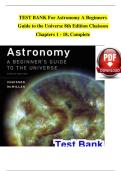
TEST BANK For Astronomy A Beginners
Guide to the Universe 8th Edition Chaisson
Chapters 1 - 18, Complete
,Table of Contents kd kd
0. Charting the Heavens: The Foundations of Astronomy
kd kd kd kd kd kd kd
1. The Copernican Revolution: The Birth of Modern Science
kd kd kd kd kd kd kd kd
2. Light and Matter: The Inner Workings of the Cosmos
kd kd kd kd kd kd kd kd kd
3. Telescopes: The Tools of Astronomy
kd kd kd kd kd
4. The Solar System: Interplanetary Matter and the Birth of the Planets
kd kd kd kd kd kd kd kd kd kd kd
5. Earth and Its Moon: Our Cosmic Backyard
kd kd kd kd kd kd kd
6. The Terrestrial Planets: A Study in Contrasts
kd kd kd kd kd kd kd
7. The Jovian Planets: Giants of the Solar System
kd kd kd kd kd kd kd kd
8. Moons, Rings, and Plutoids: Small Worlds Among Giants
kd kd kd kd kd kd kd kd
9. The Sun: Our Parent Star
kd kd kd kd kd
10. Measuring the Stars: Giants, Dwarfs, and the Main Sequence
kd kd kd kd kd kd kd kd kd
11. The Interstellar Medium: Star Formation in the Milky Way
kd kd kd kd kd kd kd kd kd
12. Stellar Evolution: The Lives and Deaths of Stars
kd kd kd kd kd kd kd kd
13. Neutron Stars and Black Holes: Strange States of Matter
kd kd kd kd kd kd kd kd kd
14. The Milky Way Galaxy: A Spiral in Space
kd kd kd kd kd kd kd kd
15. Normal and Active Galaxies: Building Blocks of the Universe
kd kd kd kd kd kd kd kd kd
16. Hubble’s Law and Dark Matter: The Large-Scale Structure of the Cosmos
kd kd kd kd kd kd kd kd kd kd kd
17. Cosmology: The Big Bang and the Fate of the Universe
kd kd kd kd kd kd kd kd kd kd
18. Life in the Universe: Are We Alone?
kd kd kd kd kd kd kd
,Chapter 0 Charting the Heavens: The Foundations of Astronomy
kd k d k d kd kd kd kd kd kd
1) Right ascension in the sky is very similar to latitude on the Earth. A
kd kd kd kd kd kd kd kd kd kd kd kd kd
NSWER: FALSE k d
Diff: 1 kd
Section Ref.: 0.1 kd k d
2) Latitude and right ascension are coordinate systems used to find objects on the celestial sp
kd kd kd kd kd kd kd kd kd kd kd kd kd kd
here.
ANSWER: FALSE k d k
Diff: 1
d kd
Section Ref.: 0.1 kd k d
3) The celestial sphere is divided into 88 modern constellations. A
kd kd kd kd kd kd kd kd kd
NSWER: TRUE k d
Diff: 1 kd
Section Ref.: 0.1 kd k d
4) In the sky, declination is measured in degrees north or south of the celestial equator. A
kd kd kd kd kd kd kd kd kd kd kd kd kd kd kd
NSWER: TRUE k d
Diff: 1 kd
Section Ref.: 0.1 kd k d
5) The south celestial pole is located at a declination of -
kd kd kd kd kd kd kd kd kd kd
90 degrees. ANSWER: TRUE
kd kd k d
Diff: 1 kd
Section Ref.: 0.1 kd k d
6) In general, the brightest star in a given constellation is designated as alpha. A
kd kd kd kd kd kd kd kd kd kd kd kd kd
NSWER: TRUE k d
Diff: 1 kd
Section Ref.: 0.1 kd k d
7) Constellations are close clusters of stars, all at about the same distance from the Sun. A
kd kd kd kd kd kd kd kd kd kd kd kd kd kd kd
NSWER: FALSE k d
Diff: 1 kd
Section Ref.: 0.1 kd k d
, 8) Over 20,000 stars are visible to the naked eye on the darkest, clearest nights. A
kd kd kd kd kd kd kd kd kd kd kd kd kd kd
NSWER: FALSE k d
Diff: 2
kd
Section Ref.: 0.1 kd k d
9) A star with a right ascension of 2.6 hrs will rise 2.6 hours after the vernal equinox. AN
kd kd kd kd kd kd kd kd kd kd kd kd kd kd kd kd kd
SWER: TRUE k d
Diff: 3
kd
Section Ref.: More Prec. 0.1
kd k d kd kd
10) A tropical year is the same as a sidereal year. A
kd kd kd kd kd kd kd kd kd kd
NSWER: FALSE k d
Diff: 1
kd
Section Ref.: 0.2 kd k d
11) The sidereal day is determined by the Earth's rotation with respect to the stars. A
kd kd kd kd kd kd kd kd kd kd kd kd kd kd
NSWER: TRUE k d
Diff: 1
kd
Section Ref.: 0.2 kd k d
12) The vernal equinox marks the beginning of spring in the northern hemisphere. A
kd kd kd kd kd kd kd kd kd kd kd kd
NSWER: TRUE k d
Diff: 1
kd
Section Ref.: 0.2 kd k d
13) There are 3,600 arc seconds in a degree. A
kd kd kd kd kd kd kd kd
NSWER: TRUE k d
Diff: 2
kd
Section Ref.: More Prec. 0.1
kd k d kd kd
14) An hour of right ascension corresponds to 60 degrees in the sky. A
kd kd kd kd kd kd kd kd kd kd kd kd
NSWER: FALSE k d
Diff: 2
kd
Section Ref.: 0.2 kd k d
15) From Earth, the Sun and Moon have about the same angular diameter. A
kd kd kd kd kd kd kd kd kd kd kd kd
NSWER: TRUE k d
Diff: 1
kd
Section Ref.: 0.2 kd k d
16) At the solstices, the Sun's declination will be 23.5 degrees from the equator. A
kd kd kd kd kd kd kd kd kd kd kd kd kd
NSWER: TRUE k d
Diff: 2
Section Ref.: 0.2
Guide to the Universe 8th Edition Chaisson
Chapters 1 - 18, Complete
,Table of Contents kd kd
0. Charting the Heavens: The Foundations of Astronomy
kd kd kd kd kd kd kd
1. The Copernican Revolution: The Birth of Modern Science
kd kd kd kd kd kd kd kd
2. Light and Matter: The Inner Workings of the Cosmos
kd kd kd kd kd kd kd kd kd
3. Telescopes: The Tools of Astronomy
kd kd kd kd kd
4. The Solar System: Interplanetary Matter and the Birth of the Planets
kd kd kd kd kd kd kd kd kd kd kd
5. Earth and Its Moon: Our Cosmic Backyard
kd kd kd kd kd kd kd
6. The Terrestrial Planets: A Study in Contrasts
kd kd kd kd kd kd kd
7. The Jovian Planets: Giants of the Solar System
kd kd kd kd kd kd kd kd
8. Moons, Rings, and Plutoids: Small Worlds Among Giants
kd kd kd kd kd kd kd kd
9. The Sun: Our Parent Star
kd kd kd kd kd
10. Measuring the Stars: Giants, Dwarfs, and the Main Sequence
kd kd kd kd kd kd kd kd kd
11. The Interstellar Medium: Star Formation in the Milky Way
kd kd kd kd kd kd kd kd kd
12. Stellar Evolution: The Lives and Deaths of Stars
kd kd kd kd kd kd kd kd
13. Neutron Stars and Black Holes: Strange States of Matter
kd kd kd kd kd kd kd kd kd
14. The Milky Way Galaxy: A Spiral in Space
kd kd kd kd kd kd kd kd
15. Normal and Active Galaxies: Building Blocks of the Universe
kd kd kd kd kd kd kd kd kd
16. Hubble’s Law and Dark Matter: The Large-Scale Structure of the Cosmos
kd kd kd kd kd kd kd kd kd kd kd
17. Cosmology: The Big Bang and the Fate of the Universe
kd kd kd kd kd kd kd kd kd kd
18. Life in the Universe: Are We Alone?
kd kd kd kd kd kd kd
,Chapter 0 Charting the Heavens: The Foundations of Astronomy
kd k d k d kd kd kd kd kd kd
1) Right ascension in the sky is very similar to latitude on the Earth. A
kd kd kd kd kd kd kd kd kd kd kd kd kd
NSWER: FALSE k d
Diff: 1 kd
Section Ref.: 0.1 kd k d
2) Latitude and right ascension are coordinate systems used to find objects on the celestial sp
kd kd kd kd kd kd kd kd kd kd kd kd kd kd
here.
ANSWER: FALSE k d k
Diff: 1
d kd
Section Ref.: 0.1 kd k d
3) The celestial sphere is divided into 88 modern constellations. A
kd kd kd kd kd kd kd kd kd
NSWER: TRUE k d
Diff: 1 kd
Section Ref.: 0.1 kd k d
4) In the sky, declination is measured in degrees north or south of the celestial equator. A
kd kd kd kd kd kd kd kd kd kd kd kd kd kd kd
NSWER: TRUE k d
Diff: 1 kd
Section Ref.: 0.1 kd k d
5) The south celestial pole is located at a declination of -
kd kd kd kd kd kd kd kd kd kd
90 degrees. ANSWER: TRUE
kd kd k d
Diff: 1 kd
Section Ref.: 0.1 kd k d
6) In general, the brightest star in a given constellation is designated as alpha. A
kd kd kd kd kd kd kd kd kd kd kd kd kd
NSWER: TRUE k d
Diff: 1 kd
Section Ref.: 0.1 kd k d
7) Constellations are close clusters of stars, all at about the same distance from the Sun. A
kd kd kd kd kd kd kd kd kd kd kd kd kd kd kd
NSWER: FALSE k d
Diff: 1 kd
Section Ref.: 0.1 kd k d
, 8) Over 20,000 stars are visible to the naked eye on the darkest, clearest nights. A
kd kd kd kd kd kd kd kd kd kd kd kd kd kd
NSWER: FALSE k d
Diff: 2
kd
Section Ref.: 0.1 kd k d
9) A star with a right ascension of 2.6 hrs will rise 2.6 hours after the vernal equinox. AN
kd kd kd kd kd kd kd kd kd kd kd kd kd kd kd kd kd
SWER: TRUE k d
Diff: 3
kd
Section Ref.: More Prec. 0.1
kd k d kd kd
10) A tropical year is the same as a sidereal year. A
kd kd kd kd kd kd kd kd kd kd
NSWER: FALSE k d
Diff: 1
kd
Section Ref.: 0.2 kd k d
11) The sidereal day is determined by the Earth's rotation with respect to the stars. A
kd kd kd kd kd kd kd kd kd kd kd kd kd kd
NSWER: TRUE k d
Diff: 1
kd
Section Ref.: 0.2 kd k d
12) The vernal equinox marks the beginning of spring in the northern hemisphere. A
kd kd kd kd kd kd kd kd kd kd kd kd
NSWER: TRUE k d
Diff: 1
kd
Section Ref.: 0.2 kd k d
13) There are 3,600 arc seconds in a degree. A
kd kd kd kd kd kd kd kd
NSWER: TRUE k d
Diff: 2
kd
Section Ref.: More Prec. 0.1
kd k d kd kd
14) An hour of right ascension corresponds to 60 degrees in the sky. A
kd kd kd kd kd kd kd kd kd kd kd kd
NSWER: FALSE k d
Diff: 2
kd
Section Ref.: 0.2 kd k d
15) From Earth, the Sun and Moon have about the same angular diameter. A
kd kd kd kd kd kd kd kd kd kd kd kd
NSWER: TRUE k d
Diff: 1
kd
Section Ref.: 0.2 kd k d
16) At the solstices, the Sun's declination will be 23.5 degrees from the equator. A
kd kd kd kd kd kd kd kd kd kd kd kd kd
NSWER: TRUE k d
Diff: 2
Section Ref.: 0.2