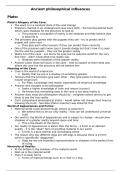
Ancient philosophical influences
Plato:
Plato’s Allegory of the Cave:
The word is in a constant state of flux and change
Prisoners chained in an underground cave since birth – fire burning behind them
which casts shadows for the prisoners to look at
o The prisoner’s conception of reality is the shadows and they believe that
is what life is
The prisoners play games with the puppets they see – try to predict which
puppet will come next –
o They give each other honours if they can predict them correctly
One of the prisoners gets loose (yes it sounds dodgy but that’s how it is) sees
the fire and the puppets – they are the greater reality
Walks out of the cave – sun burns his eyes but he sees the world for the very
first time – didn’t know what true reality was
o Shadows were imitations of the greater reality
Prisoner pities those still stuck in the cave – tries to explain to them what was
above the cave but the prisoners did not believe him
Meaning of the Cave:
Cave is the world of empiricism
o Reality that we see is a shadow of something greater
Honours that the prisoners give each other – they give power to those who
master empiricism
o For Plato, knowledge and reason supersedes all empirical knowledge
Prisoner who escapes is the philosopher
o Seeks a higher knowledge of truth and reason (a priori)
o He knows that everything seen in the cave is not what reality is
Prisoner does what the philosopher should do – enlighten others and try to get
them to see the true reality
Can’t comprehend philosophical truths – would rather not change their lives by
knowing the truth – Socrates (Plato’s teacher) was killed for this
World of Appearances and Forms:
Material world is perceived through senses (a posteriori)
o We believe this to be our only reality – how can we understand universal
truth
Our world is the World of Appearances and is subject to change – we perceive
shadows of a greater reality beyond space and time
o This is the Realm of the Forms
Our reality of appearances is lesser than the forms – a Form is an abstract
quality – it is the “ideal” form of anything material in our world
o A form is a pure eternal and unchanging entity
The reason why two different dogs are still dogs is because there is a Form
which is specifically ‘doggyness’
o Dogs we see are imperfect representations or shadows of the perfect form
of a Dog
Hierarchy of Reality:
At the bottom is the shadows of the material world
Next up is the material world
Then it is lower forms
o Forms of material beings such as a chair or a dog
, Then there are higher forms – Truth, Beauty and Justice – they are universal –
perfect version of beauty exists in the realm of the Forms
o Anytime we perceive something as beautiful it is the shadow of the form
of beauty
Top of the hierarchy – the Form of the Forms – it’s the Form of the Good
o Every other form derives from the Form of the Good
Evaluation of Plato’s philosophy:
There is a Form of Beauty
o There is a dim reflection of this in our world
o Dim reflection comes from our prior existence in the World of the Forms
The world we live in is a pale imitation of the real world
o Our world is always changing
o We use our senses to understand our world
For Plato the real world is outside the world we live in
o Real World is unchanging and eternal
o Real World is a world of ideas
o The perfect forms are in the Real World
They are fixed truths – they are absolute
The form of something is its essence
o This is why beauty is hard to define – abstract concept
o The particulars of something leads to its form
Most things in life conform to a form
o Exception is numbers and evil – they are absolute
Aristotle believed that knowledge comes from life experience rather than forms
(a posteriori)
o Questioned whether there was really an absolute standard of goodness
o Ideas of Relativism
Ideal forms don’t make sense
o Beauty isn’t in anything without something beautiful
Are there ideal forms for things that haven’t been invented?
Soul/Body Dualism can be disagreed with according to modern materialistic
arguments
o Richard Dawkins – ‘The Selfish Gene’ – “bytes and bytes and bytes of
information”
Ideal forms:
Ideal forms have the presence of good in them
o Goodness itself is the most important form (Form of the Forms)
For Plato, knowledge of the Good is the highest form of knowledge a human is
capable of
Plato and Christianity:
Similarities
o Life on Earth is imitative of life in another world (Heaven/World of the
Forms)
o Innate understanding of what is good and evil – rationality
o The essence of something relates to the concept of the soul – Forms the
identity of beings
Differences
o Plato argues for previous existence in World of the Forms
o God is sentient – the Form of Good is merely an idea
o Contrasting ideas on the nature of evil (Link to Problem of Evil)
Christianity says sin comes from free will
Plato says evil comes from an imperfection of the Forms
, Strengths:
Offers an explanation as to why we all recognise the same essential elements
o Absolutist philosophy
Explains why there are imperfections in the world
Encourages regular questioning of reality
o Urges us not to accept things at face value such as The Cave
Thinking concentrates on Forms of qualities
o Means there is an intuitive knowledge of what ‘goodness’ is
o Although it fails when pushed to logical extremes – is there any reason to
do so?
The physical world inhabited by the body is inferior to the World of the Forms
o Led to ideas that strayed from Plato’s
o People should punish their bodies for spiritual progress and live simple
lives
This was not Plato’s position
o He saw physical pleasures as unimportant compared to philosophy,
however shouldn’t be totally restricted
Criticisms of the Forms:
Doesn’t prove his ‘real world’ of the forms actually exists
o No scientific evidence this – no way to access the Forms
o Aristotle focuses on our existence as it makes more sense to understand
how the world works
What stops infinite regression
o The form of a form of a form…
Highly relativist
o The opinion of Good is relative – one person may say good is one thing
and another may say the complete opposite
o No shared concept of Good – anything ‘good’ or ‘bad’ is merely an
expression of emotion towards something
o Cannot be one Form of Good because goodness relates to specific actions
or situations
Aristotle and Ayer – goodness cannot be encapsulated into one umbrella form
o Ayer – there is no such thing as good
We’ve never experienced the world of the Forms – how can we call something
beautiful if we have no knowledge of these absolute qualities
o Plato said the soul has experience with the world of the Forms and has an
innate understanding
Relies on the truth of Dualism (difference between body/mind)
Is there a perfect form of bad things – is there a ‘Form of dog poo’ that is perfect
o How can evil derive from the Form of Good
Not enough sufficient evidence of forms
o Not much to understand about the Forms as there are so many variations
on material things – i.e a rose with 7 petals
Forms often fail when pushed to logical extremes (COUNTER: why would you do
that in the first place anyway)
Julia Annas - using only a priori knowledge restricts the range of Plato’s
argument and can often create unnecessary confusion
Completely disregards the senses, but humans have used them for thousands of
years
o Rationality doesn’t fully help us to make sense of the world we live
The physical world isn’t truly real
o It is real – we can use our sense to discern this
Plato:
Plato’s Allegory of the Cave:
The word is in a constant state of flux and change
Prisoners chained in an underground cave since birth – fire burning behind them
which casts shadows for the prisoners to look at
o The prisoner’s conception of reality is the shadows and they believe that
is what life is
The prisoners play games with the puppets they see – try to predict which
puppet will come next –
o They give each other honours if they can predict them correctly
One of the prisoners gets loose (yes it sounds dodgy but that’s how it is) sees
the fire and the puppets – they are the greater reality
Walks out of the cave – sun burns his eyes but he sees the world for the very
first time – didn’t know what true reality was
o Shadows were imitations of the greater reality
Prisoner pities those still stuck in the cave – tries to explain to them what was
above the cave but the prisoners did not believe him
Meaning of the Cave:
Cave is the world of empiricism
o Reality that we see is a shadow of something greater
Honours that the prisoners give each other – they give power to those who
master empiricism
o For Plato, knowledge and reason supersedes all empirical knowledge
Prisoner who escapes is the philosopher
o Seeks a higher knowledge of truth and reason (a priori)
o He knows that everything seen in the cave is not what reality is
Prisoner does what the philosopher should do – enlighten others and try to get
them to see the true reality
Can’t comprehend philosophical truths – would rather not change their lives by
knowing the truth – Socrates (Plato’s teacher) was killed for this
World of Appearances and Forms:
Material world is perceived through senses (a posteriori)
o We believe this to be our only reality – how can we understand universal
truth
Our world is the World of Appearances and is subject to change – we perceive
shadows of a greater reality beyond space and time
o This is the Realm of the Forms
Our reality of appearances is lesser than the forms – a Form is an abstract
quality – it is the “ideal” form of anything material in our world
o A form is a pure eternal and unchanging entity
The reason why two different dogs are still dogs is because there is a Form
which is specifically ‘doggyness’
o Dogs we see are imperfect representations or shadows of the perfect form
of a Dog
Hierarchy of Reality:
At the bottom is the shadows of the material world
Next up is the material world
Then it is lower forms
o Forms of material beings such as a chair or a dog
, Then there are higher forms – Truth, Beauty and Justice – they are universal –
perfect version of beauty exists in the realm of the Forms
o Anytime we perceive something as beautiful it is the shadow of the form
of beauty
Top of the hierarchy – the Form of the Forms – it’s the Form of the Good
o Every other form derives from the Form of the Good
Evaluation of Plato’s philosophy:
There is a Form of Beauty
o There is a dim reflection of this in our world
o Dim reflection comes from our prior existence in the World of the Forms
The world we live in is a pale imitation of the real world
o Our world is always changing
o We use our senses to understand our world
For Plato the real world is outside the world we live in
o Real World is unchanging and eternal
o Real World is a world of ideas
o The perfect forms are in the Real World
They are fixed truths – they are absolute
The form of something is its essence
o This is why beauty is hard to define – abstract concept
o The particulars of something leads to its form
Most things in life conform to a form
o Exception is numbers and evil – they are absolute
Aristotle believed that knowledge comes from life experience rather than forms
(a posteriori)
o Questioned whether there was really an absolute standard of goodness
o Ideas of Relativism
Ideal forms don’t make sense
o Beauty isn’t in anything without something beautiful
Are there ideal forms for things that haven’t been invented?
Soul/Body Dualism can be disagreed with according to modern materialistic
arguments
o Richard Dawkins – ‘The Selfish Gene’ – “bytes and bytes and bytes of
information”
Ideal forms:
Ideal forms have the presence of good in them
o Goodness itself is the most important form (Form of the Forms)
For Plato, knowledge of the Good is the highest form of knowledge a human is
capable of
Plato and Christianity:
Similarities
o Life on Earth is imitative of life in another world (Heaven/World of the
Forms)
o Innate understanding of what is good and evil – rationality
o The essence of something relates to the concept of the soul – Forms the
identity of beings
Differences
o Plato argues for previous existence in World of the Forms
o God is sentient – the Form of Good is merely an idea
o Contrasting ideas on the nature of evil (Link to Problem of Evil)
Christianity says sin comes from free will
Plato says evil comes from an imperfection of the Forms
, Strengths:
Offers an explanation as to why we all recognise the same essential elements
o Absolutist philosophy
Explains why there are imperfections in the world
Encourages regular questioning of reality
o Urges us not to accept things at face value such as The Cave
Thinking concentrates on Forms of qualities
o Means there is an intuitive knowledge of what ‘goodness’ is
o Although it fails when pushed to logical extremes – is there any reason to
do so?
The physical world inhabited by the body is inferior to the World of the Forms
o Led to ideas that strayed from Plato’s
o People should punish their bodies for spiritual progress and live simple
lives
This was not Plato’s position
o He saw physical pleasures as unimportant compared to philosophy,
however shouldn’t be totally restricted
Criticisms of the Forms:
Doesn’t prove his ‘real world’ of the forms actually exists
o No scientific evidence this – no way to access the Forms
o Aristotle focuses on our existence as it makes more sense to understand
how the world works
What stops infinite regression
o The form of a form of a form…
Highly relativist
o The opinion of Good is relative – one person may say good is one thing
and another may say the complete opposite
o No shared concept of Good – anything ‘good’ or ‘bad’ is merely an
expression of emotion towards something
o Cannot be one Form of Good because goodness relates to specific actions
or situations
Aristotle and Ayer – goodness cannot be encapsulated into one umbrella form
o Ayer – there is no such thing as good
We’ve never experienced the world of the Forms – how can we call something
beautiful if we have no knowledge of these absolute qualities
o Plato said the soul has experience with the world of the Forms and has an
innate understanding
Relies on the truth of Dualism (difference between body/mind)
Is there a perfect form of bad things – is there a ‘Form of dog poo’ that is perfect
o How can evil derive from the Form of Good
Not enough sufficient evidence of forms
o Not much to understand about the Forms as there are so many variations
on material things – i.e a rose with 7 petals
Forms often fail when pushed to logical extremes (COUNTER: why would you do
that in the first place anyway)
Julia Annas - using only a priori knowledge restricts the range of Plato’s
argument and can often create unnecessary confusion
Completely disregards the senses, but humans have used them for thousands of
years
o Rationality doesn’t fully help us to make sense of the world we live
The physical world isn’t truly real
o It is real – we can use our sense to discern this