CHEP Certification UPDATED ACTUAL Questions and CORRECT
Answers
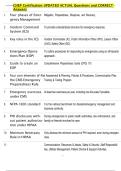
1. Four phases of Emer- Mitigation, Preparedness, Response, and Recovery.
gency Management
2. Incident Command To provide a standardized structure for emergency response.
System (ICS)
3. Key roles in the ICS Incident Commander (IC), Public Information Oflcer (PIO), Liaison Oflcer
(LNO), Safety Oflcer (SO).
4. Emergency Opera- To outline procedures for responding to emergencies using an all-hazards
tions Plan (EOP) approach.
5. Guide to create an Comprehensive Preparedness Guide (CPG) 101.
EOP
6. Four core elements of Risk Assessment & Planning, Policies & Procedures, Communication Plan,
the CMS Emergency Training & Testing Program.
Preparedness Rule
7. Emergency exercises At least two exercises per year, including one full-scale if possible.
under CMS
8. NFPA 1600 standard It is the national benchmark for disaster/emergency management and
business continuity.
9. PHI disclosure with- During emergencies to public health authorities, law enforcement, and
out patient authoriza- family or friends involved in care.
tion under HIPAA
10. Minimum Necessary Only disclose the minimum amount of PHI required, even during emergen-
Rule in HIPAA cies.
11. Communications, Resources & Assets, Safety & Security, Staff Responsibili-
ties, Utilities Management, Patient Clinical & Support Activities.
1/3
Answers
1. Four phases of Emer- Mitigation, Preparedness, Response, and Recovery.
gency Management
2. Incident Command To provide a standardized structure for emergency response.
System (ICS)
3. Key roles in the ICS Incident Commander (IC), Public Information Oflcer (PIO), Liaison Oflcer
(LNO), Safety Oflcer (SO).
4. Emergency Opera- To outline procedures for responding to emergencies using an all-hazards
tions Plan (EOP) approach.
5. Guide to create an Comprehensive Preparedness Guide (CPG) 101.
EOP
6. Four core elements of Risk Assessment & Planning, Policies & Procedures, Communication Plan,
the CMS Emergency Training & Testing Program.
Preparedness Rule
7. Emergency exercises At least two exercises per year, including one full-scale if possible.
under CMS
8. NFPA 1600 standard It is the national benchmark for disaster/emergency management and
business continuity.
9. PHI disclosure with- During emergencies to public health authorities, law enforcement, and
out patient authoriza- family or friends involved in care.
tion under HIPAA
10. Minimum Necessary Only disclose the minimum amount of PHI required, even during emergen-
Rule in HIPAA cies.
11. Communications, Resources & Assets, Safety & Security, Staff Responsibili-
ties, Utilities Management, Patient Clinical & Support Activities.
1/3