[TYPE THE COMPANY NAME]
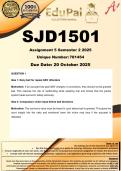
SJD1501 Assignment 6
(COMPLETE ANSWERS)
Semester 2 2025 - DUE 20
October 2025
NO PLAGIARISM
[Pick the date]
[Type the abstract of the document here. The abstract is typically a short summary of the contents of
the document. Type the abstract of the document here. The abstract is typically a short summary of
the contents of the document.]
, Exam (elaborations)
SJD1501 Assignment 6 (COMPLETE
ANSWERS) Semester 2 2025 - DUE 20
October 2025
Course
Social Dimension of Justice (SJD1501)
Institution
University Of South Africa (Unisa)
Book
Introduction to the Law of South Africa
SJD1501 Assignment 6 (COMPLETE ANSWERS) Semester 2 2025 - DUE 20
October 2025; 100% TRUSTED Complete, trusted solutions and explanations.
Ensure your success with us..
Read the articles via the links provided below and answer the questions that
follow. This assessment is related to the South African Social Security Agency
(Sassa) and corruption. entire-grant-payment-system/ and-corruption-sassa-
says-minister Based on the above: 1. In your opinion, what are the causes of
corruption in Sassa? (200 words, 5 marks) 2. What do you believe are the
consequences of Sassa corruption, for individuals and society? You are
welcome to share a personal experience, if applicable. (200 words, 5 marks)
3. What are your suggestions to prevent corruption in Sassa? (200 words, 5
marks)
1. What are the causes of corruption in SASSA?
The corruption within the South African Social Security Agency (SASSA) can be attributed to a
combination of systemic, administrative, and ethical failures. A primary cause is the weakness of
internal control systems and a lack of robust oversight. For years, auditors and oversight bodies
have highlighted poor financial management, irregular expenditure, and a failure to implement
consequence management for those implicated in fraud. This creates an environment where
corrupt individuals can operate with a sense of impunity.
Furthermore, the vulnerability of the grant payment system itself has been a significant
enabler. Reports have detailed how syndicates, often in collusion with SASSA officials, exploit
system glitches to register ghost beneficiaries, make unauthorised deductions from recipients'
accounts, and even pay grants to deceased individuals or government employees. The
bureaucratic complexity and a lack of a modern, integrated IT system also leave room for
manipulation. A final contributing factor is the entrenched culture of petty corruption, where
low-level staff may demand bribes from vulnerable applicants to expedite processes or approve
applications, leveraging their position of power for personal gain.
SJD1501 Assignment 6
(COMPLETE ANSWERS)
Semester 2 2025 - DUE 20
October 2025
NO PLAGIARISM
[Pick the date]
[Type the abstract of the document here. The abstract is typically a short summary of the contents of
the document. Type the abstract of the document here. The abstract is typically a short summary of
the contents of the document.]
, Exam (elaborations)
SJD1501 Assignment 6 (COMPLETE
ANSWERS) Semester 2 2025 - DUE 20
October 2025
Course
Social Dimension of Justice (SJD1501)
Institution
University Of South Africa (Unisa)
Book
Introduction to the Law of South Africa
SJD1501 Assignment 6 (COMPLETE ANSWERS) Semester 2 2025 - DUE 20
October 2025; 100% TRUSTED Complete, trusted solutions and explanations.
Ensure your success with us..
Read the articles via the links provided below and answer the questions that
follow. This assessment is related to the South African Social Security Agency
(Sassa) and corruption. entire-grant-payment-system/ and-corruption-sassa-
says-minister Based on the above: 1. In your opinion, what are the causes of
corruption in Sassa? (200 words, 5 marks) 2. What do you believe are the
consequences of Sassa corruption, for individuals and society? You are
welcome to share a personal experience, if applicable. (200 words, 5 marks)
3. What are your suggestions to prevent corruption in Sassa? (200 words, 5
marks)
1. What are the causes of corruption in SASSA?
The corruption within the South African Social Security Agency (SASSA) can be attributed to a
combination of systemic, administrative, and ethical failures. A primary cause is the weakness of
internal control systems and a lack of robust oversight. For years, auditors and oversight bodies
have highlighted poor financial management, irregular expenditure, and a failure to implement
consequence management for those implicated in fraud. This creates an environment where
corrupt individuals can operate with a sense of impunity.
Furthermore, the vulnerability of the grant payment system itself has been a significant
enabler. Reports have detailed how syndicates, often in collusion with SASSA officials, exploit
system glitches to register ghost beneficiaries, make unauthorised deductions from recipients'
accounts, and even pay grants to deceased individuals or government employees. The
bureaucratic complexity and a lack of a modern, integrated IT system also leave room for
manipulation. A final contributing factor is the entrenched culture of petty corruption, where
low-level staff may demand bribes from vulnerable applicants to expedite processes or approve
applications, leveraging their position of power for personal gain.