1
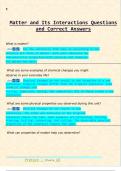
Matter and Its Interactions Questions
and Correct Answers
What is matter?
Ans✅✅: All the substances that make up everything in the
universe are forms of matter. Each pure substance has
characteristic properties—both physical and chemical.
All matter has mass.
What are some examples of chemical changes you might
observe in your everyday life?
Ans✅✅: Physical changes do not result in the formation of a new
substance. Chemical changes differ from the original substance. Some
chemical changes are
rusting, digestion, baking, and combustion. All of these create a new
substance.
What are some physical properties you observed during this unit?
Ans✅✅: Physical changes do not result in new
substances. The atoms and molecules in the original
substance remain the same. Some examples are dissolving, melting,
freezing, boiling, condensing, and cutting. The observable physical
properties of the substance remains the same.
What can properties of matter help you determine?
Pretest - Stuvia US
, 2
Ans✅✅: I can use characteristic physical and chemical
properties to identify substances.
I can collect data related to physical and chemical properties before and
after substances interact.
I can analyze and interpret this data to determine similarities and
differences before and after substances interact.
If characteristic properties differ, a chemical reaction has occurred and
resulted in the formation of a new substance.
How can illustrations and diagrams be helpful for communicating ideas?
Ans✅✅: Illustrations and diagrams can be helpful for
communicating ideas because they can represent complex ideas and
explanations in a visual way.
How can density be used to identify a substance and predict how it will behave
under different conditions?
Ans✅✅: The density of a substance is a characteristic property. If
the density of two substances is the same, they might be the same
substance. Density can also be used to predict if a solid object will
sink or float, or if an immiscible liquid (liquids that don't mix
together) will be layered above or below another liquid.
Density is a characteristic property and that it can be used to predict
layering, floating, and sinking.
How are particles in solid ice similar to the particles in liquid water, and water
vapor? How are they different?
Ans✅✅: The particles of solid ice, liquid water, and water vapor are
identical to each other. The only difference among these three substances
is the distance between particles.
How is energy related to physical changes in matter?
Pretest - Stuvia US
Matter and Its Interactions Questions
and Correct Answers
What is matter?
Ans✅✅: All the substances that make up everything in the
universe are forms of matter. Each pure substance has
characteristic properties—both physical and chemical.
All matter has mass.
What are some examples of chemical changes you might
observe in your everyday life?
Ans✅✅: Physical changes do not result in the formation of a new
substance. Chemical changes differ from the original substance. Some
chemical changes are
rusting, digestion, baking, and combustion. All of these create a new
substance.
What are some physical properties you observed during this unit?
Ans✅✅: Physical changes do not result in new
substances. The atoms and molecules in the original
substance remain the same. Some examples are dissolving, melting,
freezing, boiling, condensing, and cutting. The observable physical
properties of the substance remains the same.
What can properties of matter help you determine?
Pretest - Stuvia US
, 2
Ans✅✅: I can use characteristic physical and chemical
properties to identify substances.
I can collect data related to physical and chemical properties before and
after substances interact.
I can analyze and interpret this data to determine similarities and
differences before and after substances interact.
If characteristic properties differ, a chemical reaction has occurred and
resulted in the formation of a new substance.
How can illustrations and diagrams be helpful for communicating ideas?
Ans✅✅: Illustrations and diagrams can be helpful for
communicating ideas because they can represent complex ideas and
explanations in a visual way.
How can density be used to identify a substance and predict how it will behave
under different conditions?
Ans✅✅: The density of a substance is a characteristic property. If
the density of two substances is the same, they might be the same
substance. Density can also be used to predict if a solid object will
sink or float, or if an immiscible liquid (liquids that don't mix
together) will be layered above or below another liquid.
Density is a characteristic property and that it can be used to predict
layering, floating, and sinking.
How are particles in solid ice similar to the particles in liquid water, and water
vapor? How are they different?
Ans✅✅: The particles of solid ice, liquid water, and water vapor are
identical to each other. The only difference among these three substances
is the distance between particles.
How is energy related to physical changes in matter?
Pretest - Stuvia US