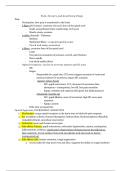
Pain , Sen sory an d An esth esia Dru gs
Pain:
- Nociception: how pain is transferred to the brain
- C fibers (NJ transit) - posterior (dor sal) horn of the spinal cord
- Small, unmyelinated (slow conducting), dull pain
- Muscle strain, soreness
- A-delta (Amtrak) - Thalamus
- Medium
- Myelinated fibers - r espon d quick ly acute
- Touch and tem p: sen sation
- A fibers - posterior horn of the spinal cord
- Large
- Not pain but sensations of pressure, stretch, and vibration
- Move rapidly
- Can block smaller fibers
- Opioid r eceptor s: can be on n er vous system and GI tract
- MU
- Kappa
- Responsible for: pupil size, CTZ zone (triggers sensation of vomit and
nausea), balance GI secretions, impact BP, and pain
- Agonist: (slows down)
- MU: pupil restrictions, N/V, decrease GI secretions (less
absorption = constipation), low BP, less pain sensation
- Kappa: sedation and euphoria (feel good, but hallucinations)
- Antagonist: (speeds up)
- MU: pupil dilation, more GI secretions, high BP, more pain
sensation
- Kappa: anxiety
- Delta (not as important)
Opioid Agonists: INCREDIB LY ADDICTIVE
1. Mechanism: occupy opioid receptors in the brain stem to block the pain response
2. Ex: morphine, codeine, fentanyl (duragesic), hydrocodone, Hydromorphone (dilaudid),
tramadol (ultram), oxycodone (oxycontin)
3. Indication: acute and chronic severe pain
4. Side effects Primary: pupil constriction, orthostatic hypotension, nausea, constipation,
hallucinations, sedation, r espir ator y depr ession (dyin g pr ocess br eathin g so
fast, tapicnic. It can r educe this w ith m or phin e and can lead to faster
com pensation)
5. Side effects wild: urinary retention, cough suppression
a. As you make the resp more even and slow, suppress the ability to cough (codeine)
, 6. Side effects life: cardiac arrest, dependence
7. Patient teaching: avoid alcohol and drugs, encourage to urinate frequently, change to
positions slowly, cough regularly to express secretions, increase fiber intake, take with
food to avoid nausea
8. Nursing intervention: monitor for warning signs of dependence, assess for bowels,
monitor respirations, lung sounds, hold if r espir ation s ar e <12 bpm , obtain vital
signs before admin, have naloxone ready, caution with HTN meds and st. john's wort
Opioid Antagonists:
1. Mechanism: blocks opioid receptors
2. Ex: naloxone (narcan)
3. Indication: reverse of an opioid overdose
4. Side effects: tachycardia, HTN, tachypnea, anxiety
5. Patient teaching: medication can increase pain
6. Nursing: maintain open airway and provide artificial ventilation as needed, institute
comfort and safety measures, monitor cardiac status and blood pressure
Opioid agonist-antagonist:
1. Mechanism: agonists of the MU opioid receptors but antagonist to kappa
2. Ex: buprenorphine (buprenex), suboxone (help people get off of opioid)
3. Indication: chronic pain, labor and delivery, adjunct to opioid disorder, opioid use
disorder
4. Side effects primary: minimal depression, minimal sedation, nausea, constipation
5. Side effects life: dependence but less compared to opioid agonists
6. Patient teaching: avoid alcohol and drugs, take exactly as prescribed, take with food to
avoid nausea, increase fiber intake
7. Nursing intervention: monitor for warning signs of dependence, assess bowel sounds,
monitor vital signs, assess respirations: hold > 12 BPM
Er got Der ivatives:
1. Mechanism: activates the alpha-adrenergic receptors and serotonin receptor in the brain
to cause constriction of cranial vessels and decrease pulsation and hyperperfusion
2. Ex: ergotamine (ergomar)
3. Indication: terminate a migraine headache
4. Side effects primary: chest pain, arrhythmia, numbness/tingling, muscle pain, nausea
5. Side effects life: MI, ergotism, withdrawal
6. Ergotism: severe nausea/vomiting, severe thirst, hypoperfusion, chest pain, blood
pressure changes, confusion
7. Patient teaching: do not increase dose without discuss with provider, keep extremities
warm, take as soon as migraine begins
8. Nursing: do not combine with beta-blockers, manage nausea and vomiting which is very
common
Pain:
- Nociception: how pain is transferred to the brain
- C fibers (NJ transit) - posterior (dor sal) horn of the spinal cord
- Small, unmyelinated (slow conducting), dull pain
- Muscle strain, soreness
- A-delta (Amtrak) - Thalamus
- Medium
- Myelinated fibers - r espon d quick ly acute
- Touch and tem p: sen sation
- A fibers - posterior horn of the spinal cord
- Large
- Not pain but sensations of pressure, stretch, and vibration
- Move rapidly
- Can block smaller fibers
- Opioid r eceptor s: can be on n er vous system and GI tract
- MU
- Kappa
- Responsible for: pupil size, CTZ zone (triggers sensation of vomit and
nausea), balance GI secretions, impact BP, and pain
- Agonist: (slows down)
- MU: pupil restrictions, N/V, decrease GI secretions (less
absorption = constipation), low BP, less pain sensation
- Kappa: sedation and euphoria (feel good, but hallucinations)
- Antagonist: (speeds up)
- MU: pupil dilation, more GI secretions, high BP, more pain
sensation
- Kappa: anxiety
- Delta (not as important)
Opioid Agonists: INCREDIB LY ADDICTIVE
1. Mechanism: occupy opioid receptors in the brain stem to block the pain response
2. Ex: morphine, codeine, fentanyl (duragesic), hydrocodone, Hydromorphone (dilaudid),
tramadol (ultram), oxycodone (oxycontin)
3. Indication: acute and chronic severe pain
4. Side effects Primary: pupil constriction, orthostatic hypotension, nausea, constipation,
hallucinations, sedation, r espir ator y depr ession (dyin g pr ocess br eathin g so
fast, tapicnic. It can r educe this w ith m or phin e and can lead to faster
com pensation)
5. Side effects wild: urinary retention, cough suppression
a. As you make the resp more even and slow, suppress the ability to cough (codeine)
, 6. Side effects life: cardiac arrest, dependence
7. Patient teaching: avoid alcohol and drugs, encourage to urinate frequently, change to
positions slowly, cough regularly to express secretions, increase fiber intake, take with
food to avoid nausea
8. Nursing intervention: monitor for warning signs of dependence, assess for bowels,
monitor respirations, lung sounds, hold if r espir ation s ar e <12 bpm , obtain vital
signs before admin, have naloxone ready, caution with HTN meds and st. john's wort
Opioid Antagonists:
1. Mechanism: blocks opioid receptors
2. Ex: naloxone (narcan)
3. Indication: reverse of an opioid overdose
4. Side effects: tachycardia, HTN, tachypnea, anxiety
5. Patient teaching: medication can increase pain
6. Nursing: maintain open airway and provide artificial ventilation as needed, institute
comfort and safety measures, monitor cardiac status and blood pressure
Opioid agonist-antagonist:
1. Mechanism: agonists of the MU opioid receptors but antagonist to kappa
2. Ex: buprenorphine (buprenex), suboxone (help people get off of opioid)
3. Indication: chronic pain, labor and delivery, adjunct to opioid disorder, opioid use
disorder
4. Side effects primary: minimal depression, minimal sedation, nausea, constipation
5. Side effects life: dependence but less compared to opioid agonists
6. Patient teaching: avoid alcohol and drugs, take exactly as prescribed, take with food to
avoid nausea, increase fiber intake
7. Nursing intervention: monitor for warning signs of dependence, assess bowel sounds,
monitor vital signs, assess respirations: hold > 12 BPM
Er got Der ivatives:
1. Mechanism: activates the alpha-adrenergic receptors and serotonin receptor in the brain
to cause constriction of cranial vessels and decrease pulsation and hyperperfusion
2. Ex: ergotamine (ergomar)
3. Indication: terminate a migraine headache
4. Side effects primary: chest pain, arrhythmia, numbness/tingling, muscle pain, nausea
5. Side effects life: MI, ergotism, withdrawal
6. Ergotism: severe nausea/vomiting, severe thirst, hypoperfusion, chest pain, blood
pressure changes, confusion
7. Patient teaching: do not increase dose without discuss with provider, keep extremities
warm, take as soon as migraine begins
8. Nursing: do not combine with beta-blockers, manage nausea and vomiting which is very
common