----------------------------------------
Psychopathology
Topics:
● Definitions of Abnormality
● Phobias
● Depression
● Obsessive-compulsive Disorder
● The Behavioural Approach
● The Cognitive Approach
● The Biological Approach
Definitions of Abnormality
What is Psychopathology?
Psychopathology → the study of psychological disorders.
- One issue with studying mental health problems is how to identify when
someone is psychologically unwell.
- Another cause for concern is how to determine if their behaviour
differs from what is considered ‘normal’ and at what point should that
person be classified as ‘abnormal’?
Consequently, psychologists and health professionals have put forward
different definitions of abnormality in an attempt to understand abnormal
behaviour.
Statistical Infrequency
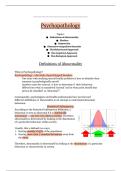
According to the Statistical Infrequency definition, a
behaviour is seen as abnormal if it is statistically
uncommon or not seen very often in society. Therefore,
abnormality is determined by looking at the distribution
of a particular behaviour within society.
Usually, this is defined two ways:
1. Scoring outside of 95% of the population.
2. Scoring more than 2 standard deviations away from
the mean
Therefore, abnormality is determined by looking at the distribution of a particular
behaviour or characteristic in society.
,Evaluations
- One problem with the statistical infrequency definition of abnormality is the
issue of m isdiagn osis . Certain behaviours are statistically common; for
example, approximately 10% of the population will experience depression at
some point making this behaviour ‘normal’, technically. On the other hand,
certain behaviours – for example, high IQ – are statistically uncommon and
therefore considered abnormal despite their desirable nature. This is therefore
a serious drawback of adopting the statistical infrequency definition in
explaining abnormality and perhaps should not be used in isolation when
making a diagnosis.
- A further issue with the statistical infrequency definition of abnormality is that
labellin g an individual as abn or m al can be un helpful . This is
especially true, for example, of someone with a low IQ since they will be able
to live quite happily without distress to themselves or others. Such a label may
contribute to a poor self‐image or become an invitation for discrimination.
This means that being labelled as statistically infrequent could cause the
person more distress than the condition itself.
- One of the most prominent issues with using statistical infrequency is that it
often fails to account for cultur al var iation s in behaviour, beliefs, and
norms. What is considered statistically infrequent in one culture may be
entirely typical in another. For example, certain rituals, expressions of
emotion, or social behaviours that deviate from Western statistical norms may
be entirely appropriate within the context of another culture. Furthermore,
relying solely on statistical norms can be ethnocentric, as it tends to favour the
cultural norms and values of the majority or the culture in which the
measurement was originally developed. This can lead to pathologizing
individuals from minority or non-Western cultures, as their behaviours may
fall outside of the statistical norm but are perfectly acceptable within their
own cultural context.
Deviation from Social Norms
Social n or m → an unwritten rule about what is acceptable within a particular
society.
A person is seen as abnormal if their thinking or behaviour violates these unwritten
rules (social norms) about what is acceptable, is unexpected by other group
members or offends in some way the other members of that society/ social group.
Social norms can be classified as being either:
a. implicit (unspoken expectations of behaviour, e.g. queuing)
b. or explicit (enforced expectations, e.g. through laws and regulations).
, We can therefore determine whether or not a behaviour is abnormal based on if they
break implicit or explicit rules.
Evaluations
- One issue with the deviation from social norms definition of abnormality is
the idea of cultur al r elativism . Social norms differ between cultures and
what is considered normal in one culture may be abnormal in another. For
example, in approximately 75 countries in the world homosexuality is still
illegal, and therefore considered abnormal. However, in the rest of the world
homosexuality is considered normal. The result of this is that there is no
global standard for defining behaviour as abnormal and therefore abnormality
is not standardised.
- Furthermore, social norms change over time which raises an issue known as
h in dsight bias/tim e bias . For example, homosexuality was regarded as a
mental illness in the UK until 1973, often resulting in institutionalisation, but
is now simply considered a variation of normal behaviour. This means that,
historically, reliance on the deviation from social norm definition of
abnormality may have resulted in violations of human rights where people, by
today’s standards, are deemed ‘abnormal’. It could be argued that diagnoses
upon these grounds may have been given as a form of social control over
minority groups as a means to exclude those who do not conform from society
(Szas, 1974).
+ One strength of DSN as a definition of abnormality is that it has pr actical
application . For example, psychotic symptoms in schizophrenia (delusions
and hallucinations) can be viewed as a deviation from the way society typically
behaves and provide a reference for family members or patients to refer
themselves for treatment. This is a strength as it allows non medical
professionals to easily understand what ‘normal’ behaviour is and seek
treatment appropriately, thereby showing the definition has high face validity.
Failure to Function Adequately
According to the Failure to Function Adequately (FFA) definition, a person is
considered abnormal if they are unable to cope with the demands of everyday life and
live independently in society.
Furthermore, to be classified as abnormal, a person’s behaviour should cause
personal suffering and distress because of their failure to cope. However, they may
also cause distress or discomfort to other people who observe their behaviour.
Rosenhan’s Criteria
Rosenhan provided a list of 7 criteria for failing to function. Patients must meet most
or all in order to be considered abnormal
Psychopathology
Topics:
● Definitions of Abnormality
● Phobias
● Depression
● Obsessive-compulsive Disorder
● The Behavioural Approach
● The Cognitive Approach
● The Biological Approach
Definitions of Abnormality
What is Psychopathology?
Psychopathology → the study of psychological disorders.
- One issue with studying mental health problems is how to identify when
someone is psychologically unwell.
- Another cause for concern is how to determine if their behaviour
differs from what is considered ‘normal’ and at what point should that
person be classified as ‘abnormal’?
Consequently, psychologists and health professionals have put forward
different definitions of abnormality in an attempt to understand abnormal
behaviour.
Statistical Infrequency
According to the Statistical Infrequency definition, a
behaviour is seen as abnormal if it is statistically
uncommon or not seen very often in society. Therefore,
abnormality is determined by looking at the distribution
of a particular behaviour within society.
Usually, this is defined two ways:
1. Scoring outside of 95% of the population.
2. Scoring more than 2 standard deviations away from
the mean
Therefore, abnormality is determined by looking at the distribution of a particular
behaviour or characteristic in society.
,Evaluations
- One problem with the statistical infrequency definition of abnormality is the
issue of m isdiagn osis . Certain behaviours are statistically common; for
example, approximately 10% of the population will experience depression at
some point making this behaviour ‘normal’, technically. On the other hand,
certain behaviours – for example, high IQ – are statistically uncommon and
therefore considered abnormal despite their desirable nature. This is therefore
a serious drawback of adopting the statistical infrequency definition in
explaining abnormality and perhaps should not be used in isolation when
making a diagnosis.
- A further issue with the statistical infrequency definition of abnormality is that
labellin g an individual as abn or m al can be un helpful . This is
especially true, for example, of someone with a low IQ since they will be able
to live quite happily without distress to themselves or others. Such a label may
contribute to a poor self‐image or become an invitation for discrimination.
This means that being labelled as statistically infrequent could cause the
person more distress than the condition itself.
- One of the most prominent issues with using statistical infrequency is that it
often fails to account for cultur al var iation s in behaviour, beliefs, and
norms. What is considered statistically infrequent in one culture may be
entirely typical in another. For example, certain rituals, expressions of
emotion, or social behaviours that deviate from Western statistical norms may
be entirely appropriate within the context of another culture. Furthermore,
relying solely on statistical norms can be ethnocentric, as it tends to favour the
cultural norms and values of the majority or the culture in which the
measurement was originally developed. This can lead to pathologizing
individuals from minority or non-Western cultures, as their behaviours may
fall outside of the statistical norm but are perfectly acceptable within their
own cultural context.
Deviation from Social Norms
Social n or m → an unwritten rule about what is acceptable within a particular
society.
A person is seen as abnormal if their thinking or behaviour violates these unwritten
rules (social norms) about what is acceptable, is unexpected by other group
members or offends in some way the other members of that society/ social group.
Social norms can be classified as being either:
a. implicit (unspoken expectations of behaviour, e.g. queuing)
b. or explicit (enforced expectations, e.g. through laws and regulations).
, We can therefore determine whether or not a behaviour is abnormal based on if they
break implicit or explicit rules.
Evaluations
- One issue with the deviation from social norms definition of abnormality is
the idea of cultur al r elativism . Social norms differ between cultures and
what is considered normal in one culture may be abnormal in another. For
example, in approximately 75 countries in the world homosexuality is still
illegal, and therefore considered abnormal. However, in the rest of the world
homosexuality is considered normal. The result of this is that there is no
global standard for defining behaviour as abnormal and therefore abnormality
is not standardised.
- Furthermore, social norms change over time which raises an issue known as
h in dsight bias/tim e bias . For example, homosexuality was regarded as a
mental illness in the UK until 1973, often resulting in institutionalisation, but
is now simply considered a variation of normal behaviour. This means that,
historically, reliance on the deviation from social norm definition of
abnormality may have resulted in violations of human rights where people, by
today’s standards, are deemed ‘abnormal’. It could be argued that diagnoses
upon these grounds may have been given as a form of social control over
minority groups as a means to exclude those who do not conform from society
(Szas, 1974).
+ One strength of DSN as a definition of abnormality is that it has pr actical
application . For example, psychotic symptoms in schizophrenia (delusions
and hallucinations) can be viewed as a deviation from the way society typically
behaves and provide a reference for family members or patients to refer
themselves for treatment. This is a strength as it allows non medical
professionals to easily understand what ‘normal’ behaviour is and seek
treatment appropriately, thereby showing the definition has high face validity.
Failure to Function Adequately
According to the Failure to Function Adequately (FFA) definition, a person is
considered abnormal if they are unable to cope with the demands of everyday life and
live independently in society.
Furthermore, to be classified as abnormal, a person’s behaviour should cause
personal suffering and distress because of their failure to cope. However, they may
also cause distress or discomfort to other people who observe their behaviour.
Rosenhan’s Criteria
Rosenhan provided a list of 7 criteria for failing to function. Patients must meet most
or all in order to be considered abnormal