Evolution
Origin of An Idea About Origins
Important People:
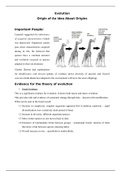
Lamarck suggested the inheritance
of acquired characteristics (which
was disproved). Organisms cannot
pass down characteristics acquired
during its life. He believed that
species have a common ancestor
and evolution occurred as species
adapted to their environment.
Charles Darwin had explanations
for Modification with descent (plenty of evidence shows diversity of species) and Natural
selection (Individuals best adapted to the environment will leave the most offspring).
Evidence for the theory of evolution
1. Fossil Evidence
This is a significant evidence for evolution. It shows both macro and micro evolution.
This provides info and evidence of systematic change through time – descent with modification.
What can be seen in the fossil record:
1.1 Increase in complexity: simplest organisms appeared first (Cambrian explosion – rapid
diversification over a relatively short period of time).
1.2 Increase in diversity: different organisms/species.
1.3 More extinct species as one moves back in time.
1.4 Existence of intermediate forms between groups – transitional fossils: mixture of traits
that show a link between species (missing links).
1.5 Overall increase in size – unicellular to multicellular.
, 2. Biogeography
The study of where species occur and why – different regions with similar climatic conditions
contained vastly different animals and plants.
Evolutionary patterns:
2.1 A clustering pattern of ‘closely allied’ species inhabiting neighboring patches of habitat.
2.2 Hugely different collections of plants and animals in regions of the same latitude with
similar climates and conditions.
2.3 The distribution of species on oceanic islands differed and species on the islands are more
closely related to the mainland.
2.4 The biogeography of fossils – fossils of extinct species closely resemble living species
that occurred in the same region.
3. Evidence from genetics
Comparing chromosomal DNA and mitochondrial DNA.
All organisms have descended from a common ancestor but also shows how closely organisms
are related to each other.
All organisms have descended from a common ancestor as there are many genes in all living
organisms that are encoded to make identical proteins.
Organisms are related to each other by varying degrees – similarity of sequences of
chromosomal DNA and mt DNA nucleotide to work out how related species are.
4. Comparative Anatomy
Comparing internal and
external structures – features
such as homologies.
Homologous structures are
similar in fundamental
structure position and
development – pentadactyl
, forelimb of vertebrates. This led to divergent or adaptive radiation evolutionary paths –
indicating a common ancestor.
Analogous structures are similar in different
organisms because they evolved in a similar
environment, where they serve the same or similar
purposes – origin of the wing (bat vs insect). This
led to convergent evolution.
5. Embryology
Marked similarities in structure during early stages
of the development. This supports idea of a
common ancestor.
Embryos all have nerve cord, gill slits, a fish-like heart and tail.
6. Vestigial Organs
The tailbone in humans (coccyx), homologous to the functional tail of other primates.
Appendix in humans. The rudiments of the pelvic girdle in the hindquarters of a dolphin.
Origin of An Idea About Origins
Important People:
Lamarck suggested the inheritance
of acquired characteristics (which
was disproved). Organisms cannot
pass down characteristics acquired
during its life. He believed that
species have a common ancestor
and evolution occurred as species
adapted to their environment.
Charles Darwin had explanations
for Modification with descent (plenty of evidence shows diversity of species) and Natural
selection (Individuals best adapted to the environment will leave the most offspring).
Evidence for the theory of evolution
1. Fossil Evidence
This is a significant evidence for evolution. It shows both macro and micro evolution.
This provides info and evidence of systematic change through time – descent with modification.
What can be seen in the fossil record:
1.1 Increase in complexity: simplest organisms appeared first (Cambrian explosion – rapid
diversification over a relatively short period of time).
1.2 Increase in diversity: different organisms/species.
1.3 More extinct species as one moves back in time.
1.4 Existence of intermediate forms between groups – transitional fossils: mixture of traits
that show a link between species (missing links).
1.5 Overall increase in size – unicellular to multicellular.
, 2. Biogeography
The study of where species occur and why – different regions with similar climatic conditions
contained vastly different animals and plants.
Evolutionary patterns:
2.1 A clustering pattern of ‘closely allied’ species inhabiting neighboring patches of habitat.
2.2 Hugely different collections of plants and animals in regions of the same latitude with
similar climates and conditions.
2.3 The distribution of species on oceanic islands differed and species on the islands are more
closely related to the mainland.
2.4 The biogeography of fossils – fossils of extinct species closely resemble living species
that occurred in the same region.
3. Evidence from genetics
Comparing chromosomal DNA and mitochondrial DNA.
All organisms have descended from a common ancestor but also shows how closely organisms
are related to each other.
All organisms have descended from a common ancestor as there are many genes in all living
organisms that are encoded to make identical proteins.
Organisms are related to each other by varying degrees – similarity of sequences of
chromosomal DNA and mt DNA nucleotide to work out how related species are.
4. Comparative Anatomy
Comparing internal and
external structures – features
such as homologies.
Homologous structures are
similar in fundamental
structure position and
development – pentadactyl
, forelimb of vertebrates. This led to divergent or adaptive radiation evolutionary paths –
indicating a common ancestor.
Analogous structures are similar in different
organisms because they evolved in a similar
environment, where they serve the same or similar
purposes – origin of the wing (bat vs insect). This
led to convergent evolution.
5. Embryology
Marked similarities in structure during early stages
of the development. This supports idea of a
common ancestor.
Embryos all have nerve cord, gill slits, a fish-like heart and tail.
6. Vestigial Organs
The tailbone in humans (coccyx), homologous to the functional tail of other primates.
Appendix in humans. The rudiments of the pelvic girdle in the hindquarters of a dolphin.