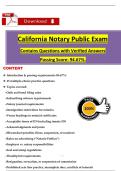
California Notary Public Exam
Contains Questions with Verified Answers
Passing Score: 94.67%.
CONTENT
Introduction & passing requirements (94.67%)
45 multiple-choice practice questions
Topics covered:
Oath and bond filing rules
Subscribing witness requirements
Notary journal requirements
Immigration restrictions for notaries
Venue headings in notarial certificates
Acceptable forms of ID (including inmate ID)
Acknowledgments and jurats
Misconduct penalties (fines, suspension, revocation)
Rules on advertising (“Notario Publico”)
Employer vs. notary responsibilities
Seal and stamp regulations
Thumbprint requirements
Resignation, revocation, or suspension of commission
Prohibited acts (law practice, incomplete docs, conflicts of interest)
, The exam consists of 45 multiple-choice questions & Possible Questions to be
Tested
1. If your oath and bond are not filed within the time limit for qualifying, which of
the following apply?
A. You must retake the six hour training notary training course
B. You may pay a $20 late processing fee in the case of delay beyond your control
including but not limited to mail service delays and county clerk mail
processing delays
C. Your commission is no longer valid and you must apply for another one
D. You must pay a $20 late processing fee to proceed with the application
Answer: C. Your commission is no longer valid and you must apply for another
one
2. Suppose a subscribing witness brings you a document to be notarized and
is then placed under oath. Which of the following must be said by the
subscribing witness?
A. The principal asked the subscribing witness to sign the document as a
witness and actually signed
B. The subscribing witness either saw the principal sign the document OR
heard the principal acknowledge that they signed the document
C. The principal signer is the person described in the document and the
subscribing witness personally knows the principal
, 3. Only one of the following is not a required item in a notary public's journal.
Which one is it?
A. The county in which each signer presently resides
B. The date, time and type of each official act (e.g., acknowledgment, jurat)
C. The signature of each person whose signature is being notarized
D. The character of every instrument sworn to, affirmed, acknowledged or
proved before the notary public (e.g., deed of trust)
Answer: A. The county in which each signer presently resides
4. A notary public who holds himself or herself out as being an immigration
specialist, immigration consultant or any other title or description reflecting an
expertise in immigration matters shall not:
A. assist in entering data, provided by the client, on immigration forms provid-
ed by a federal or state agency
B. charge any fees for notarial services in relation to immigration documents
C. advertise in any manner whatsoever that he or she is a notary public
D. act in the capacity of a notary public
Answer: C. advertise in any manner whatsoever that he or she is a notary public
5. Suppose that you are notarizing a document for a friend who you have
known since childhood. Which of the following is not necessary to include in
the journal:
A. The serial number of an identifying document presented
B. Notary fee (since you are not going to charge your friend)
Contains Questions with Verified Answers
Passing Score: 94.67%.
CONTENT
Introduction & passing requirements (94.67%)
45 multiple-choice practice questions
Topics covered:
Oath and bond filing rules
Subscribing witness requirements
Notary journal requirements
Immigration restrictions for notaries
Venue headings in notarial certificates
Acceptable forms of ID (including inmate ID)
Acknowledgments and jurats
Misconduct penalties (fines, suspension, revocation)
Rules on advertising (“Notario Publico”)
Employer vs. notary responsibilities
Seal and stamp regulations
Thumbprint requirements
Resignation, revocation, or suspension of commission
Prohibited acts (law practice, incomplete docs, conflicts of interest)
, The exam consists of 45 multiple-choice questions & Possible Questions to be
Tested
1. If your oath and bond are not filed within the time limit for qualifying, which of
the following apply?
A. You must retake the six hour training notary training course
B. You may pay a $20 late processing fee in the case of delay beyond your control
including but not limited to mail service delays and county clerk mail
processing delays
C. Your commission is no longer valid and you must apply for another one
D. You must pay a $20 late processing fee to proceed with the application
Answer: C. Your commission is no longer valid and you must apply for another
one
2. Suppose a subscribing witness brings you a document to be notarized and
is then placed under oath. Which of the following must be said by the
subscribing witness?
A. The principal asked the subscribing witness to sign the document as a
witness and actually signed
B. The subscribing witness either saw the principal sign the document OR
heard the principal acknowledge that they signed the document
C. The principal signer is the person described in the document and the
subscribing witness personally knows the principal
, 3. Only one of the following is not a required item in a notary public's journal.
Which one is it?
A. The county in which each signer presently resides
B. The date, time and type of each official act (e.g., acknowledgment, jurat)
C. The signature of each person whose signature is being notarized
D. The character of every instrument sworn to, affirmed, acknowledged or
proved before the notary public (e.g., deed of trust)
Answer: A. The county in which each signer presently resides
4. A notary public who holds himself or herself out as being an immigration
specialist, immigration consultant or any other title or description reflecting an
expertise in immigration matters shall not:
A. assist in entering data, provided by the client, on immigration forms provid-
ed by a federal or state agency
B. charge any fees for notarial services in relation to immigration documents
C. advertise in any manner whatsoever that he or she is a notary public
D. act in the capacity of a notary public
Answer: C. advertise in any manner whatsoever that he or she is a notary public
5. Suppose that you are notarizing a document for a friend who you have
known since childhood. Which of the following is not necessary to include in
the journal:
A. The serial number of an identifying document presented
B. Notary fee (since you are not going to charge your friend)