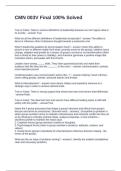
CMN 003V Final 100% Solved
True or False: There is various definitions of leadership because we can't agree what is
its exactly. - answer True
What do all the different definitions of leadership incorporate? - answer The ability to
direct or influence other's behaviors thought towards a productive end.
What 3 leadership qualities do strong leaders have? - answer Vision (the ability to
picture a new or different reality from what currently exists for the group), initiative (uses
change, adaption and growth as a means of group's survival or as transformative rather
than a threat to their power or stability), and charisma (generate a positive image that
motivates others, persuades with this charm).
Leaders have strong _____ skills. They listen passively/actively and make their
audience feel like they are the _______ in the room. – answer communication, actively,
most important person
Unethical leaders use communication tactics like...? – answer bullying, harsh criticism,
name calling gossip, slander, personal attacks and threats
What is Macvalienism? - answer Uses deceit, flattery and exploitive measure in a
strategic way in order to achieve desired ends.
True or False: There is strong support that shows that men and women lead differently.
- answerFalse
True or False: The idea that men and women have different leading styles is still held
widely with the public. - answerTrue
Name the 4 group processes that shape a group's decision and effects how group's
discuss and arrive at conclusions. Describe each. - answer1. Groupthink (a problem in
which group members strive to maintain cohesiveness and minimize conflict but they do
so by refusing to critically examine ideas, analyze proposals, or test solutions --
sacrifices growth to maintain the status quo)
2. Cognitive forces (group member's beliefs or thoughts)
3. Psychological forces (refer to group member's emotions, attitudes, motives, and
values)
4. Social forces (group's standards for what behaviors influence decision making , the
norms of the group).
What are the six steps of problem solving? - answer1. Identify the problem (establishes
clear and necessary problem)
,2. Analyze (helps determine the problem's scope and other related factors)
3. Generate solutions (brainstorming and defining criteria for future solutions --
groupthink can occur here, especially if the group doesn't respect or consider
everyone's ideas)
4. Evaluate options
5. Implement solutions (putting into action the decision the group has made)
6. Assess the results (requires evaluation the success or effectiveness of the solution
that was put into action and is needed to figure out the groups next steps and future
problems)
In 1959, social psychologists, ___ and ____, found that power is divided into ___
(number) of forms. - answerFrench and Raven
5
In work situations, the person with the valued knowledge is the person people ___ and
_____. - answerrespect and often to refer to for help
True or False: Expert power alone can help a person move through organizational
levels. - answerFalse
Possession of expert power is often seen as a stepping stone to other sources power
such as ____ power. A person may be promoted to a higher position due to expert
power, leading to _____ power. - answerLegitimate
Referent power comes from a person's ______ or ______. - answerperceived
attractiveness or worthiness
Referent power is derived from the ____ relationships that a person cultivates others in
the organization. - answerinterpersonal
Referent power comes from what leadership quality? - answerCharisma
Legitimate power comes from the belief that this person has rights or titles such as
______, _____, etc. - answerright, titles, manager, parent, etc.
Legitimate power is also known as ____ power. - answerPositional
Legitimate power is unstable and unpredictable. Why? - answerIf you lose the tittle of
the position, the title can disappear with it, especially if that's what you relied on for
power.
Reward power supports legitimate power and results from a person's ability to ____
another for their compliance. - answercompensate
Using the definition of reward power, describe what would occur after this statement.
"An employee is likely to respond favorably to orders and directions if he or she receives
, _____ (provide some examples)." - answera tangible reward such as a pay raise or
better job assignment
Name some intangible rewards at work. - answerVerbal approval, encouragement, and
praise
If reward power is used effectively, it can greatly motivate others. What happens if it is
used improperly (like favoritism)? - answerDemoralize those that work for you and
diminish their output
The opposite of reward power is __________ power. - answerCoercive
Coercive power is the ability to ____ someone for ____ using an order or direction. -
answerpunish, non-compliance
Coercive power is not achieved out of respect, but out of ____. - answerFear
Labor union strike threats, denial of promotion or pay raise, and litigation are all
examples of ____ power. - answerCoercive power
Benfari et al. added 3 additional source of power. Name those 3. - answerInformation,
affiliation, and group power.
Describe information power (duration, definition, how long does it hold?). - answerIt's
short term, when a person knows something that is wanted or needed. Ex) someone
knows of a wanted change in an organization but once that change occurs, they've lost
that power of information. This power only holds once the information has reached a
wider audience.
Describe affiliation power. - answerWhen a person gains favor or is connected to
someone in power ex) family member of a powerful political figure. Can be enhanced
when the person works to build other kinds of power and works to build other coalitions.
Describe shared power. - answerShared power. Shared with the group that is looking to
solve or address problems collectively.
A work group is defined as a _______. - answersmall, interdependent collection of
people with
a common identity who interact with one another, usually face-to-face over time, to
reach
a goal.
True or False: Virtually every small group expert argues any collection much
larger than 20 people loses many of the properties that define groups—at least effective
ones. - answerTrue
True or False: There is various definitions of leadership because we can't agree what is
its exactly. - answer True
What do all the different definitions of leadership incorporate? - answer The ability to
direct or influence other's behaviors thought towards a productive end.
What 3 leadership qualities do strong leaders have? - answer Vision (the ability to
picture a new or different reality from what currently exists for the group), initiative (uses
change, adaption and growth as a means of group's survival or as transformative rather
than a threat to their power or stability), and charisma (generate a positive image that
motivates others, persuades with this charm).
Leaders have strong _____ skills. They listen passively/actively and make their
audience feel like they are the _______ in the room. – answer communication, actively,
most important person
Unethical leaders use communication tactics like...? – answer bullying, harsh criticism,
name calling gossip, slander, personal attacks and threats
What is Macvalienism? - answer Uses deceit, flattery and exploitive measure in a
strategic way in order to achieve desired ends.
True or False: There is strong support that shows that men and women lead differently.
- answerFalse
True or False: The idea that men and women have different leading styles is still held
widely with the public. - answerTrue
Name the 4 group processes that shape a group's decision and effects how group's
discuss and arrive at conclusions. Describe each. - answer1. Groupthink (a problem in
which group members strive to maintain cohesiveness and minimize conflict but they do
so by refusing to critically examine ideas, analyze proposals, or test solutions --
sacrifices growth to maintain the status quo)
2. Cognitive forces (group member's beliefs or thoughts)
3. Psychological forces (refer to group member's emotions, attitudes, motives, and
values)
4. Social forces (group's standards for what behaviors influence decision making , the
norms of the group).
What are the six steps of problem solving? - answer1. Identify the problem (establishes
clear and necessary problem)
,2. Analyze (helps determine the problem's scope and other related factors)
3. Generate solutions (brainstorming and defining criteria for future solutions --
groupthink can occur here, especially if the group doesn't respect or consider
everyone's ideas)
4. Evaluate options
5. Implement solutions (putting into action the decision the group has made)
6. Assess the results (requires evaluation the success or effectiveness of the solution
that was put into action and is needed to figure out the groups next steps and future
problems)
In 1959, social psychologists, ___ and ____, found that power is divided into ___
(number) of forms. - answerFrench and Raven
5
In work situations, the person with the valued knowledge is the person people ___ and
_____. - answerrespect and often to refer to for help
True or False: Expert power alone can help a person move through organizational
levels. - answerFalse
Possession of expert power is often seen as a stepping stone to other sources power
such as ____ power. A person may be promoted to a higher position due to expert
power, leading to _____ power. - answerLegitimate
Referent power comes from a person's ______ or ______. - answerperceived
attractiveness or worthiness
Referent power is derived from the ____ relationships that a person cultivates others in
the organization. - answerinterpersonal
Referent power comes from what leadership quality? - answerCharisma
Legitimate power comes from the belief that this person has rights or titles such as
______, _____, etc. - answerright, titles, manager, parent, etc.
Legitimate power is also known as ____ power. - answerPositional
Legitimate power is unstable and unpredictable. Why? - answerIf you lose the tittle of
the position, the title can disappear with it, especially if that's what you relied on for
power.
Reward power supports legitimate power and results from a person's ability to ____
another for their compliance. - answercompensate
Using the definition of reward power, describe what would occur after this statement.
"An employee is likely to respond favorably to orders and directions if he or she receives
, _____ (provide some examples)." - answera tangible reward such as a pay raise or
better job assignment
Name some intangible rewards at work. - answerVerbal approval, encouragement, and
praise
If reward power is used effectively, it can greatly motivate others. What happens if it is
used improperly (like favoritism)? - answerDemoralize those that work for you and
diminish their output
The opposite of reward power is __________ power. - answerCoercive
Coercive power is the ability to ____ someone for ____ using an order or direction. -
answerpunish, non-compliance
Coercive power is not achieved out of respect, but out of ____. - answerFear
Labor union strike threats, denial of promotion or pay raise, and litigation are all
examples of ____ power. - answerCoercive power
Benfari et al. added 3 additional source of power. Name those 3. - answerInformation,
affiliation, and group power.
Describe information power (duration, definition, how long does it hold?). - answerIt's
short term, when a person knows something that is wanted or needed. Ex) someone
knows of a wanted change in an organization but once that change occurs, they've lost
that power of information. This power only holds once the information has reached a
wider audience.
Describe affiliation power. - answerWhen a person gains favor or is connected to
someone in power ex) family member of a powerful political figure. Can be enhanced
when the person works to build other kinds of power and works to build other coalitions.
Describe shared power. - answerShared power. Shared with the group that is looking to
solve or address problems collectively.
A work group is defined as a _______. - answersmall, interdependent collection of
people with
a common identity who interact with one another, usually face-to-face over time, to
reach
a goal.
True or False: Virtually every small group expert argues any collection much
larger than 20 people loses many of the properties that define groups—at least effective
ones. - answerTrue