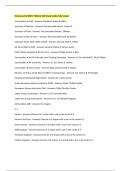
2025/2026 ATI MENTAL HEALTH
EXAMINATION/GRADED A+
Spiritual practices related to death for *Muslims* - ANSWER--turn client on right
side to face Mecca;
-when death occurs, body must be covered at all times and it is preferred that only
workers of same sex touch the client
Erikson's Stages of Growth and Development - ANSWER-Trust vs Mistrust [birth
to 1 yr];
Autonomy vs Shame and Doubt [1-3 yrs];
Initiative vs Guilt [3-6 yrs];
Industry vs Inferiority [6-12 yrs];
Identity vs Role Confusion [12-20 yrs];
Intimacy vs Isolation [20-35 yrs];
Generativity vs Stagnation [35-65 yrs];
Integrity vs Despair [65 yr to death]
Priority for PTSD client - ANSWER-safety; making the client feel safe
DNR vs Living Will - ANSWER-DNR is a *medical* document the HCP creates -
a living will is a *legal* document the client creates; DNR can be included in a
,living will but it can be totally separate; if DNR w/o a living will, the family can
have a say-so about resuscitation efforts
ADHD - Teaching for Parents - ANSWER--Model positive behaviors;
-Verbal instruction combined w/visual cues;
-Structured activities should be planned for the AM;
-Use charts to assist w/organization
Electroconvulsive therapy (ECT) - ANSWER--lithium and MAOIs should be
discontinued 2 weeks prior to procedure;
-atropine is given IM 30 min prior to procedure to decrease secretions;
-succinylcholine immediately following admin of -anesthesia prior to procedure to
prevent muscle contractions and fractures
ECT - What to monitor *during* therapy - ANSWER--respiratory rate and effort;
-BP;
-duration of seizure [typical is 25-60 seconds; seizures greater than 90 seconds are
treated w/diazepam [Valium]
Phases of a therapeutic nurse-client relationship - ANSWER-
*PREINTERACTION* - before contact w/client; RN focuses on own
preconceived ideas, stereotypes, etc.;
*ORIENTATION/INTRODUCTORY* - establish acceptance, trust, boundaries;
identify expectations and time frame; define goals; discuss and prepare for
termination and separation of relationship;
*WORKING* - explore, evaluate, and focus on client's problems; encourage
independence;
, *TERMINATION/SEPARATION* - evaluate progress and achievement of goals;
identify responses to termination such as anger, distancing, return of symptoms,
and dependency; encourage client to express feelings about termination; identify
strengths; refer out to community resources
Levels of anxiety - ANSWER-*MILD* -associated w/tension of everyday life;
alert and perceptual field is increased; can be motivating;
*MODERATE* - focus is on immediate concerns; select inattentiveness and
perceptual field is narrowed; learning and problem solving still occur;
*SEVERE* - feeling that something bad is about to happen; focus is on minute or
scattered details; needs direction to focus and perceptual field significantly
narrowed; learning and problem solving are impossible; all behavior aimed at
relieving anxiety;
*PANIC* - associated w/dread and terror and a sense of impending doom; can't
communicate or function effectively; if prolonged, panic can lead to exhaustion
and death
TYPES OF DELUSIONS - ANSWER-Alterations in thought are false fixed beliefs
that cannot
be corrected by reasoning and are usually bizarre.
● Ideas of reference: Misconstrues trivial events and
attaches personal significance to them (believes others are talking about him)
● Persecution: Feels singled out for harm by others (being hunted by FBI)
● Grandeur: Believes that she is all powerful and
important, like a god
● Somatic delusions: Believes that his body is changing in
an unusual way (growing a third arm)
● Jealousy: Believes that her partner is sexually involved
EXAMINATION/GRADED A+
Spiritual practices related to death for *Muslims* - ANSWER--turn client on right
side to face Mecca;
-when death occurs, body must be covered at all times and it is preferred that only
workers of same sex touch the client
Erikson's Stages of Growth and Development - ANSWER-Trust vs Mistrust [birth
to 1 yr];
Autonomy vs Shame and Doubt [1-3 yrs];
Initiative vs Guilt [3-6 yrs];
Industry vs Inferiority [6-12 yrs];
Identity vs Role Confusion [12-20 yrs];
Intimacy vs Isolation [20-35 yrs];
Generativity vs Stagnation [35-65 yrs];
Integrity vs Despair [65 yr to death]
Priority for PTSD client - ANSWER-safety; making the client feel safe
DNR vs Living Will - ANSWER-DNR is a *medical* document the HCP creates -
a living will is a *legal* document the client creates; DNR can be included in a
,living will but it can be totally separate; if DNR w/o a living will, the family can
have a say-so about resuscitation efforts
ADHD - Teaching for Parents - ANSWER--Model positive behaviors;
-Verbal instruction combined w/visual cues;
-Structured activities should be planned for the AM;
-Use charts to assist w/organization
Electroconvulsive therapy (ECT) - ANSWER--lithium and MAOIs should be
discontinued 2 weeks prior to procedure;
-atropine is given IM 30 min prior to procedure to decrease secretions;
-succinylcholine immediately following admin of -anesthesia prior to procedure to
prevent muscle contractions and fractures
ECT - What to monitor *during* therapy - ANSWER--respiratory rate and effort;
-BP;
-duration of seizure [typical is 25-60 seconds; seizures greater than 90 seconds are
treated w/diazepam [Valium]
Phases of a therapeutic nurse-client relationship - ANSWER-
*PREINTERACTION* - before contact w/client; RN focuses on own
preconceived ideas, stereotypes, etc.;
*ORIENTATION/INTRODUCTORY* - establish acceptance, trust, boundaries;
identify expectations and time frame; define goals; discuss and prepare for
termination and separation of relationship;
*WORKING* - explore, evaluate, and focus on client's problems; encourage
independence;
, *TERMINATION/SEPARATION* - evaluate progress and achievement of goals;
identify responses to termination such as anger, distancing, return of symptoms,
and dependency; encourage client to express feelings about termination; identify
strengths; refer out to community resources
Levels of anxiety - ANSWER-*MILD* -associated w/tension of everyday life;
alert and perceptual field is increased; can be motivating;
*MODERATE* - focus is on immediate concerns; select inattentiveness and
perceptual field is narrowed; learning and problem solving still occur;
*SEVERE* - feeling that something bad is about to happen; focus is on minute or
scattered details; needs direction to focus and perceptual field significantly
narrowed; learning and problem solving are impossible; all behavior aimed at
relieving anxiety;
*PANIC* - associated w/dread and terror and a sense of impending doom; can't
communicate or function effectively; if prolonged, panic can lead to exhaustion
and death
TYPES OF DELUSIONS - ANSWER-Alterations in thought are false fixed beliefs
that cannot
be corrected by reasoning and are usually bizarre.
● Ideas of reference: Misconstrues trivial events and
attaches personal significance to them (believes others are talking about him)
● Persecution: Feels singled out for harm by others (being hunted by FBI)
● Grandeur: Believes that she is all powerful and
important, like a god
● Somatic delusions: Believes that his body is changing in
an unusual way (growing a third arm)
● Jealousy: Believes that her partner is sexually involved