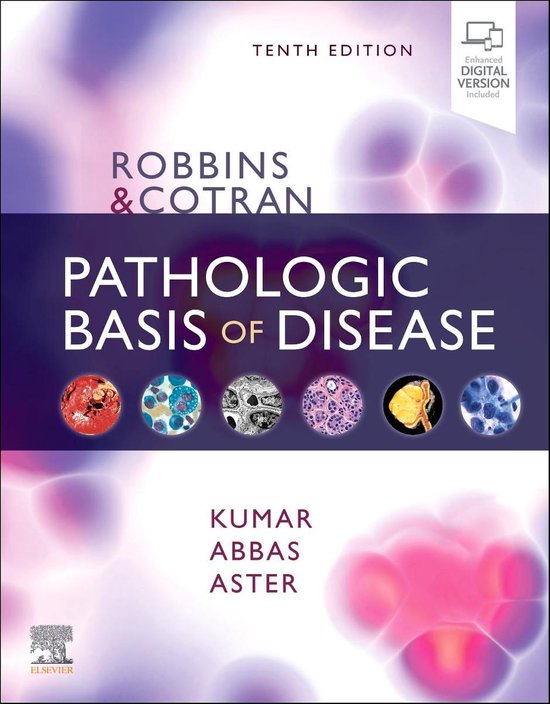
Robbins & Cotran 10th Ed. Pathology Test Bank | Chapter-
by-Chapter Questions & Verified Solutions
Robbins & Cotran Pathologic Basis of Disease
10th Edition
• Author(s)Vinay Kumar; Abul K. Abbas; Jon C. Aster
Chapter Reference – Chapter 1: The Cell as a Unit of Health
and Disease
The Genome
Cellular Housekeeping
Cellular Metabolism and Mitochondrial Function
Cellular Activation
Growth Factors and Receptors
Extracellular Matrix
Maintaining Cell Populations
Stem: A 45-year-old man with early-onset colorectal cancer is
found to have numerous insertion–deletion mutations at short
tandem repeat loci (microsatellites). Which DNA repair defect
most directly explains these findings?
A. Defective nucleotide excision repair (NER)
B. Defective base excision repair (BER)
,C. Defective DNA mismatch repair (MMR)
D. Defective homologous recombination (double-strand break
repair)
Correct Answer – C
Rationales
• Correct (C): DNA mismatch repair corrects replication
slippage errors at microsatellites; defects produce
microsatellite instability and predispose to colorectal
cancers (Lynch syndrome).
• Incorrect (A): NER repairs bulky helix-distorting lesions
(e.g., UV dimers), not replication slippage at
microsatellites.
• Incorrect (B): BER repairs small base modifications
(oxidation, alkylation), not microsatellite replication errors.
• Incorrect (D): Homologous recombination repairs double-
strand breaks; its defect leads to chromosomal instability
rather than microsatellite instability.
Teaching Point: Mismatch repair deficiency causes
microsatellite instability and increases colorectal cancer risk.
2
Chapter Reference – Chapter 1: The Cell as a Unit of Health
and Disease
The Genome
,Cellular Housekeeping
Cellular Metabolism and Mitochondrial Function
Cellular Activation
Growth Factors and Receptors
Extracellular Matrix
Maintaining Cell Populations
Stem: A patient exposed to cyanide develops profound lactic
acidosis and tissue hypoxia despite normal arterial oxygen
content. Which mitochondrial target is inhibited by cyanide to
produce this metabolic picture?
A. Complex I (NADH dehydrogenase)
B. Complex II (succinate dehydrogenase)
C. Complex III (cytochrome bc1)
D. Complex IV (cytochrome c oxidase)
Correct Answer – D
Rationales
• Correct (D): Cyanide binds to cytochrome c oxidase
(Complex IV), blocking electron transfer to oxygen, halting
oxidative phosphorylation and increasing anaerobic
glycolysis and lactate.
• Incorrect (A): Complex I inhibition causes similar effects
but cyanide specifically targets Complex IV.
• Incorrect (B): Complex II feeds electrons from succinate
but is not cyanide’s primary target.
, • Incorrect (C): Complex III inhibition impairs respiration, but
cyanide acts at Complex IV.
Teaching Point: Inhibition of Complex IV blocks final electron
transfer, causing anaerobic metabolism and lactic acidosis.
3
Chapter Reference – Chapter 1: The Cell as a Unit of Health
and Disease
The Genome
Cellular Housekeeping
Cellular Metabolism and Mitochondrial Function
Cellular Activation
Growth Factors and Receptors
Extracellular Matrix
Maintaining Cell Populations
Stem: Neurons in a patient with a familial neurodegenerative
syndrome show accumulation of ubiquitinated protein
aggregates. Which cellular system normally disposes of
ubiquitinated misfolded proteins?
A. Autophagy–lysosomal pathway
B. Ubiquitin–proteasome system (UPS)
C. Endoplasmic reticulum-associated degradation (ERAD)
without ubiquitination
D. Exosome secretion
Correct Answer – B
by-Chapter Questions & Verified Solutions
Robbins & Cotran Pathologic Basis of Disease
10th Edition
• Author(s)Vinay Kumar; Abul K. Abbas; Jon C. Aster
Chapter Reference – Chapter 1: The Cell as a Unit of Health
and Disease
The Genome
Cellular Housekeeping
Cellular Metabolism and Mitochondrial Function
Cellular Activation
Growth Factors and Receptors
Extracellular Matrix
Maintaining Cell Populations
Stem: A 45-year-old man with early-onset colorectal cancer is
found to have numerous insertion–deletion mutations at short
tandem repeat loci (microsatellites). Which DNA repair defect
most directly explains these findings?
A. Defective nucleotide excision repair (NER)
B. Defective base excision repair (BER)
,C. Defective DNA mismatch repair (MMR)
D. Defective homologous recombination (double-strand break
repair)
Correct Answer – C
Rationales
• Correct (C): DNA mismatch repair corrects replication
slippage errors at microsatellites; defects produce
microsatellite instability and predispose to colorectal
cancers (Lynch syndrome).
• Incorrect (A): NER repairs bulky helix-distorting lesions
(e.g., UV dimers), not replication slippage at
microsatellites.
• Incorrect (B): BER repairs small base modifications
(oxidation, alkylation), not microsatellite replication errors.
• Incorrect (D): Homologous recombination repairs double-
strand breaks; its defect leads to chromosomal instability
rather than microsatellite instability.
Teaching Point: Mismatch repair deficiency causes
microsatellite instability and increases colorectal cancer risk.
2
Chapter Reference – Chapter 1: The Cell as a Unit of Health
and Disease
The Genome
,Cellular Housekeeping
Cellular Metabolism and Mitochondrial Function
Cellular Activation
Growth Factors and Receptors
Extracellular Matrix
Maintaining Cell Populations
Stem: A patient exposed to cyanide develops profound lactic
acidosis and tissue hypoxia despite normal arterial oxygen
content. Which mitochondrial target is inhibited by cyanide to
produce this metabolic picture?
A. Complex I (NADH dehydrogenase)
B. Complex II (succinate dehydrogenase)
C. Complex III (cytochrome bc1)
D. Complex IV (cytochrome c oxidase)
Correct Answer – D
Rationales
• Correct (D): Cyanide binds to cytochrome c oxidase
(Complex IV), blocking electron transfer to oxygen, halting
oxidative phosphorylation and increasing anaerobic
glycolysis and lactate.
• Incorrect (A): Complex I inhibition causes similar effects
but cyanide specifically targets Complex IV.
• Incorrect (B): Complex II feeds electrons from succinate
but is not cyanide’s primary target.
, • Incorrect (C): Complex III inhibition impairs respiration, but
cyanide acts at Complex IV.
Teaching Point: Inhibition of Complex IV blocks final electron
transfer, causing anaerobic metabolism and lactic acidosis.
3
Chapter Reference – Chapter 1: The Cell as a Unit of Health
and Disease
The Genome
Cellular Housekeeping
Cellular Metabolism and Mitochondrial Function
Cellular Activation
Growth Factors and Receptors
Extracellular Matrix
Maintaining Cell Populations
Stem: Neurons in a patient with a familial neurodegenerative
syndrome show accumulation of ubiquitinated protein
aggregates. Which cellular system normally disposes of
ubiquitinated misfolded proteins?
A. Autophagy–lysosomal pathway
B. Ubiquitin–proteasome system (UPS)
C. Endoplasmic reticulum-associated degradation (ERAD)
without ubiquitination
D. Exosome secretion
Correct Answer – B