CELL DIVISION & THE CELL CYCLE –
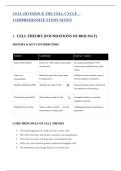
COMPREHENSIVE STUDY NOTES
1. CELL THEORY (FOUNDATIONS OF BIOLOGY)
HISTORY & KEY CONTRIBUTORS
Scientist Contribution Fun Fact / Context
Robert Hooke (1665) First to see “cells” under a microscope He actually named them “cells”
in cork slices. because they looked like tiny monk
rooms.
Anton van Observed living cells in pond water Built his own microscopes; some of
Leeuwenhoek (“animalcules”). the first people to see bacteria.
Matthias Schleiden (1838) All plants are made of cells. 🌿 Focused on plant tissues; emphasized
the importance of the nucleus.
Theodor Schwann (1839) All animals are made of cells. 🐾 Extended cell theory to animals,
making it universal.
Rudolf Virchow (1855) “Omnis cellula e cellula” → all cells Challenged the idea of spontaneous
come from pre-existing cells. generation.
CORE PRINCIPLES OF CELL THEORY
All living organisms are made of one or more cells.
The cell is the basic unit of life, structure, and organization.
Cells arise from pre-existing cells, not spontaneously.
Cells carry and transmit genetic material to daughter cells.
All metabolism and energy flow occur inside cells.
, by Unknown Author is licensed under
2. THE CELL CYCLE: LIFE OF A CELL
DEFINITION:
The cell cycle is the series of events a cell goes through to grow, copy its DNA, and divide.
Think of it as the life schedule of a cell.
STAGES OF THE CELL CYCLE
Interphase – The Preparation Stage
Cells spend most of their life here.
G1 (Gap 1)
Cell grows in size.
Produces proteins, enzymes, and organelles.
Performs normal metabolic activities.
Checkpoint: Enough nutrients? DNA intact?
S (Synthesis)
COMPREHENSIVE STUDY NOTES
1. CELL THEORY (FOUNDATIONS OF BIOLOGY)
HISTORY & KEY CONTRIBUTORS
Scientist Contribution Fun Fact / Context
Robert Hooke (1665) First to see “cells” under a microscope He actually named them “cells”
in cork slices. because they looked like tiny monk
rooms.
Anton van Observed living cells in pond water Built his own microscopes; some of
Leeuwenhoek (“animalcules”). the first people to see bacteria.
Matthias Schleiden (1838) All plants are made of cells. 🌿 Focused on plant tissues; emphasized
the importance of the nucleus.
Theodor Schwann (1839) All animals are made of cells. 🐾 Extended cell theory to animals,
making it universal.
Rudolf Virchow (1855) “Omnis cellula e cellula” → all cells Challenged the idea of spontaneous
come from pre-existing cells. generation.
CORE PRINCIPLES OF CELL THEORY
All living organisms are made of one or more cells.
The cell is the basic unit of life, structure, and organization.
Cells arise from pre-existing cells, not spontaneously.
Cells carry and transmit genetic material to daughter cells.
All metabolism and energy flow occur inside cells.
, by Unknown Author is licensed under
2. THE CELL CYCLE: LIFE OF A CELL
DEFINITION:
The cell cycle is the series of events a cell goes through to grow, copy its DNA, and divide.
Think of it as the life schedule of a cell.
STAGES OF THE CELL CYCLE
Interphase – The Preparation Stage
Cells spend most of their life here.
G1 (Gap 1)
Cell grows in size.
Produces proteins, enzymes, and organelles.
Performs normal metabolic activities.
Checkpoint: Enough nutrients? DNA intact?
S (Synthesis)