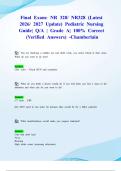
Finall Exam:l NRl 328/l NR328l (Latestl
2026/l 2027l Update)l Pediatricl Nursingl
Guide|l Q/Al |l Gradel A|l 100%l Correctl
(Verifiedl Answers)l -Chamberlain
Q:l Youl arel checkingl al toddlerl outl andl childl voids,l youl noticel bloodl inl theirl urine.l
Whatl dol youl wantl tol dol next?
Answer:
CBCl Labsl -l Checkl BUNl andl creatinine
Q:l Whatl dol youl thinkl al doctorl wouldl dol ifl youl toldl theml youl feell al massl inl thel
abdomenl andl whatl elsel dol youl wantl tol do?
Answer:
CTl Scanl ,l CBC
(Dol NOTl needl tol testl urinel forl ketonesl (thisl wouldl bel forl al DKAl patient))
Q:l Whatl manifestationsl wouldl makel youl suspectl leukemia?
Answer:
Cutsl thatl don'tl heal
Fever
Bruising
Highl whitel countl (recurringl infections)
,Q:l Whatl arel teachingl pointsl forl mucositis?
Answer:
Nol alcoholl mouthwash
Nol citrus,l lidocainel isl al goodl idea
Keepl lipsl moist
Softl toothbrush
Q:l Whatl arel examplesl ofl neutropenicl precautions?
Answer:
Nol freshl flowers,l fruit,l veggies
wearingl PPE
Monitorl lowl WBC,l infection
Q:l Al 7-year-oldl childl diagnosedl withl growthl hormonel deficiencyl isl prescribedl dailyl
growthl hormonel therapy.l Thel healthcarel providerl hasl recommendedl administeringl thel
growthl hormone.l Whichl ofl thel followingl statementsl bestl reflectsl thel appropriatel timingl
forl givingl thel growthl hormonel tol thel child?
A)l Inl thel morning,l beforel schooll
B)l Inl thel evening,l beforel bedtimel
C)l Inl thel afternoon,l afterl lunchl
D)l Atl anyl timel ofl thel day,l asl longl asl itl isl consistent
Answer:
B)l Inl thel evening,l beforel bedtime
, Q:l Al pediatricl patientl isl receivingl chemotherapyl knownl tol affectl thel bonel marrow.l
Thel nursel shouldl closelyl monitorl thel childl forl potentiall sidel effects.l Selectl alll thatl
apply:
A)l Feverl
B)l Lowl whitel bloodl celll (WBC)l countl
C)l Painlessl bruisingl
D)l Highl bloodl pressurel
E)l Elevatedl redl bloodl celll (RBC)l count
Answer:
A)l Feverl
B)l Lowl whitel bloodl celll (WBC)l countl
C)l Painlessl bruising
Q:l Al pediatricl patientl isl admittedl withl increasedl intracraniall pressurel (ICP)l duel tol al
traumaticl brainl injury.l Thel nursel isl implementingl interventionsl tol managel thel child'sl
condition.l Selectl alll appropriatel interventions:
A)l Elevatel thel headl ofl thel bedl tol al 30-degreel angle.l
B)l Administerl antipyreticsl asl prescribedl tol reducel fever.l
C)l Encouragel activitiesl thatl increasel intrathoracicl pressure.l
D)l Administerl sedativesl tol promotel restl andl sleep.l
E)l Maintainl strictl fluidl restriction.
Answer:
A)l Elevatel thel headl ofl thel bedl tol al 30-degreel angle.l
B)l Administerl antipyreticsl asl prescribedl tol reducel fever.l
Maintainingl strictl fluidl restrictionl isl notl al standardl interventionl forl increasedl ICPl inl
children.l Appropriatel hydrationl isl importantl tol maintainl normall cerebrall perfusion,l andl
fluidl balancel shouldl bel carefullyl managed,l butl strictl fluidl restrictionl isl notl typicallyl
necessary.l Administeringl sedativesl tol promotel restl andl sleepl isl generallyl notl
recommendedl becausel itl canl maskl neurologicall changesl andl depressl thel respiratoryl drive
2026/l 2027l Update)l Pediatricl Nursingl
Guide|l Q/Al |l Gradel A|l 100%l Correctl
(Verifiedl Answers)l -Chamberlain
Q:l Youl arel checkingl al toddlerl outl andl childl voids,l youl noticel bloodl inl theirl urine.l
Whatl dol youl wantl tol dol next?
Answer:
CBCl Labsl -l Checkl BUNl andl creatinine
Q:l Whatl dol youl thinkl al doctorl wouldl dol ifl youl toldl theml youl feell al massl inl thel
abdomenl andl whatl elsel dol youl wantl tol do?
Answer:
CTl Scanl ,l CBC
(Dol NOTl needl tol testl urinel forl ketonesl (thisl wouldl bel forl al DKAl patient))
Q:l Whatl manifestationsl wouldl makel youl suspectl leukemia?
Answer:
Cutsl thatl don'tl heal
Fever
Bruising
Highl whitel countl (recurringl infections)
,Q:l Whatl arel teachingl pointsl forl mucositis?
Answer:
Nol alcoholl mouthwash
Nol citrus,l lidocainel isl al goodl idea
Keepl lipsl moist
Softl toothbrush
Q:l Whatl arel examplesl ofl neutropenicl precautions?
Answer:
Nol freshl flowers,l fruit,l veggies
wearingl PPE
Monitorl lowl WBC,l infection
Q:l Al 7-year-oldl childl diagnosedl withl growthl hormonel deficiencyl isl prescribedl dailyl
growthl hormonel therapy.l Thel healthcarel providerl hasl recommendedl administeringl thel
growthl hormone.l Whichl ofl thel followingl statementsl bestl reflectsl thel appropriatel timingl
forl givingl thel growthl hormonel tol thel child?
A)l Inl thel morning,l beforel schooll
B)l Inl thel evening,l beforel bedtimel
C)l Inl thel afternoon,l afterl lunchl
D)l Atl anyl timel ofl thel day,l asl longl asl itl isl consistent
Answer:
B)l Inl thel evening,l beforel bedtime
, Q:l Al pediatricl patientl isl receivingl chemotherapyl knownl tol affectl thel bonel marrow.l
Thel nursel shouldl closelyl monitorl thel childl forl potentiall sidel effects.l Selectl alll thatl
apply:
A)l Feverl
B)l Lowl whitel bloodl celll (WBC)l countl
C)l Painlessl bruisingl
D)l Highl bloodl pressurel
E)l Elevatedl redl bloodl celll (RBC)l count
Answer:
A)l Feverl
B)l Lowl whitel bloodl celll (WBC)l countl
C)l Painlessl bruising
Q:l Al pediatricl patientl isl admittedl withl increasedl intracraniall pressurel (ICP)l duel tol al
traumaticl brainl injury.l Thel nursel isl implementingl interventionsl tol managel thel child'sl
condition.l Selectl alll appropriatel interventions:
A)l Elevatel thel headl ofl thel bedl tol al 30-degreel angle.l
B)l Administerl antipyreticsl asl prescribedl tol reducel fever.l
C)l Encouragel activitiesl thatl increasel intrathoracicl pressure.l
D)l Administerl sedativesl tol promotel restl andl sleep.l
E)l Maintainl strictl fluidl restriction.
Answer:
A)l Elevatel thel headl ofl thel bedl tol al 30-degreel angle.l
B)l Administerl antipyreticsl asl prescribedl tol reducel fever.l
Maintainingl strictl fluidl restrictionl isl notl al standardl interventionl forl increasedl ICPl inl
children.l Appropriatel hydrationl isl importantl tol maintainl normall cerebrall perfusion,l andl
fluidl balancel shouldl bel carefullyl managed,l butl strictl fluidl restrictionl isl notl typicallyl
necessary.l Administeringl sedativesl tol promotel restl andl sleepl isl generallyl notl
recommendedl becausel itl canl maskl neurologicall changesl andl depressl thel respiratoryl drive