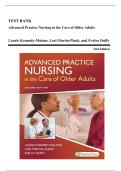
TEST BANK
Advanced Practice Nursing in the Care of Older Adults
Laurie Kennedy-Malone, Lori Martin-Plank, and Evelyn Duffy
2nd Edition
,Table of Contents
Chapter 01 Changes With Aging 1
Chapter 02 Health Promotion 8
Chapter 03 Exercise in Older Adults 16
Chapter 04 Comprehensive Geriatric Assessment 24
Chapter 05 Symptoms and Syndromes 31
Chapter 06 Skin and Lymphatic Disorders 39
Chapter 07 Head, Neck, and Face Disorders 47
Chapter 08 Chest Disorders 56
Chapter 09 Peripheral Vascular Disorders 64
Chapter 10 Abdominal Disorders 72
Chapter 11 Urological and Gynecological Disorders 81
Chapter 12 Musculoskeletal Disorders 88
Chapter 13 Central and Peripheral Nervous System Disorders 96
Chapter 14 Endocrine, Metabolic, and Nutritional Disorders 104
Chapter 15 Hematological and Immune System Disorders 113
Chapter 16 Psychosocial Disorders 120
Chapter 17 Polypharmacy 128
Chapter 18 Chronic Illness and the APRN 136
Chapter 19 Palliative Care and End-of-Life Care 145
,______________________________________________________________________________________________
Test Bank - Advanced Practice Nursing in the Care of Older Adults, 2nd Edition (Kennedy-Malone, 2019)
Chapter 1: Changes With Aging
MULTIPLE CHOICE
1. Mrs. Smith, 75 years old, reports that she is weak, has difficulty urinating, and is
dehydrated. Although she is afebrile, the nurse conducts a thorough physical examination,
including urinalysis and complete blood count (CBC). The total assessment is necessary
because:
a. All body systems interact, and symptoms could indicate a variety of diagnoses.
b. The symptoms are vague and may be signs of aging.
c. There may be other signs or symptoms more indicative of the condition.
d. Mrs. Smith may not be reporting all significant information.
ANS: A
Feedback
A The clinician must be aware that all the systems interact and, in doing so, can
increase the older person’s vulnerability to illness/disease.
B The nurse must not attribute symptoms only to the aging process.
C There may be comorbidities accompanying this condition.
D Assumptions of not reporting properly may not be true.
REF: Page: 2
2. A patient with renal disease has blood work drawn, and the results show an increase in
serum creatinine. The nurse practitioner needs to know which of the following laboratory
values before ordering medications?
a. CBC
b. Culture and sensitivity of the urine
c. Creatinine clearance
d. Uric acid levels
ANS: C
Feedback
A A CBC will not evaluate kidney function for a patient with renal disease.
B A culture and sensitivity test reflects the presence of an infection and the
antibiotic to which the organism is sensitive.
C The calculation of creatinine clearance provides an estimation of renal function.
D Uric acid level is elevated in the presence of gout.
REF: Page: 3
3. Which of the following statements is true regarding diagnostic testing?
a. A test is ordered for a specific purpose.
b. A test is the most invasive available.
c. There is no need to discuss results with the patient.
d. If a test is needed, it should be ordered regardless of risk to the patient.
______________________________________________________________________________________________
1|Page
Downloaded by: faouzimouad | Want to earn $1.236
Distribution of this document is illegal extra per year?
, ______________________________________________________________________________________________
Test Bank - Advanced Practice Nursing in the Care of Older Adults, 2nd Edition (Kennedy-Malone, 2019)
ANS: A
Feedback
A The nurse practitioner should have a plan for the use of each test result value
obtained.
B When considering which laboratory tests to order, it is worth remembering the
doctrine primum no nnocere—first, do no harm.
C Once laboratory tests are available for review, tests results should be discussed
with the patient, with abnormal test results interpreted for the aging individual
and addressed with the patient and caregivers.
D Any risks involved in laboratory testing must be considered concerning the
patient’s clinical condition and weighed against the test’s expected benefits.
REF: Page: 3
4. Janey, 25 years old, may experience arthritis differently than 65-year-old Mrs. Johnson
because:
a. The body undergoes physiological changes with aging.
b. A healthy body does not experience significant changes as one gets older.
c. Older patients do not feel any systemic symptoms, such as malaise and weight
loss.
d. Even though the same joints are usually affected, age makes it feel different.
ANS: A
Feedback
A Knowledge of the bimodality of age onset of certain disease conditions will aid
the advanced practice nurse in avoiding misdiagnosis or delay in diagnosis due
to lack of recognition.
B Symptoms of rheumatoid arthritis may be different depending on the age of the
patient.
C Younger patients may not experience constitutional symptoms such as fever,
malaise, weight loss, and depression.
D In late-onset rheumatoid arthritis, the joint involvement is more often in the
larger joints.
REF: Page: 5
5. The nurse practitioner is examining an 85-year-old man with reports of abdominal pain,
weakness, and loss of appetite. Which is the most likely condition to be tested for and ruled
out?
a. Neoplasms and carcinomas
b. Partial seizure
c. Sarcopenia
d. Hirschsprung’s disease
ANS: A
Feedback
A Certain diseases, such as neoplasms and carcinomas, are more common in the
______________________________________________________________________________________________
2|Page
Downloaded by: faouzimouad | Want to earn $1.236
Distribution of this document is illegal extra per year?
Advanced Practice Nursing in the Care of Older Adults
Laurie Kennedy-Malone, Lori Martin-Plank, and Evelyn Duffy
2nd Edition
,Table of Contents
Chapter 01 Changes With Aging 1
Chapter 02 Health Promotion 8
Chapter 03 Exercise in Older Adults 16
Chapter 04 Comprehensive Geriatric Assessment 24
Chapter 05 Symptoms and Syndromes 31
Chapter 06 Skin and Lymphatic Disorders 39
Chapter 07 Head, Neck, and Face Disorders 47
Chapter 08 Chest Disorders 56
Chapter 09 Peripheral Vascular Disorders 64
Chapter 10 Abdominal Disorders 72
Chapter 11 Urological and Gynecological Disorders 81
Chapter 12 Musculoskeletal Disorders 88
Chapter 13 Central and Peripheral Nervous System Disorders 96
Chapter 14 Endocrine, Metabolic, and Nutritional Disorders 104
Chapter 15 Hematological and Immune System Disorders 113
Chapter 16 Psychosocial Disorders 120
Chapter 17 Polypharmacy 128
Chapter 18 Chronic Illness and the APRN 136
Chapter 19 Palliative Care and End-of-Life Care 145
,______________________________________________________________________________________________
Test Bank - Advanced Practice Nursing in the Care of Older Adults, 2nd Edition (Kennedy-Malone, 2019)
Chapter 1: Changes With Aging
MULTIPLE CHOICE
1. Mrs. Smith, 75 years old, reports that she is weak, has difficulty urinating, and is
dehydrated. Although she is afebrile, the nurse conducts a thorough physical examination,
including urinalysis and complete blood count (CBC). The total assessment is necessary
because:
a. All body systems interact, and symptoms could indicate a variety of diagnoses.
b. The symptoms are vague and may be signs of aging.
c. There may be other signs or symptoms more indicative of the condition.
d. Mrs. Smith may not be reporting all significant information.
ANS: A
Feedback
A The clinician must be aware that all the systems interact and, in doing so, can
increase the older person’s vulnerability to illness/disease.
B The nurse must not attribute symptoms only to the aging process.
C There may be comorbidities accompanying this condition.
D Assumptions of not reporting properly may not be true.
REF: Page: 2
2. A patient with renal disease has blood work drawn, and the results show an increase in
serum creatinine. The nurse practitioner needs to know which of the following laboratory
values before ordering medications?
a. CBC
b. Culture and sensitivity of the urine
c. Creatinine clearance
d. Uric acid levels
ANS: C
Feedback
A A CBC will not evaluate kidney function for a patient with renal disease.
B A culture and sensitivity test reflects the presence of an infection and the
antibiotic to which the organism is sensitive.
C The calculation of creatinine clearance provides an estimation of renal function.
D Uric acid level is elevated in the presence of gout.
REF: Page: 3
3. Which of the following statements is true regarding diagnostic testing?
a. A test is ordered for a specific purpose.
b. A test is the most invasive available.
c. There is no need to discuss results with the patient.
d. If a test is needed, it should be ordered regardless of risk to the patient.
______________________________________________________________________________________________
1|Page
Downloaded by: faouzimouad | Want to earn $1.236
Distribution of this document is illegal extra per year?
, ______________________________________________________________________________________________
Test Bank - Advanced Practice Nursing in the Care of Older Adults, 2nd Edition (Kennedy-Malone, 2019)
ANS: A
Feedback
A The nurse practitioner should have a plan for the use of each test result value
obtained.
B When considering which laboratory tests to order, it is worth remembering the
doctrine primum no nnocere—first, do no harm.
C Once laboratory tests are available for review, tests results should be discussed
with the patient, with abnormal test results interpreted for the aging individual
and addressed with the patient and caregivers.
D Any risks involved in laboratory testing must be considered concerning the
patient’s clinical condition and weighed against the test’s expected benefits.
REF: Page: 3
4. Janey, 25 years old, may experience arthritis differently than 65-year-old Mrs. Johnson
because:
a. The body undergoes physiological changes with aging.
b. A healthy body does not experience significant changes as one gets older.
c. Older patients do not feel any systemic symptoms, such as malaise and weight
loss.
d. Even though the same joints are usually affected, age makes it feel different.
ANS: A
Feedback
A Knowledge of the bimodality of age onset of certain disease conditions will aid
the advanced practice nurse in avoiding misdiagnosis or delay in diagnosis due
to lack of recognition.
B Symptoms of rheumatoid arthritis may be different depending on the age of the
patient.
C Younger patients may not experience constitutional symptoms such as fever,
malaise, weight loss, and depression.
D In late-onset rheumatoid arthritis, the joint involvement is more often in the
larger joints.
REF: Page: 5
5. The nurse practitioner is examining an 85-year-old man with reports of abdominal pain,
weakness, and loss of appetite. Which is the most likely condition to be tested for and ruled
out?
a. Neoplasms and carcinomas
b. Partial seizure
c. Sarcopenia
d. Hirschsprung’s disease
ANS: A
Feedback
A Certain diseases, such as neoplasms and carcinomas, are more common in the
______________________________________________________________________________________________
2|Page
Downloaded by: faouzimouad | Want to earn $1.236
Distribution of this document is illegal extra per year?