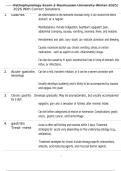
Pathophysiology Exam 2 Rasmussen University Winter 2025|
2026 With Correct Solutions
1. Gastritis an inflammation of the stomachs mucosal lining. It can involve the entire
stomach or a region.
Manifestations: Include indigestion, heartburn, epigastric pain,
abdominal cramping, nausea, vomiting, anorexia, fever, and malaise.
Hematemesis and dark, tarry stools can indicate ulceration and bleeding.
Causes: excessive alcohol use, chronic vomiting, stress, or certain
medications such as aspirin or anti- inflammatory drugs.
Can also be caused by H. pylori- bacteria that lives in lining of stomach, bile
reflux, or infections.
2. Acute gastritis Can be a mild, transient irritation, or it can be a severe ulceration with
hemorrhage
Usually develops suddenly and is likely to be accompanied by nausea
and epigas- tric pain
3. Chronic gastritis Develops gradually. May be asymptomatic, but usually accompanied
by a dull
epigastric pain and a sensation of fullness after minimal intake.
Can be further categorized as erosive or nonerosive. Complications: peptic
ulcers, gastric cancer, and hemorrhage
4. gastritis Acute is often self-limiting and resolves within 3 days. Treatment
Treat- ment
strategies for acute vary depending on the underlying etiology (e.g.,
antibiotics).
Treatment strategies for chronic include etiology-specific interventions,
antacids, acid-reducing agents, and mucosal barrier agents.
1/
56
, Pathophysiology Exam 2 Rasmussen University Winter 2025|
2026 With Correct Solutions
5. Gastroenteritis Inflammation of the stomach and intestines, usually because of an
infection or
allergic reaction
2/
56
, Pathophysiology Exam 2 Rasmussen University Winter 2025|
2026 With Correct Solutions
6. GERD gastroesophageal reflux disease- where chyme periodically backs up
from the
stomach into the esophagus.
Causes: are certain foods like chocolate, catteine, carbonated bevs, citrus
fruit, tomatoes, spicy or fatty foods, peppermint, alcohol, nicotine,
obesity, pregnancy, and certain medications.
Complications: overtime the reflux of stomach acid damages the tissue
lining of the esophagus and can lead to permanent damage of it and
even cancer.
7. PUD, Peptic lesions attecting the lining of the stomach or duodenum.
ulcer disease
Vary in severity from superficial erosions to complete penetration
through the GI tract wall Develops because of an imbalance between
destructive forces and protective mechanisms
Manifestations: epigastric or abdominal pain, abdominal cramping,
heartburn, indigestion, nausea, and vomiting
8. Duodenal ulcers • Most commonly associated with excessive acid or H. pylori
infections
• Typically present with epigastric pain that is relieved in the
presence of food
9. Gastric ulcers • Less frequent but more deadly.
• Typically associated with malignancy and nonsteroidal anti-
inflammatory drugs.
• Pain typically worsens with eating.
10. Stress ulcers • Develop because of a major physiological stressor on the body due to
local
tissue ischemia, tissue acidosis, bile salts entering the stomach, and
3/
56
, Pathophysiology Exam 2 Rasmussen University Winter 2025|
2026 With Correct Solutions
decreased GI motility.
11. Curling's ulcers stress ulcers associated with burns
12. Cushing's ulcersstress ulcers associated with head injuries
4/
56
2026 With Correct Solutions
1. Gastritis an inflammation of the stomachs mucosal lining. It can involve the entire
stomach or a region.
Manifestations: Include indigestion, heartburn, epigastric pain,
abdominal cramping, nausea, vomiting, anorexia, fever, and malaise.
Hematemesis and dark, tarry stools can indicate ulceration and bleeding.
Causes: excessive alcohol use, chronic vomiting, stress, or certain
medications such as aspirin or anti- inflammatory drugs.
Can also be caused by H. pylori- bacteria that lives in lining of stomach, bile
reflux, or infections.
2. Acute gastritis Can be a mild, transient irritation, or it can be a severe ulceration with
hemorrhage
Usually develops suddenly and is likely to be accompanied by nausea
and epigas- tric pain
3. Chronic gastritis Develops gradually. May be asymptomatic, but usually accompanied
by a dull
epigastric pain and a sensation of fullness after minimal intake.
Can be further categorized as erosive or nonerosive. Complications: peptic
ulcers, gastric cancer, and hemorrhage
4. gastritis Acute is often self-limiting and resolves within 3 days. Treatment
Treat- ment
strategies for acute vary depending on the underlying etiology (e.g.,
antibiotics).
Treatment strategies for chronic include etiology-specific interventions,
antacids, acid-reducing agents, and mucosal barrier agents.
1/
56
, Pathophysiology Exam 2 Rasmussen University Winter 2025|
2026 With Correct Solutions
5. Gastroenteritis Inflammation of the stomach and intestines, usually because of an
infection or
allergic reaction
2/
56
, Pathophysiology Exam 2 Rasmussen University Winter 2025|
2026 With Correct Solutions
6. GERD gastroesophageal reflux disease- where chyme periodically backs up
from the
stomach into the esophagus.
Causes: are certain foods like chocolate, catteine, carbonated bevs, citrus
fruit, tomatoes, spicy or fatty foods, peppermint, alcohol, nicotine,
obesity, pregnancy, and certain medications.
Complications: overtime the reflux of stomach acid damages the tissue
lining of the esophagus and can lead to permanent damage of it and
even cancer.
7. PUD, Peptic lesions attecting the lining of the stomach or duodenum.
ulcer disease
Vary in severity from superficial erosions to complete penetration
through the GI tract wall Develops because of an imbalance between
destructive forces and protective mechanisms
Manifestations: epigastric or abdominal pain, abdominal cramping,
heartburn, indigestion, nausea, and vomiting
8. Duodenal ulcers • Most commonly associated with excessive acid or H. pylori
infections
• Typically present with epigastric pain that is relieved in the
presence of food
9. Gastric ulcers • Less frequent but more deadly.
• Typically associated with malignancy and nonsteroidal anti-
inflammatory drugs.
• Pain typically worsens with eating.
10. Stress ulcers • Develop because of a major physiological stressor on the body due to
local
tissue ischemia, tissue acidosis, bile salts entering the stomach, and
3/
56
, Pathophysiology Exam 2 Rasmussen University Winter 2025|
2026 With Correct Solutions
decreased GI motility.
11. Curling's ulcers stress ulcers associated with burns
12. Cushing's ulcersstress ulcers associated with head injuries
4/
56