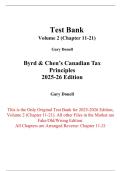
Test Bank
Volume 2 (Chapter 11-21)
Gary Donell
Byrd & Chen’s Canadian Tax
Principles
2025-26 Edition
Gary Donell
This is the Only Original Test Bank for 2025-2026 Edition,
Volume 2 (Chapter 11-21). All other Files in the Market are
Fake/Old/Wrong Edition.
All Chapters are Arranged Reverse: Chapter 11-21
,Byrd and Chen's Canadian Tax Principles, 2025-2026 (Donell)
Chapter 21 GST/HST
21.1 Quick Review
1) There are no items in this section.
Type: ES
21.2 Self-Study Problems
1) There are no items in this section.
Type: ES
21.3 Practical Case
1) There are no items in this section.
Type: ES
21.4 Online Exercises
1) Briefly describe the advantages, from the point of view of a business, of an HST system as compared to
a combined GST/PST system.
Answer: The main advantages can be described as follows:
• An HST system is less complex. With an HST system, the staff of the business only has to understand
and deal with one set of rules. In contrast, under a GST/PST system, two separate sets of rules must be
followed.
• An HST system has lower compliance costs. GST/PST systems require the filing of two separate tax
returns, as opposed to the one return that is required with an HST system.
• With an HST system, business organizations receive ITCs for all of the HST paid on their purchases and
expenses. They receive ITCs for only the GST portion under a GST/PST system.
Type: ES
Topic: GST/HST - basic rules & general concepts
2) Describe two factors that have been influential in the increased use of transaction based taxes in
various countries around the world.
Answer: The required two factors can be selected from the following:
• Simplicity - Transaction taxes are easy to administer and collect. No forms are required from
individuals paying the tax and, if the individual wishes to purchase a particular good or service, it is
difficult to evade payment.
• Incentives to Work - An often cited disadvantage of income tax is that it can discourage individual
initiative to work and invest. Transaction taxes do not have this characteristic.
• Consistency - Transaction taxes avoid the fluctuating income and family unit problems that are
associated with progressive income tax systems.
• Keeping the Tax Revenues in Canada - While some types of income can be moved out of Canada,
resulting in the related taxes being paid in a non-Canadian jurisdiction, taxes on Canadian transactions
remain in Canada.
Type: ES
Topic: GST/HST - basic rules & general concepts
1
Copyright © 2026 Pearson Canada Inc.
,3) What is the basic problem with a multi-stage tax that is assessed on turnover at the various stages of
the production/sale cycle?
Answer: The problem is that there are multiple layers of tax. When the tax is applied at each level using
normal markups, there is a tax on taxes that have been previously paid. This can result in a very high
overall rate being charged in the process of getting the product to the ultimate consumer.
Type: ES
Topic: GST/HST - basic rules & general concepts
4) Explain the difference between an accounts-based value added tax (VAT) and invoice-credit VAT.
Answer: An accounts-based VAT system only applies a specified rate to the value added at each stage in
the production/distribution process. Such systems require an accounting based measurement of the
amount of value added.
An invoice-credit VAT applies a specified rate to the revenue generated at each stage in the
production/distribution process. The remittance of this amount is offset by claiming ITCs for the tax that
has been paid on all current purchases and on the full amount of capital expenditures used in producing
these revenues. Its application involves no matching of costs and revenues, and no allocation of costs to
periods other than the period in which property was purchased.
Type: ES
Topic: GST/HST - basic rules & general concepts
5) Describe the GST/HST consequences related to the sale of:
• fully taxable goods and services;
• zero-rated goods and services; and
• exempt goods and services.
Answer: The GST/HST consequences are as follows:
Fully Taxable Goods and Services - The vendor would charge GST/HST on all such sales. The vendor
would be eligible for ITCs for GST/HST paid on the costs and expenses associated with such sales.
Zero-Rated Goods and Services - The vendor would not charge GST/HST on such sales. The vendor
would be eligible for ITCs for GST/HST paid on the costs and expenses associated with such sales.
Exempt Goods and Services - The vendor would not charge GST/HST on such sales. The vendor would
not be eligible for ITCs for GST/HST paid on the costs and expenses associated with such sales.
Type: ES
Topic: GST/HST - basic rules & general concepts
6) Describe the "place of supply" rules as they apply to (1) tangible goods other than real property, and (2)
services.
Answer: With respect to tangible goods, GST/HST will be collected using the rules of the province or
territory where the goods are delivered.
With respect to services, GST/HST will be collected using the rules of the province or territory where the
service is performed.
Type: ES
Topic: GST/HST - basic rules & general concepts
2
Copyright © 2026 Pearson Canada Inc.
, 7) John is not a GST/HST registrant and is a resident of Ontario where a 13% HST rate is in effect. He
purchases a new automobile from an automobile dealership and is being given a trade-in allowance for
his old automobile. Explain how the HST will apply to John's purchase.
Answer: HST will only be charged on the net cost of the new automobile. The 13% rate will be applied to
the cost of the new car, less the trade-in allowance provided.
Type: ES
Topic: GST/HST - calculations (regular method)
8) Give two examples of entities that would have to file a GST or HST return, but do not have to file an
income tax return.
Answer: Partnerships and non-profit organizations are most commonly mentioned in the textbook.
Type: ES
Topic: GST/HST - basic rules & general concepts
9) Explain how the GST/HST registration requirements apply to non-residents.
Answer: In general, non-residents are not required to register for GST/HST. However, if a non-resident is
carrying on business in Canada, registration would be required. In addition, a non-resident could
voluntarily register.
Type: ES
Topic: GST/HST - registration
10) Describe the "last four calendar quarters" test that is used to determine eligibility for the small
supplier's exemption.
Answer: Under this test, a person qualifies as a small supplier if, during the four consecutive calendar
quarters preceding the current quarter, the entity together with associated persons did not have
cumulative taxable supplies exceeding $30,000. If that $30,000 limit is exceeded in the preceding four
quarters then the person remains a small supplier for those four quarters and one calendar month
following those quarters.
Type: ES
Topic: GST/HST - small supplier exemption
11) An individual with taxable sales of less than $30,000 in the previous calendar year has asked your
advice as to whether the individual should register for GST/HST purposes. What questions should you
ask about the business in order to give the appropriate advice?
Answer: The basic questions that should be asked are as follows:
• Do you have large amounts of fully taxable expenditures that would generate ITCs?
• Do you expect to exceed $30,000 in annual taxable sales in the near future?
• Would adding GST/HST to your sale price reduce your ability to compete?
Type: ES
Topic: GST/HST - registration
3
Copyright © 2026 Pearson Canada Inc.
Volume 2 (Chapter 11-21)
Gary Donell
Byrd & Chen’s Canadian Tax
Principles
2025-26 Edition
Gary Donell
This is the Only Original Test Bank for 2025-2026 Edition,
Volume 2 (Chapter 11-21). All other Files in the Market are
Fake/Old/Wrong Edition.
All Chapters are Arranged Reverse: Chapter 11-21
,Byrd and Chen's Canadian Tax Principles, 2025-2026 (Donell)
Chapter 21 GST/HST
21.1 Quick Review
1) There are no items in this section.
Type: ES
21.2 Self-Study Problems
1) There are no items in this section.
Type: ES
21.3 Practical Case
1) There are no items in this section.
Type: ES
21.4 Online Exercises
1) Briefly describe the advantages, from the point of view of a business, of an HST system as compared to
a combined GST/PST system.
Answer: The main advantages can be described as follows:
• An HST system is less complex. With an HST system, the staff of the business only has to understand
and deal with one set of rules. In contrast, under a GST/PST system, two separate sets of rules must be
followed.
• An HST system has lower compliance costs. GST/PST systems require the filing of two separate tax
returns, as opposed to the one return that is required with an HST system.
• With an HST system, business organizations receive ITCs for all of the HST paid on their purchases and
expenses. They receive ITCs for only the GST portion under a GST/PST system.
Type: ES
Topic: GST/HST - basic rules & general concepts
2) Describe two factors that have been influential in the increased use of transaction based taxes in
various countries around the world.
Answer: The required two factors can be selected from the following:
• Simplicity - Transaction taxes are easy to administer and collect. No forms are required from
individuals paying the tax and, if the individual wishes to purchase a particular good or service, it is
difficult to evade payment.
• Incentives to Work - An often cited disadvantage of income tax is that it can discourage individual
initiative to work and invest. Transaction taxes do not have this characteristic.
• Consistency - Transaction taxes avoid the fluctuating income and family unit problems that are
associated with progressive income tax systems.
• Keeping the Tax Revenues in Canada - While some types of income can be moved out of Canada,
resulting in the related taxes being paid in a non-Canadian jurisdiction, taxes on Canadian transactions
remain in Canada.
Type: ES
Topic: GST/HST - basic rules & general concepts
1
Copyright © 2026 Pearson Canada Inc.
,3) What is the basic problem with a multi-stage tax that is assessed on turnover at the various stages of
the production/sale cycle?
Answer: The problem is that there are multiple layers of tax. When the tax is applied at each level using
normal markups, there is a tax on taxes that have been previously paid. This can result in a very high
overall rate being charged in the process of getting the product to the ultimate consumer.
Type: ES
Topic: GST/HST - basic rules & general concepts
4) Explain the difference between an accounts-based value added tax (VAT) and invoice-credit VAT.
Answer: An accounts-based VAT system only applies a specified rate to the value added at each stage in
the production/distribution process. Such systems require an accounting based measurement of the
amount of value added.
An invoice-credit VAT applies a specified rate to the revenue generated at each stage in the
production/distribution process. The remittance of this amount is offset by claiming ITCs for the tax that
has been paid on all current purchases and on the full amount of capital expenditures used in producing
these revenues. Its application involves no matching of costs and revenues, and no allocation of costs to
periods other than the period in which property was purchased.
Type: ES
Topic: GST/HST - basic rules & general concepts
5) Describe the GST/HST consequences related to the sale of:
• fully taxable goods and services;
• zero-rated goods and services; and
• exempt goods and services.
Answer: The GST/HST consequences are as follows:
Fully Taxable Goods and Services - The vendor would charge GST/HST on all such sales. The vendor
would be eligible for ITCs for GST/HST paid on the costs and expenses associated with such sales.
Zero-Rated Goods and Services - The vendor would not charge GST/HST on such sales. The vendor
would be eligible for ITCs for GST/HST paid on the costs and expenses associated with such sales.
Exempt Goods and Services - The vendor would not charge GST/HST on such sales. The vendor would
not be eligible for ITCs for GST/HST paid on the costs and expenses associated with such sales.
Type: ES
Topic: GST/HST - basic rules & general concepts
6) Describe the "place of supply" rules as they apply to (1) tangible goods other than real property, and (2)
services.
Answer: With respect to tangible goods, GST/HST will be collected using the rules of the province or
territory where the goods are delivered.
With respect to services, GST/HST will be collected using the rules of the province or territory where the
service is performed.
Type: ES
Topic: GST/HST - basic rules & general concepts
2
Copyright © 2026 Pearson Canada Inc.
, 7) John is not a GST/HST registrant and is a resident of Ontario where a 13% HST rate is in effect. He
purchases a new automobile from an automobile dealership and is being given a trade-in allowance for
his old automobile. Explain how the HST will apply to John's purchase.
Answer: HST will only be charged on the net cost of the new automobile. The 13% rate will be applied to
the cost of the new car, less the trade-in allowance provided.
Type: ES
Topic: GST/HST - calculations (regular method)
8) Give two examples of entities that would have to file a GST or HST return, but do not have to file an
income tax return.
Answer: Partnerships and non-profit organizations are most commonly mentioned in the textbook.
Type: ES
Topic: GST/HST - basic rules & general concepts
9) Explain how the GST/HST registration requirements apply to non-residents.
Answer: In general, non-residents are not required to register for GST/HST. However, if a non-resident is
carrying on business in Canada, registration would be required. In addition, a non-resident could
voluntarily register.
Type: ES
Topic: GST/HST - registration
10) Describe the "last four calendar quarters" test that is used to determine eligibility for the small
supplier's exemption.
Answer: Under this test, a person qualifies as a small supplier if, during the four consecutive calendar
quarters preceding the current quarter, the entity together with associated persons did not have
cumulative taxable supplies exceeding $30,000. If that $30,000 limit is exceeded in the preceding four
quarters then the person remains a small supplier for those four quarters and one calendar month
following those quarters.
Type: ES
Topic: GST/HST - small supplier exemption
11) An individual with taxable sales of less than $30,000 in the previous calendar year has asked your
advice as to whether the individual should register for GST/HST purposes. What questions should you
ask about the business in order to give the appropriate advice?
Answer: The basic questions that should be asked are as follows:
• Do you have large amounts of fully taxable expenditures that would generate ITCs?
• Do you expect to exceed $30,000 in annual taxable sales in the near future?
• Would adding GST/HST to your sale price reduce your ability to compete?
Type: ES
Topic: GST/HST - registration
3
Copyright © 2026 Pearson Canada Inc.