NSG 129: Nursing Leadership and Management
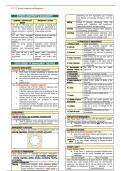
NURSING LEADERSHIP & MANAGEMENT determining the most appropriate type of patient
care delivery, and grouping activities to meet unit
Leadership – behaviour and Management - process goals.
attitude Staffing consist of recruiting, interviewing, hiring, and
The act of influencing and The process of leading and orienting staff. Scheduling, staff development,
motivating a group of people to directing an organization to employee socialization, and team building.
act in the same direction meet its goals through the use Directing consists of motivating, managing conflict, delegating,
towards achieving a common of appropriate resources. communicating, and facilitating
goal. Controlling functions include performance appraisals, fiscal
do not have delegated legitimate source of power due accountability, quality control, legal and ethical
authority but obtain their power to the delegated authority control, and professional and collegial control.
through other means, such as
influence 14 PRINCIPLES OF MANAGEMENT
focus on group process, emphasize control, decision 1. Division of work allows specialization
information gathering, making, decision analysis, and right to command balanced with
2. Authority
feedback, and empowering results responsibility and accountability
others employees will only obey orders if
have goals that may or may greater formal responsibility 3. Discipline management play their part by providing
not reflect those of the and accountability for good leadership
organization rationality and control than there should only be one boss with no
4. Unity of command
leaders conflicting lines of command
people engaged in the same kind of
DEVELOPMENT OF MANAGEMENT THEORIES 5. Unity of direction activities must have the same objectives
in a single plan
SCIENTIFIC MANAGEMENT 6. Subordination of the goals of the firms are always
Frederick W. Taylor “father of scientific management” individual interest to paramount.
Work should be studied scientifically to determine the general interest
method of task performance that would yield maximum 7. Remuneration payment is an important motivator
work output with minimum work expenditure. 8. Centralization or depends on the condition of business and
Work should be studied, every methods and steps before Decentralization the quality of its personnel
acting 9. Scalar chain/line of refers to the number of levels in the
Efficient to task authority hierarchy
Four overriding principles of scientific management: both material order (minimizes lost time &
1. Traditional “rule of thumb” means of organizing work useless handling of materials) and social
10. Order
must be replaced with scientific methods. order (organization and selection) are
2. A scientific personnel system must be established so that necessary.
workers can be hired, trained, and promoted based on employees should be treated well to
their technical competence and abilities. 11. Equity achieve
3. Workers should be able to view how they “fit” into the equity
organization and how they contribute to overall 12. Stability of tenure job security and career progress are
organizational productivity. of personnel important for employees to work better
4. The relationship between managers and workers should allow personnel to show their initiative, it
be cooperative and interdependent, and the work should 13. Initiative may be a source of strength for the
be shared equally. organization
management should foster the moral
14. Esprit de corps
BUREAUCRACY of employees
Max Weber (1922)
THEORY OF SOCIAL AND ECONOMIC ORGANIZATION PARTICIPATION MANAGEMENT
advocated bureaucracy Mary Parker Follett (1926) was one of the first theorists to suggest
Need for legalized, formal authority and consistent rules participative decision making or participative management.
and regulations for personnel in different positions Managers should have authority with, rather than over,
employees.
MANAGEMENT FUNCTIONS
Henry Fayol (1925) first identified the management functions of ILLUMINATION STUDIES
planning, organization, command, coordination, and control Elton Mayo and his Harvard associates (1927-1932)
look at the relationship between light illumination in the
factory and productivity.
indicated that people respond to the fact that they
Hawthorne
are being studied, attempting to increase whatever
effect
behavior
THEORY X AND Y
Douglas McGregor (1960)
ACTIVITIES OF MANAGEMENT X and Theory Y, posited that managerial attitudes about
Luther Gulick (1937) expanded on Fayol’s management employees can be directly correlated with employee
functions in his introduction of the “ Seven Activities of Management ” satisfaction.
- planning, organizing, staffing, directing, coordinating, reporting, Theory X managers Theory Y managers
and budgeting. believe that their employees are believe that their workers enjoy
Activities of Management: basically lazy, need constant their work, are self-motivated,
Planning determines philosophy, goals, objectives, policies, supervision and direction, and and are willing to work hard to
procedures, and rules; carrying out long-and short- are indifferent to organizational meet personal and
range projections; determining a fiscal course of needs. organizational goals.
, NSG 129: Nursing Leadership and Management
Laissez-faire characterized by the following behaviors:
leader Is permissive, with little or no control.
Motivates by support when requested
by the group. Provides little or no
direction.
Uses upward and downward
communication between members of
the group.
Disperses decision making throughout
the group.
Places emphasis on the group.
Does not criticize.
CONTINGENCY APPROACH
Fiedler (1967)
EMPLOYEE PARTICIPATION suggests that no one leadership style is ideal for every
Chris Argyris (1964), managerial domination causes workers to situation.
become discouraged and passive. Interrelationships between the group’s leader and its
If self-esteem and independence needs are not met, members were most influenced by the manager’s ability
employees will become discouraged and troublesome or to be a good leader
may leave the organization.
SITUATIONAL APPROACH
Management Theories (Summary) Hersey and Blanchard (1977)
Theorist Theory Tridimensional leadership effectiveness model predicts
Taylor Scientific management which leadership style is most appropriate in each
Weber Bureaucratic organizations situation on the basis of the level of the followers’
Fayol Management functions maturity.
Gulick Activities of managements As people mature, leadership style becomes less task
Follet Participative management focused and more relationship oriented.
Mayo Hawthorne effect
McGregor Theory X and Y TRANSACTIONAL AND TRANSFORMATIONAL APPROACH
Argyris Employee participation Burns (2003)
both leaders and followers have the ability to raise each
DEVELOPMENT OF LEADERSHP THEORIES other to higher levels of motivation and morality.
There are two primary types of leaders in management
GREAT MAN THEORY Transactional Transformational
From Aristotelian philosophy, asserts that some people Traditional manager, concerned committed, has a vision, and is
are born to lead, whereas others are born to be led. with the day-to-day operations able to empower others with
Great leaders will arise when the situation demands it. this vision
Focuses on Identifies common
TRAIT THEORY management tasks values
assume that some people have certain characteristics or Is committed Is a caretaker
personality traits that make them better leaders than Uses trade-offs to Inspires others with
others. meet goals vision
Does not identify Has long-term vision
shared values Looks at effects
Examines causes Empowers others
Uses contingency
reward
EXEMPLARY LEADERSHIP
LEADERSHIP STYLES
Kouzes and Posner's Five Practices for Exemplary Leadership
Lewin and White
Democratic exhibits the following behaviors:
1. Modeling the way: Requires value clarification and self-
leader Less control is maintained.
awareness so that behavior is congruent with values.
Economic and ego awards are used to
2. Inspiring a shared vision: Entails visioning which inspires
motivate.
followers to want to participate in goal attainment.
Others are directed through
3. Challenging the process: Identifying opportunities and
suggestions and guidance.
taking action.
Communication flows up and down.
4. Enabling others to act: Fostering collaboration, trust, and
Decision making involves others.
the sharing of power.
Emphasis is on “we” rather than “I” and
5. Encouraging the heart: Recognize, appreciate, and
“you.”
celebrate followers and the achievement of shared goals.
Criticism is constructive.
- Dili sa tanan oras bright ta hahahaha
Authoritarian characterized by the following behaviors:
-
leader Strong control is maintained over the
INTEGRATING LEADERSHIP AND MANAGEMENT
work group.
Others are motivated by coercion. Gardner (1990) asserted that integrated leader-managers possess
Others are directed with commands. six distinguishing traits:
Communication flows downward.
Decision making does not involve 1. They think longer term.
others. 2. They look outward, toward the larger organization.
Emphasis is on difference in status (“I” 3. They influence others beyond their own group.
4. They emphasize vision, values, and motivation.
NURSING LEADERSHIP & MANAGEMENT determining the most appropriate type of patient
care delivery, and grouping activities to meet unit
Leadership – behaviour and Management - process goals.
attitude Staffing consist of recruiting, interviewing, hiring, and
The act of influencing and The process of leading and orienting staff. Scheduling, staff development,
motivating a group of people to directing an organization to employee socialization, and team building.
act in the same direction meet its goals through the use Directing consists of motivating, managing conflict, delegating,
towards achieving a common of appropriate resources. communicating, and facilitating
goal. Controlling functions include performance appraisals, fiscal
do not have delegated legitimate source of power due accountability, quality control, legal and ethical
authority but obtain their power to the delegated authority control, and professional and collegial control.
through other means, such as
influence 14 PRINCIPLES OF MANAGEMENT
focus on group process, emphasize control, decision 1. Division of work allows specialization
information gathering, making, decision analysis, and right to command balanced with
2. Authority
feedback, and empowering results responsibility and accountability
others employees will only obey orders if
have goals that may or may greater formal responsibility 3. Discipline management play their part by providing
not reflect those of the and accountability for good leadership
organization rationality and control than there should only be one boss with no
4. Unity of command
leaders conflicting lines of command
people engaged in the same kind of
DEVELOPMENT OF MANAGEMENT THEORIES 5. Unity of direction activities must have the same objectives
in a single plan
SCIENTIFIC MANAGEMENT 6. Subordination of the goals of the firms are always
Frederick W. Taylor “father of scientific management” individual interest to paramount.
Work should be studied scientifically to determine the general interest
method of task performance that would yield maximum 7. Remuneration payment is an important motivator
work output with minimum work expenditure. 8. Centralization or depends on the condition of business and
Work should be studied, every methods and steps before Decentralization the quality of its personnel
acting 9. Scalar chain/line of refers to the number of levels in the
Efficient to task authority hierarchy
Four overriding principles of scientific management: both material order (minimizes lost time &
1. Traditional “rule of thumb” means of organizing work useless handling of materials) and social
10. Order
must be replaced with scientific methods. order (organization and selection) are
2. A scientific personnel system must be established so that necessary.
workers can be hired, trained, and promoted based on employees should be treated well to
their technical competence and abilities. 11. Equity achieve
3. Workers should be able to view how they “fit” into the equity
organization and how they contribute to overall 12. Stability of tenure job security and career progress are
organizational productivity. of personnel important for employees to work better
4. The relationship between managers and workers should allow personnel to show their initiative, it
be cooperative and interdependent, and the work should 13. Initiative may be a source of strength for the
be shared equally. organization
management should foster the moral
14. Esprit de corps
BUREAUCRACY of employees
Max Weber (1922)
THEORY OF SOCIAL AND ECONOMIC ORGANIZATION PARTICIPATION MANAGEMENT
advocated bureaucracy Mary Parker Follett (1926) was one of the first theorists to suggest
Need for legalized, formal authority and consistent rules participative decision making or participative management.
and regulations for personnel in different positions Managers should have authority with, rather than over,
employees.
MANAGEMENT FUNCTIONS
Henry Fayol (1925) first identified the management functions of ILLUMINATION STUDIES
planning, organization, command, coordination, and control Elton Mayo and his Harvard associates (1927-1932)
look at the relationship between light illumination in the
factory and productivity.
indicated that people respond to the fact that they
Hawthorne
are being studied, attempting to increase whatever
effect
behavior
THEORY X AND Y
Douglas McGregor (1960)
ACTIVITIES OF MANAGEMENT X and Theory Y, posited that managerial attitudes about
Luther Gulick (1937) expanded on Fayol’s management employees can be directly correlated with employee
functions in his introduction of the “ Seven Activities of Management ” satisfaction.
- planning, organizing, staffing, directing, coordinating, reporting, Theory X managers Theory Y managers
and budgeting. believe that their employees are believe that their workers enjoy
Activities of Management: basically lazy, need constant their work, are self-motivated,
Planning determines philosophy, goals, objectives, policies, supervision and direction, and and are willing to work hard to
procedures, and rules; carrying out long-and short- are indifferent to organizational meet personal and
range projections; determining a fiscal course of needs. organizational goals.
, NSG 129: Nursing Leadership and Management
Laissez-faire characterized by the following behaviors:
leader Is permissive, with little or no control.
Motivates by support when requested
by the group. Provides little or no
direction.
Uses upward and downward
communication between members of
the group.
Disperses decision making throughout
the group.
Places emphasis on the group.
Does not criticize.
CONTINGENCY APPROACH
Fiedler (1967)
EMPLOYEE PARTICIPATION suggests that no one leadership style is ideal for every
Chris Argyris (1964), managerial domination causes workers to situation.
become discouraged and passive. Interrelationships between the group’s leader and its
If self-esteem and independence needs are not met, members were most influenced by the manager’s ability
employees will become discouraged and troublesome or to be a good leader
may leave the organization.
SITUATIONAL APPROACH
Management Theories (Summary) Hersey and Blanchard (1977)
Theorist Theory Tridimensional leadership effectiveness model predicts
Taylor Scientific management which leadership style is most appropriate in each
Weber Bureaucratic organizations situation on the basis of the level of the followers’
Fayol Management functions maturity.
Gulick Activities of managements As people mature, leadership style becomes less task
Follet Participative management focused and more relationship oriented.
Mayo Hawthorne effect
McGregor Theory X and Y TRANSACTIONAL AND TRANSFORMATIONAL APPROACH
Argyris Employee participation Burns (2003)
both leaders and followers have the ability to raise each
DEVELOPMENT OF LEADERSHP THEORIES other to higher levels of motivation and morality.
There are two primary types of leaders in management
GREAT MAN THEORY Transactional Transformational
From Aristotelian philosophy, asserts that some people Traditional manager, concerned committed, has a vision, and is
are born to lead, whereas others are born to be led. with the day-to-day operations able to empower others with
Great leaders will arise when the situation demands it. this vision
Focuses on Identifies common
TRAIT THEORY management tasks values
assume that some people have certain characteristics or Is committed Is a caretaker
personality traits that make them better leaders than Uses trade-offs to Inspires others with
others. meet goals vision
Does not identify Has long-term vision
shared values Looks at effects
Examines causes Empowers others
Uses contingency
reward
EXEMPLARY LEADERSHIP
LEADERSHIP STYLES
Kouzes and Posner's Five Practices for Exemplary Leadership
Lewin and White
Democratic exhibits the following behaviors:
1. Modeling the way: Requires value clarification and self-
leader Less control is maintained.
awareness so that behavior is congruent with values.
Economic and ego awards are used to
2. Inspiring a shared vision: Entails visioning which inspires
motivate.
followers to want to participate in goal attainment.
Others are directed through
3. Challenging the process: Identifying opportunities and
suggestions and guidance.
taking action.
Communication flows up and down.
4. Enabling others to act: Fostering collaboration, trust, and
Decision making involves others.
the sharing of power.
Emphasis is on “we” rather than “I” and
5. Encouraging the heart: Recognize, appreciate, and
“you.”
celebrate followers and the achievement of shared goals.
Criticism is constructive.
- Dili sa tanan oras bright ta hahahaha
Authoritarian characterized by the following behaviors:
-
leader Strong control is maintained over the
INTEGRATING LEADERSHIP AND MANAGEMENT
work group.
Others are motivated by coercion. Gardner (1990) asserted that integrated leader-managers possess
Others are directed with commands. six distinguishing traits:
Communication flows downward.
Decision making does not involve 1. They think longer term.
others. 2. They look outward, toward the larger organization.
Emphasis is on difference in status (“I” 3. They influence others beyond their own group.
4. They emphasize vision, values, and motivation.