SOLUTION MANUAL
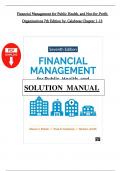
Financial Management For Public, Health, And Not-For-
Profit Organizations Seventh Edition
By Steven A. Finkler All Chapters 1-15
,TABLE OF CONTENTS
part i: introduction: setting the stage
chapter 1: introduction to financial management
part ii: planning
chapter 2: planning for success:
budgeting chapter 3: additional budgeting
concepts chapter 4: understanding costs
chapter 5: capital budgeting
chapter 6: long-term financing
part iii: implementation and controlling results
chapter 7: managing short-term resources and obligations
chapter 8: accountability and control
part iv: reporting results
chapter 9: taking stock of where you are: the balance sheet chapter
10: reporting the results of operations: the activity and cash flow
statements
chapter 11: unique aspects of accounting for not-for-profit
and health-care organizations
chapter 12: unique aspects of accounting for state and local
governments—part i: the recording process
chapter 13: unique aspects of accounting for state and local
governments—part ii: reporting financial results
part v: financial analysis
chapter 14: financial statement analysis
chapter 15: financial condition analysis
, Instructor’s Manual for Financial Management for Public, Health, and Not-for-Profit Organizations1,
2E
INTRODUCTION
Chapter 1
FINANCIAL
questions for discussion
1-1. financial management is the subset of management that focuses on generating financial
information that can improve decisions. the decisions are oriented toward achieving
the various goals of the organization while maintaining a satisfactory financial situation.
financial management encompasses the broad areas of accounting and finance.
1-2. in proprietary, or for-profit, organizations, an underlying goal is to maximize the wealth of
the owners of the organization.
1-3. in public service organizations, decisions are oriented toward achieving the various goals
of the organization while maintaining a satisfactory financial situation.
1-4. accounting is a system for keeping track of the financial status of an organization and the
financial results of its activities. it has often been referred to as the language of business.
the vocabulary used by accounting is the language of nonbusiness organizations as well.
1-5. accounting is subdivided into two major areas: managerial accounting and financial
accounting. managerial accounting relates to generating any financial information that
managers can use to improve the future results of the organization. this includes
techniques designed to generate any financial data that might help managers make more
effective decisions. major aspects of managerial accounting relate to making financial
plans for the organization, implementing those plans, and then working to ensure that
the plans are achieved. some examples of managerial accounting include preparing
annual operating budgets, generating information for use in making major investment
decisions, and providing the data needed to decide whether to buy or lease a major
piece of equipment. financial accounting provides retrospective information. as events
that have financial implications occur they are recorded by the financial accounting
system. from time to time (usually monthly, quarterly, or annually), the recorded data
are summarized and reported to interested users. the users include both internal
managers and people outside the organization. those outsiders include those who have
lent or might lend money to the organization (creditors), those who might sell things
to the
organization (called suppliers or vendors), and other interested parties. these
interested parties may include those with a particular interest in public service
, organizations, such as regulators, legislators, and citizens. financial reports
prOVIDE
Financial Management For Public, Health, And Not-For-
Profit Organizations Seventh Edition
By Steven A. Finkler All Chapters 1-15
,TABLE OF CONTENTS
part i: introduction: setting the stage
chapter 1: introduction to financial management
part ii: planning
chapter 2: planning for success:
budgeting chapter 3: additional budgeting
concepts chapter 4: understanding costs
chapter 5: capital budgeting
chapter 6: long-term financing
part iii: implementation and controlling results
chapter 7: managing short-term resources and obligations
chapter 8: accountability and control
part iv: reporting results
chapter 9: taking stock of where you are: the balance sheet chapter
10: reporting the results of operations: the activity and cash flow
statements
chapter 11: unique aspects of accounting for not-for-profit
and health-care organizations
chapter 12: unique aspects of accounting for state and local
governments—part i: the recording process
chapter 13: unique aspects of accounting for state and local
governments—part ii: reporting financial results
part v: financial analysis
chapter 14: financial statement analysis
chapter 15: financial condition analysis
, Instructor’s Manual for Financial Management for Public, Health, and Not-for-Profit Organizations1,
2E
INTRODUCTION
Chapter 1
FINANCIAL
questions for discussion
1-1. financial management is the subset of management that focuses on generating financial
information that can improve decisions. the decisions are oriented toward achieving
the various goals of the organization while maintaining a satisfactory financial situation.
financial management encompasses the broad areas of accounting and finance.
1-2. in proprietary, or for-profit, organizations, an underlying goal is to maximize the wealth of
the owners of the organization.
1-3. in public service organizations, decisions are oriented toward achieving the various goals
of the organization while maintaining a satisfactory financial situation.
1-4. accounting is a system for keeping track of the financial status of an organization and the
financial results of its activities. it has often been referred to as the language of business.
the vocabulary used by accounting is the language of nonbusiness organizations as well.
1-5. accounting is subdivided into two major areas: managerial accounting and financial
accounting. managerial accounting relates to generating any financial information that
managers can use to improve the future results of the organization. this includes
techniques designed to generate any financial data that might help managers make more
effective decisions. major aspects of managerial accounting relate to making financial
plans for the organization, implementing those plans, and then working to ensure that
the plans are achieved. some examples of managerial accounting include preparing
annual operating budgets, generating information for use in making major investment
decisions, and providing the data needed to decide whether to buy or lease a major
piece of equipment. financial accounting provides retrospective information. as events
that have financial implications occur they are recorded by the financial accounting
system. from time to time (usually monthly, quarterly, or annually), the recorded data
are summarized and reported to interested users. the users include both internal
managers and people outside the organization. those outsiders include those who have
lent or might lend money to the organization (creditors), those who might sell things
to the
organization (called suppliers or vendors), and other interested parties. these
interested parties may include those with a particular interest in public service
, organizations, such as regulators, legislators, and citizens. financial reports
prOVIDE