OWN SUMMARY MARKETING & INNOVATION
Lecture 1
Inertia keep on doing the same thing, absence of change. But, by definition, innovation is
change for the customers, the firm & the firm’s context.
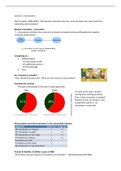
Customer intimacy measure of your awareness of - and alignment with - your customers’
needs and values. “true customer intimacy requires a deep understanding of the context in
which our products and services are used in the course of our customers’ day-to-day lives”
, Lecture 2
The curse of success
Article Subject Results Conclusion
Tripsas (1997) Complementary 3 factors in incumbents’ Even when investments of new
assets and survival: investments, entrants are higher and their
incumbent technological products are superior over the
survival performance, and incumbents’, specialized
specialized complementary assets are of
complementary assets vital importance for market
share
Hillebrand et Customer Customer orientation Proactive stance towards the
al. (2011) orientation and negatively influences market is beneficial for the
future market willingness to cannibalize firm’s innovativeness. Customer
focus on firm (wtc) sales and orientation is beneficial for
innovativeness investments. Future incremental change, but creates
market focus positively inertia for radical, new
influences all three developments.
dimensions of wtc (sales,
routines, investments).
(wtc = willingness to
cannabilize)
WHY WOULD THE NEW TECHNOLOGY SELL AT THIS POINT IN TIME?
- Potential for growth
- Innovative features
- Early adopters
- Marketing and perception
- Niche market needs
- Strategic positioning
WHY LEADING FIRMS FAIL:
- Managerial myopia tendency of managers to focus on short-term goals and
neglect long-term value creation (e.g. “The Beatles have no future in show business”)
- “small markets don’t solve the growth needs of large companies”
- Core capabilities become core rigidities (e.g. Holiday Inn: “20 years ago when you
listened to what customers wanted, they wanted a clean room and not to be surprised.
That fed our brand’s strategy: Ok, let’s make sure it all looks similar.”)
WHY DO INCUMBENTS FAIL? (according to Tripsas)
- Investments in new technology
- Technical capabilities
- Specialized complementary assets
,CANNIBALIZATION
Cannibalization drop in sales and demand for a product when the company replaces it
with a new one (it can occur when a new product is similar to an existing product, and both
share the same customer base) “If anyone is going to cannibalize us, I want it to be us. I don’t
want it to be a competitor (Steve Jobs)
WHY DO FIRMS FAIL?
Firms size itself is not a problem
Incumbents sometimes at a disadvantage
- Being too close to your customer can be harmful
- Current capabilities may hamper success
SOME SOLUTIONS:
Organize according to market requirements
- DEC versus IBM
Be willing to cannibalize
- Focus on understanding current and future customers / current and future customer
needs
- That is: innovation based on in-depth understanding of customer value
Tripsas (1997)
Unraveling the process of creative destruction: complementary assets and incumbent survival
in the typesetter industry
Why do incumbents’ firms sometimes fail drastically in the face of radical technological
change, yet other times survive? Tripsas analyzed the technological and competitive history
of the typesetter industry. During 100 years, the industry has undergone 3 waves of creative
destruction where competence destroying, and architectural technological change
transformed in the industry.
2 CONTRASTING PERSPECTIVES ON PROCESS OF CREATIVE DESTRUCTION:
1) Fluid industries where new entrants innovate with technologically superior products
and displace incumbents’ firms, in repeating cycles
2) Advantages that established firms have over new entrants play a role over potential
technological superiority.
3 CRUCIAL FACTORS THAT INFLUENCE ULTIMATE COMMERCIAL
PERFORMANCE (OF INCUMBENTS AND NEW ENTRANTS):
Investment in developing new technology
, - When innovation is radical incumbents are less incentivized to invest in new
technology. When innovation is incremental incumbents have greater
incentives than new entrants to invest
- Established firms fail to invest in developing radical innovations as a result of their
resource allocation mechanisms (guided by needs of existing customers)
Technical capabilities
Technological progress is characterized as passing through long periods of incremental
innovation punctuated by periods of radical change
- In an incremental period, incumbents have advantage over new entrants, due to the
build up of innovations upon incumbents’ capabilities.
- Core competencies can become core rigidities, which enables new entrants to get an
advantage in a radical competence-destroying technological shift. Established firms
also become more inert to change, which is a disadvantage in the long-term.
Ability to appropriate the benefits of technological innovation through specialized
complementary assets
- Incumbents’ complementary assets (e.g. manufacturing, distribution) influence the
extent to which new entrants hold an (commercial) advantage.
- If a firm has access to specialized complementary assets necessary for exploitation of
an innovation, that firm has a distinct advantage in appropriating the benefits.
They serve as a buffer when firms are faced with competence-destroying technological
change.
determine success in competence-destroying technological change
When complementary assets did not retain their value, new entrants dominated the market,
whereas incumbents whose complementary assets were preserved, maintained a strong market
presence. This is also shown in Tripsas’ market share model in which complementary assets
have a .99 percent in market share, independent from technological disadvantages.
CONCLUSIONS:
- Established firms were handicapped by their prior experience, because their approach
to new product development was shaped by it. They were consistently inferior to those
of new entrants.
- Incumbents did not necessarily suffer commercial consequences as a result of this
technical inferiority. When their specialized complementary assets retained their value,
they were found to buffer incumbents from the effects of competence destruction.
Hillebrand et al. (2010)
Customer orientation and future market focus in NSD (=New Service Development)
Recent studies draw attention to the limitations of close customer ties. This study investigates
the impact of customer orientation and future market focus on firm innovativeness in new
service development
Lecture 1
Inertia keep on doing the same thing, absence of change. But, by definition, innovation is
change for the customers, the firm & the firm’s context.
Customer intimacy measure of your awareness of - and alignment with - your customers’
needs and values. “true customer intimacy requires a deep understanding of the context in
which our products and services are used in the course of our customers’ day-to-day lives”
, Lecture 2
The curse of success
Article Subject Results Conclusion
Tripsas (1997) Complementary 3 factors in incumbents’ Even when investments of new
assets and survival: investments, entrants are higher and their
incumbent technological products are superior over the
survival performance, and incumbents’, specialized
specialized complementary assets are of
complementary assets vital importance for market
share
Hillebrand et Customer Customer orientation Proactive stance towards the
al. (2011) orientation and negatively influences market is beneficial for the
future market willingness to cannibalize firm’s innovativeness. Customer
focus on firm (wtc) sales and orientation is beneficial for
innovativeness investments. Future incremental change, but creates
market focus positively inertia for radical, new
influences all three developments.
dimensions of wtc (sales,
routines, investments).
(wtc = willingness to
cannabilize)
WHY WOULD THE NEW TECHNOLOGY SELL AT THIS POINT IN TIME?
- Potential for growth
- Innovative features
- Early adopters
- Marketing and perception
- Niche market needs
- Strategic positioning
WHY LEADING FIRMS FAIL:
- Managerial myopia tendency of managers to focus on short-term goals and
neglect long-term value creation (e.g. “The Beatles have no future in show business”)
- “small markets don’t solve the growth needs of large companies”
- Core capabilities become core rigidities (e.g. Holiday Inn: “20 years ago when you
listened to what customers wanted, they wanted a clean room and not to be surprised.
That fed our brand’s strategy: Ok, let’s make sure it all looks similar.”)
WHY DO INCUMBENTS FAIL? (according to Tripsas)
- Investments in new technology
- Technical capabilities
- Specialized complementary assets
,CANNIBALIZATION
Cannibalization drop in sales and demand for a product when the company replaces it
with a new one (it can occur when a new product is similar to an existing product, and both
share the same customer base) “If anyone is going to cannibalize us, I want it to be us. I don’t
want it to be a competitor (Steve Jobs)
WHY DO FIRMS FAIL?
Firms size itself is not a problem
Incumbents sometimes at a disadvantage
- Being too close to your customer can be harmful
- Current capabilities may hamper success
SOME SOLUTIONS:
Organize according to market requirements
- DEC versus IBM
Be willing to cannibalize
- Focus on understanding current and future customers / current and future customer
needs
- That is: innovation based on in-depth understanding of customer value
Tripsas (1997)
Unraveling the process of creative destruction: complementary assets and incumbent survival
in the typesetter industry
Why do incumbents’ firms sometimes fail drastically in the face of radical technological
change, yet other times survive? Tripsas analyzed the technological and competitive history
of the typesetter industry. During 100 years, the industry has undergone 3 waves of creative
destruction where competence destroying, and architectural technological change
transformed in the industry.
2 CONTRASTING PERSPECTIVES ON PROCESS OF CREATIVE DESTRUCTION:
1) Fluid industries where new entrants innovate with technologically superior products
and displace incumbents’ firms, in repeating cycles
2) Advantages that established firms have over new entrants play a role over potential
technological superiority.
3 CRUCIAL FACTORS THAT INFLUENCE ULTIMATE COMMERCIAL
PERFORMANCE (OF INCUMBENTS AND NEW ENTRANTS):
Investment in developing new technology
, - When innovation is radical incumbents are less incentivized to invest in new
technology. When innovation is incremental incumbents have greater
incentives than new entrants to invest
- Established firms fail to invest in developing radical innovations as a result of their
resource allocation mechanisms (guided by needs of existing customers)
Technical capabilities
Technological progress is characterized as passing through long periods of incremental
innovation punctuated by periods of radical change
- In an incremental period, incumbents have advantage over new entrants, due to the
build up of innovations upon incumbents’ capabilities.
- Core competencies can become core rigidities, which enables new entrants to get an
advantage in a radical competence-destroying technological shift. Established firms
also become more inert to change, which is a disadvantage in the long-term.
Ability to appropriate the benefits of technological innovation through specialized
complementary assets
- Incumbents’ complementary assets (e.g. manufacturing, distribution) influence the
extent to which new entrants hold an (commercial) advantage.
- If a firm has access to specialized complementary assets necessary for exploitation of
an innovation, that firm has a distinct advantage in appropriating the benefits.
They serve as a buffer when firms are faced with competence-destroying technological
change.
determine success in competence-destroying technological change
When complementary assets did not retain their value, new entrants dominated the market,
whereas incumbents whose complementary assets were preserved, maintained a strong market
presence. This is also shown in Tripsas’ market share model in which complementary assets
have a .99 percent in market share, independent from technological disadvantages.
CONCLUSIONS:
- Established firms were handicapped by their prior experience, because their approach
to new product development was shaped by it. They were consistently inferior to those
of new entrants.
- Incumbents did not necessarily suffer commercial consequences as a result of this
technical inferiority. When their specialized complementary assets retained their value,
they were found to buffer incumbents from the effects of competence destruction.
Hillebrand et al. (2010)
Customer orientation and future market focus in NSD (=New Service Development)
Recent studies draw attention to the limitations of close customer ties. This study investigates
the impact of customer orientation and future market focus on firm innovativeness in new
service development