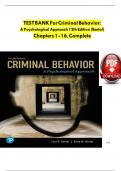
TEST BANK For Criminal Behavior:
A Psychological Approach 12th Edition (Bartol)
Chapters 1 - 16, Complete
110
,Table of contents
1. Introduction to Criminal Behavior
2. Origins of Criminal Behavior: Developmental Risk and Protective Factors
3. Origins of Criminal Behavior: Biological/Neurological Factors
4. Origins of Criminal Behavior: Learning and Situational Factors
5. Human Aggression and Violence
6. Juvenile Delinquency
7. Psychopathy
8. Crime and Mental Disorders
9. Homicide, Assault, and Intimate Partner and Family Violence
10.Multiple Murder, School, and Workplace Violence 11.Psychology
of Modern Terrorism
12. Sexual Assault
13. Sexual Assault of Children and Youth
14. Burglary, Home Invasions, Thefts, and "White-Collar" Offenses
15.Violent Economic Crime, Cybercrime, and Crimes of Intimidation
16. Substance Abuse and Crime
111
,Criminal Behavior: A Psychological Approach, 12e (Bartol)
Chapter 1 Introduction to Criminal Behavior
1.1 Multiple-Choice Questions
1) Criminal behavior is best defined as
A) antisocial behavior.
B) deviant behavior.
C) an intentional act in violation of a criminal code.
D) a failure to impede the criminal process.
ANSWER: C
Page Ref: 2
Objective: Define criminal behavior and juvenile delinquency
Level: Basic
2) The end result of a theory that is not verified is
A) justification.
B) falsification.
C) clarification.
D) subjugation.
ANSWER: B
Page Ref: 6
Objective: Identify the different perspectives of human nature that underlie the theoretical
development and research of criminal behavior
Level: Intermediate
3) Which piece of data would be included in the UCR?
A) A reported robbery with no arrest
B) A reported forgery with no arrest
C) A reported simple assault with no arrest
D) A reported statutory rape with no
arrest ANSWER: A
Page Ref: 36
Objective: Introduce the reader to the various measurements of criminal and delinquent behavior
Level: Difficult
4) All of the following are consistent with the developmental approach to the study of crime
112
, except
A) examining factors that place a child at risk of engaging in serious delinquency.
B) identifying the age of onset of antisocial behavior.
C) searching for protective factors in a child's life.
D) obtaining a child's IQ score as he or she enters adolescence.
ANSWER: D
Page Ref: 13
Objective: Point out that the study of criminal behavior and delinquency, from a psychological
perspective, has shifted from a personality toward a more cognitive and developmental focus
Level: Intermediate
5) According dto dthe dauthors, dour dinability dto dprevent d crime dis dlargely ddue dto dthe
A) declining d interest d in dthe d field dof dcriminology.
B) lack dof davailable dresearch dfunding.
C) complexity dof dthe dissue.
D) difficulty din ddefining drelevant
dterms. d ANSWER: d dC
Page dRef: d3
Objective: dDefine dcriminal dbehavior d and d juvenile
ddelinquency d Level: d dIntermediate
6) After dhearing dthat d her dneighbors' dhome dwas dburglarized, dDee dtold d her dco-worker
dthat dher d neighbors dwere dasking d for dthe dburglary dbecause dthey dnever d locked dtheir
ddoors dand ddidn't d have da d security dsystem. d Dee's dstatements dreflect dthe
A) fairness ddoctrine.
B) self-fulfilling dprophecy.
C) cognition ddistortion.
D) just-world dhypothesis.
d ANSWER: d dD
Page dRef: d5
Objective: dIdentify dthe ddifferent d perspectives dof dhuman dnature dthat dunderlie dthe dtheoretical
d development d and dresearch dof dcriminal dbehavior
Level: d dDifficult
7) Dr. dBrown dis da ddevelopmental dcriminologist. dDr. dBrown's dresearch dmost d likely dexamines
A) demographic d features dof doffenders dwho d participate din dburglary.
B) how dviolent d individuals dlearn dtheir daggressive d behavior.
C) the dunequal dpower ddistribution damong d members dof dsociety.
D) when drobberies dmost dfrequently
doccur. d ANSWER: d dB
113
A Psychological Approach 12th Edition (Bartol)
Chapters 1 - 16, Complete
110
,Table of contents
1. Introduction to Criminal Behavior
2. Origins of Criminal Behavior: Developmental Risk and Protective Factors
3. Origins of Criminal Behavior: Biological/Neurological Factors
4. Origins of Criminal Behavior: Learning and Situational Factors
5. Human Aggression and Violence
6. Juvenile Delinquency
7. Psychopathy
8. Crime and Mental Disorders
9. Homicide, Assault, and Intimate Partner and Family Violence
10.Multiple Murder, School, and Workplace Violence 11.Psychology
of Modern Terrorism
12. Sexual Assault
13. Sexual Assault of Children and Youth
14. Burglary, Home Invasions, Thefts, and "White-Collar" Offenses
15.Violent Economic Crime, Cybercrime, and Crimes of Intimidation
16. Substance Abuse and Crime
111
,Criminal Behavior: A Psychological Approach, 12e (Bartol)
Chapter 1 Introduction to Criminal Behavior
1.1 Multiple-Choice Questions
1) Criminal behavior is best defined as
A) antisocial behavior.
B) deviant behavior.
C) an intentional act in violation of a criminal code.
D) a failure to impede the criminal process.
ANSWER: C
Page Ref: 2
Objective: Define criminal behavior and juvenile delinquency
Level: Basic
2) The end result of a theory that is not verified is
A) justification.
B) falsification.
C) clarification.
D) subjugation.
ANSWER: B
Page Ref: 6
Objective: Identify the different perspectives of human nature that underlie the theoretical
development and research of criminal behavior
Level: Intermediate
3) Which piece of data would be included in the UCR?
A) A reported robbery with no arrest
B) A reported forgery with no arrest
C) A reported simple assault with no arrest
D) A reported statutory rape with no
arrest ANSWER: A
Page Ref: 36
Objective: Introduce the reader to the various measurements of criminal and delinquent behavior
Level: Difficult
4) All of the following are consistent with the developmental approach to the study of crime
112
, except
A) examining factors that place a child at risk of engaging in serious delinquency.
B) identifying the age of onset of antisocial behavior.
C) searching for protective factors in a child's life.
D) obtaining a child's IQ score as he or she enters adolescence.
ANSWER: D
Page Ref: 13
Objective: Point out that the study of criminal behavior and delinquency, from a psychological
perspective, has shifted from a personality toward a more cognitive and developmental focus
Level: Intermediate
5) According dto dthe dauthors, dour dinability dto dprevent d crime dis dlargely ddue dto dthe
A) declining d interest d in dthe d field dof dcriminology.
B) lack dof davailable dresearch dfunding.
C) complexity dof dthe dissue.
D) difficulty din ddefining drelevant
dterms. d ANSWER: d dC
Page dRef: d3
Objective: dDefine dcriminal dbehavior d and d juvenile
ddelinquency d Level: d dIntermediate
6) After dhearing dthat d her dneighbors' dhome dwas dburglarized, dDee dtold d her dco-worker
dthat dher d neighbors dwere dasking d for dthe dburglary dbecause dthey dnever d locked dtheir
ddoors dand ddidn't d have da d security dsystem. d Dee's dstatements dreflect dthe
A) fairness ddoctrine.
B) self-fulfilling dprophecy.
C) cognition ddistortion.
D) just-world dhypothesis.
d ANSWER: d dD
Page dRef: d5
Objective: dIdentify dthe ddifferent d perspectives dof dhuman dnature dthat dunderlie dthe dtheoretical
d development d and dresearch dof dcriminal dbehavior
Level: d dDifficult
7) Dr. dBrown dis da ddevelopmental dcriminologist. dDr. dBrown's dresearch dmost d likely dexamines
A) demographic d features dof doffenders dwho d participate din dburglary.
B) how dviolent d individuals dlearn dtheir daggressive d behavior.
C) the dunequal dpower ddistribution damong d members dof dsociety.
D) when drobberies dmost dfrequently
doccur. d ANSWER: d dB
113