

Question 2: Summary
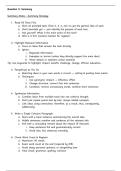
Summary Notes - Summary Strategy
1. Read All Texts First
a. Skim all provided texts (Text 2, 3, 4, etc.) to get the general idea of each.
b. Don’t annotate yet — just identify the purpose of each text.
c. Ask yourself: What is the main point of this text?
d. Who is it for? (context matters for register)
2. Highlight Relevant Information
a. Focus on ideas that answer the task directly.
b. Ignore:
i. Repeated information
ii. Examples or stories (unless they directly support the main idea)
iii. Minor details or statistics unless essential
Tip: Use keywords to highlight: impact, benefit, challenge, change, official, education…
3. Paraphrase as You Go
a. Rewriting ideas in your own words is crucial — cutting & pasting loses marks.
b. Techniques:
i. Use synonyms: impact → influence, effect
ii. Change structure: convert lists into sentences
iii. Condense: remove unnecessary words, combine short sentences
4. Synthesize Information
a. Combine ideas from multiple texts into one cohesive thought.
b. Don’t just repeat points text by text; merge related concepts.
c. Link ideas using connectives: therefore, as a result, thus, consequently,
additionally.
5. Write a Single Cohesive Paragraph
a. Start with a topic sentence summarising the overall idea.
b. Middle sentences combine and condense all the relevant info.
c. End with a concluding remark about the impact (if relevant).
i. Keep sentences full and grammatically correct.
ii. Avoid lists; link sentences smoothly.
6. Check Word Count & Register
a. Maximum: 90 words.
b. Exact word count at the end (required by IEB).
c. Avoid slang, personal opinions, or storytelling tone
d. Final check: grammar, spelling, cohesion
Summary Notes - Summary Strategy
1. Read All Texts First
a. Skim all provided texts (Text 2, 3, 4, etc.) to get the general idea of each.
b. Don’t annotate yet — just identify the purpose of each text.
c. Ask yourself: What is the main point of this text?
d. Who is it for? (context matters for register)
2. Highlight Relevant Information
a. Focus on ideas that answer the task directly.
b. Ignore:
i. Repeated information
ii. Examples or stories (unless they directly support the main idea)
iii. Minor details or statistics unless essential
Tip: Use keywords to highlight: impact, benefit, challenge, change, official, education…
3. Paraphrase as You Go
a. Rewriting ideas in your own words is crucial — cutting & pasting loses marks.
b. Techniques:
i. Use synonyms: impact → influence, effect
ii. Change structure: convert lists into sentences
iii. Condense: remove unnecessary words, combine short sentences
4. Synthesize Information
a. Combine ideas from multiple texts into one cohesive thought.
b. Don’t just repeat points text by text; merge related concepts.
c. Link ideas using connectives: therefore, as a result, thus, consequently,
additionally.
5. Write a Single Cohesive Paragraph
a. Start with a topic sentence summarising the overall idea.
b. Middle sentences combine and condense all the relevant info.
c. End with a concluding remark about the impact (if relevant).
i. Keep sentences full and grammatically correct.
ii. Avoid lists; link sentences smoothly.
6. Check Word Count & Register
a. Maximum: 90 words.
b. Exact word count at the end (required by IEB).
c. Avoid slang, personal opinions, or storytelling tone
d. Final check: grammar, spelling, cohesion

