100% de satisfacción garantizada Inmediatamente disponible después del pago Tanto en línea como en PDF No estas atado a nada 4,6 TrustPilot
logo-home
Examen

Basic EKG Patterns Practice Exam With Correct Answers 100% Verified.

Puntuación
-
Vendido
-
Páginas
16
Grado
A+
Subido en
02-09-2025
Escrito en
2025/2026

Asystole - Which rhythm is this? Atrial fibrillation - Which rhythm is this? Normal sinus rhythm with multifocal PVCs - Which rhythm is this? Normal sinus rhythm with unifocal PVCs - Which rhythm is this? Sinus Tachycardia rhthym - Which rhythm is this? Supraventricular tachycardia - Which rhythm is this? Asystole - Which rhythm is this? bigeminy - Which rhythm is this? Ventricular Fibrillation - Course - Which rhythm is this? Ventricular Fibrillation - Fine - Which rhythm is this? pacemaker rhythm - Which rhythm is this? Sinus bradycardia - Which rhythm is this? Sinus rhythm - Which rhythm is this? Sinus Tachycardia - Which rhythm is this? Atrial fibrillation - Which rhythm is this? Atrial flutter - Which rhythm is this? Paroxysmal tachycardia - Which rhythm is this? don't need to know - Which rhythm is this? PVC (Premature Ventricular Contraction) - Which rhythm is this? Torsades de pointes - Which rhythm is this? Ventricular fibrillation - Which rhythm is this? Ventricular tachycardia - Which rhythm is this? First-degree AV block - Which rhythm is this? Third-degree AV block - Which rhythm is this? Type I second-degree AV block - 1,2,3 drop - Which rhythm is this? 3:1 Type II second-degree AV block - Which rhythm is this? Sinus bradycardia - Which rhythm is this? Supraventricular tachycardia - Which rhythm is this? Unifocal couplet PVCs - Unifocal PVCs - 1. Right Ventricular Hypertrophy Criteria 2. Cause? - RAD - Right Axis Deviation I- AVL + V1 R wave is larger than the S wave V6 S wave is larger than the R wave 2. Pulmonary disease and congenital heart disease 1. Left Ventricular Hypertrophy Criteria - Left axis deviation beyond 15 degrees I + AVL - R wave in V5 or V6 plus S wave V1 or V2 exceeds 35 mm Only really applies to those > 35 yo as chest wall is otherwise too thin Ways to Calculate Rate 1. Rule of 300 (Good for Regular Rhythms) 2. Count the boxes (Good for Fast Rhythms) 3. Rhythm Strip (Good for Irreg Rhythms ) - 1. 300 / Number of Large Squares (0.2 sec) btw R waves 2. - 6-50 7-42 3. Count # of complex on rhythm strip x 6 (gives an average over 10 sec period) 1.When SA nodes stops - what happens 2. Atrial pacemaker rate 3. Junctional pacemaker rate - MOST COMMON 4. Ventricular pacemaker rate - 1. Escape beats - all myocardial cells have ability to behave as pacemakers 2. 60 -75 bpm 3. located near av node - 40-60 4. 30-45 Junctional Escape - often no p waves rate 40-60 bpm Ventricular Escape Beat - wide bizarre QRS / no P wave / Rate about 33 bpm Usually associated with unconsciousness after accelerated fib. PAC - Premature Atrial Contraction what do they look like cause? PJC - Premature Junction Contraction what do they look like? cause? - PAC - normal sinus beat ( p wave - narrow qrs)thrown in but has diff wave morphology suggesting different pacemaker. Re-entrant loop / Increased automaticity - DIGITALIS TOXICITY PJC - No P wave (or retrograde) with narrow QRS ( suggesting ventricles are depolarizing normally - no slowly /wide qrs as with ventricular origin). PSVT 1. Characteristics 2. How to stop it - 1. Absolutely regular rhythm P Waves often lost in qrs or retrograde Qrs usually narrow 2. Carotid Massage slows conduction through av node. Makes body think BP is rising and interrupt Rentrant loop. - gently apply pressure 10-15 sec - ONE SIDE ONLY Atrial Flutter 1 What happens? 2. Cause ? 3. What causes AV Block? 4. What happens with Carotid Massage - 1. atrial depol happens a such a rapid rate - discrete P waves are not seen. Get FLUTTER WAVES (back to back Ps) between QRS --> Sawtooth pattern. 2. Usually single reentrant loop!! 3 Av node can't handle all the impulses - not all pass through. 2:1 block - 2 Ps pass though to every 1 QRS (only 1 P started ventricular depol) 3:1 Block - 3 P waves pass through for every 1 QRS 4 Increases degrees of block (i.e. 2:1 to 4:1 ) - can see saw tooth pattern easier. Atrial Fibrillation 1. What happens? 2. Cause 3. What's EKG look like with regard to P Waves? 4. Why is it IRREGULARLY IRREGULAR?? 5. Most common cause? - 1. Atrial CHAOS!! - av node can be bombarded with >500 atrial impulses/min. 2. Usually due to MULTIPLE RE_ENTRANT LOOPS 3. No true P waves - often undulating base or waves line, sometimes flat. 4. AV node only lets occasional impulse through resulting in irregular QRS rate. IRREG IRREGULAR. 5. Long standing HTN MAT - Multi Focal Atrial Tachycardia 1. cause (cardiac wise) 2. Rhythm? Rate? 3. P waves? 4. Effect of Carotid Massage. - 1. Random firing of several diff atrial foci 2. Irregular Rhythm, usually 100-220 bpm (or less) 3. P waves present for each qrs (at least 3 diff morphologies -represent diff foci firing) 4. Carotid massage has no effect. Rarely requires treatment. Paroxysmal Atrial Tachycardia (PAT) 1. Cardiac causes? 2. What does EKG look like?? 3. How can your discern from PSVT - 1. Enhanced automaticity of ectopic foci (digitalis Toxicity) OR reentrant circuit 2. REGULAR rhythm with rate of 100-200 bpm - may be hard to see P waves 3. Carotid Massage has no effect, may be warm up or cool down period. PreVentricular Contractions (PVC)s 1. what does it look lik

Mostrar más Leer menos
Institución
EKG.
Grado
EKG.


Ups! No podemos cargar tu documento ahora. Inténtalo de nuevo o contacta con soporte.

Escuela, estudio y materia

Institución
EKG.
Grado
EKG.

Información del documento

Subido en
2 de septiembre de 2025
Número de páginas
16
Escrito en
2025/2026
Tipo
Examen
Contiene
Preguntas y respuestas

Temas

Vista previa del contenido

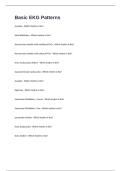
Basic EKG Patterns
Asystole - Which rhythm is this?


Atrial fibrillation - Which rhythm is this?


Normal sinus rhythm with multifocal PVCs - Which rhythm is this?


Normal sinus rhythm with unifocal PVCs - Which rhythm is this?


Sinus Tachycardia rhthym - Which rhythm is this?


Supraventricular tachycardia - Which rhythm is this?


Asystole - Which rhythm is this?


bigeminy - Which rhythm is this?


Ventricular Fibrillation - Course - Which rhythm is this?


Ventricular Fibrillation - Fine - Which rhythm is this?


pacemaker rhythm - Which rhythm is this?


Sinus bradycardia - Which rhythm is this?


Sinus rhythm - Which rhythm is this?

,Sinus Tachycardia - Which rhythm is this?


Atrial fibrillation - Which rhythm is this?


Atrial flutter - Which rhythm is this?


Paroxysmal tachycardia - Which rhythm is this?


don't need to know - Which rhythm is this?


PVC (Premature Ventricular Contraction) - Which rhythm is this?


Torsades de pointes - Which rhythm is this?


Ventricular fibrillation - Which rhythm is this?


Ventricular tachycardia - Which rhythm is this?


First-degree AV block - Which rhythm is this?


Third-degree AV block - Which rhythm is this?


Type I second-degree AV block - 1,2,3 drop - Which rhythm is this?


3:1 Type II second-degree AV block - Which rhythm is this?


Sinus bradycardia - Which rhythm is this?


Supraventricular tachycardia - Which rhythm is this?

, Unifocal couplet PVCs -


Unifocal PVCs -


1. Right Ventricular Hypertrophy Criteria

2. Cause? - RAD - Right Axis Deviation I- AVL +


V1 R wave is larger than the S wave

V6 S wave is larger than the R wave


2. Pulmonary disease and congenital heart disease


1. Left Ventricular Hypertrophy Criteria - Left axis deviation beyond 15 degrees I + AVL -


R wave in V5 or V6 plus S wave V1 or V2 exceeds 35 mm


Only really applies to those > 35 yo as chest wall is otherwise too thin


Ways to Calculate Rate

1. Rule of 300 (Good for Regular Rhythms)

2. Count the boxes (Good for Fast Rhythms)

3. Rhythm Strip (Good for Irreg Rhythms ) - 1. 300 / Number of Large Squares (0.2 sec) btw R waves

2. 1-300 2-150 3-100 4- 75 5-60 6-50 7-42

3. Count # of complex on rhythm strip x 6 (gives an average over 10 sec period)


1.When SA nodes stops - what happens

2. Atrial pacemaker rate

3. Junctional pacemaker rate - MOST COMMON
$15.99
Accede al documento completo:

100% de satisfacción garantizada
Inmediatamente disponible después del pago
Tanto en línea como en PDF
No estas atado a nada


Documento también disponible en un lote

Conoce al vendedor

Seller avatar
Los indicadores de reputación están sujetos a la cantidad de artículos vendidos por una tarifa y las reseñas que ha recibido por esos documentos. Hay tres niveles: Bronce, Plata y Oro. Cuanto mayor reputación, más podrás confiar en la calidad del trabajo del vendedor.
Rechga Nursing
Seguir Necesitas iniciar sesión para seguir a otros usuarios o asignaturas
Vendido
15
Miembro desde
1 año
Número de seguidores
2
Documentos
2232
Última venta
2 semanas hace

5.0

10 reseñas

5
10
4
0
3
0
2
0
1
0

Recientemente visto por ti

Por qué los estudiantes eligen Stuvia

Creado por compañeros estudiantes, verificado por reseñas

Calidad en la que puedes confiar: escrito por estudiantes que aprobaron y evaluado por otros que han usado estos resúmenes.

¿No estás satisfecho? Elige otro documento

¡No te preocupes! Puedes elegir directamente otro documento que se ajuste mejor a lo que buscas.

Paga como quieras, empieza a estudiar al instante

Sin suscripción, sin compromisos. Paga como estés acostumbrado con tarjeta de crédito y descarga tu documento PDF inmediatamente.

Student with book image

“Comprado, descargado y aprobado. Así de fácil puede ser.”

Alisha Student

Preguntas frecuentes