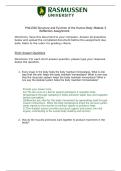
PHA1500 Structure and Function of the Human Body Module 3
Reflection Assignment
Directions: Save this document to your computer. Answer all questions
below and upload the completed document before the assignment due
date. Refer to the rubric for grading criteria.
Short Answer Questions
Directions: For each short answer question, please type your response
below the question.
1. Every organ in the body helps the body maintain homeostasis. What is one
way that the skin helps the body maintain homeostasis? What is one way
that the muscular system helps the body maintain homeostasis? What is
one way the skeletal system helps the body maintain homeostasis?
Provide your answer here.
1A) The skin acts as a barrier against pathogens it regulates body
temperature through sweating it helps prevents water loss and supports
sensor perception.
1B)Muscles are vital for the body movement by generating heat through
muscle contractions. When the body temperature drops the nervous system
sends signals to the muscles to contract rapidly to produce heat.
1C)The skeletal system provides structural support and protect the vital
organs, contributing to the overall body stability and function
2. How do the muscles and bones work together to produce movement in the
body?
, Provide your answer here.
By attaching to each other through the tendons, the muscles contract when
they are signaled by the nervous system, pulling them on the bones and
causing them to move at joints. This allows for a wide range of motion in
the body.
3. In your own words, explain the process of muscle contraction. Be sure to
include what happens between actin and myosin during this process.
Provide your answer here.
Muscle contraction happens when the thin actin filaments in the the muscle
fiber goes past the thicker myosin filaments, this causes the muscle to
shorten.
Drawing Prompts
For each drawing prompt below, take a photo of your hand-drawn image.
Paste the image into the space below the corresponding prompt.
4. Draw a cross section of the skin. Include both the dermis and epidermis.
Include and label each of the following structures:
a. Arrector pili muscle
b. Blood vessels
c. Dermis
d. Epidermis
e. Hair root
Reflection Assignment
Directions: Save this document to your computer. Answer all questions
below and upload the completed document before the assignment due
date. Refer to the rubric for grading criteria.
Short Answer Questions
Directions: For each short answer question, please type your response
below the question.
1. Every organ in the body helps the body maintain homeostasis. What is one
way that the skin helps the body maintain homeostasis? What is one way
that the muscular system helps the body maintain homeostasis? What is
one way the skeletal system helps the body maintain homeostasis?
Provide your answer here.
1A) The skin acts as a barrier against pathogens it regulates body
temperature through sweating it helps prevents water loss and supports
sensor perception.
1B)Muscles are vital for the body movement by generating heat through
muscle contractions. When the body temperature drops the nervous system
sends signals to the muscles to contract rapidly to produce heat.
1C)The skeletal system provides structural support and protect the vital
organs, contributing to the overall body stability and function
2. How do the muscles and bones work together to produce movement in the
body?
, Provide your answer here.
By attaching to each other through the tendons, the muscles contract when
they are signaled by the nervous system, pulling them on the bones and
causing them to move at joints. This allows for a wide range of motion in
the body.
3. In your own words, explain the process of muscle contraction. Be sure to
include what happens between actin and myosin during this process.
Provide your answer here.
Muscle contraction happens when the thin actin filaments in the the muscle
fiber goes past the thicker myosin filaments, this causes the muscle to
shorten.
Drawing Prompts
For each drawing prompt below, take a photo of your hand-drawn image.
Paste the image into the space below the corresponding prompt.
4. Draw a cross section of the skin. Include both the dermis and epidermis.
Include and label each of the following structures:
a. Arrector pili muscle
b. Blood vessels
c. Dermis
d. Epidermis
e. Hair root