Summary – Social Media: Risks & Opportunities – December 9, 2024
Papers
Lecture 2
Pabian, S., De Backer, C.J.S., & Vandebosch, H. (2015). Dark Triad personality traits and
adolescent cyber-aggression
First to study the association between Dark Triad traits (as a combined Dark Triad
cluster) and cyber-aggression among an adolescent population
Cyber-aggression = online aggression (it’s the same!)
Method: Cross-sectional survey among adolescents aged 14-18
Results: 1 out of 3 engaged at least once in the past three months in one or more than
one of the eight cyber-aggression activities
Saying things about someone to make the person a laughing stock was the most
used activity
Followed by sending insulting messages
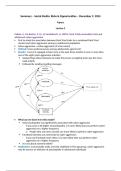
What can we learn from this model?
Only psychopathy was significantly associated with cyber-aggression
- If you score a bit higher of psychopathy, it is more likely that you perform cyber-
aggression on a higher frequency
o People who are more narcistic are more likely to perform cyber-aggression
Facebook intensity was connected to cyber-aggression
- If you use Facebook more often, it is more likely that you perform cyber-
aggression on a higher frequency
It is not about extreme beliefs!
Implication: as personality traits are fairly stabilized in this age group, cyber-aggression
may be used as an indicator of psychopathy in adolescent individuals
, Prevention?
Social perspective-taking skills have been proven successful in overcoming
egocentrism and antisocial behavior
Include training of these skills in prevention programs
Limitations:
Short Dark Triad instrument did not allow to investigate sub-constructs of
Machiavellianism, Narcissism and Psychopathy
More recently: Dark Tetrad ---> sadism as fourth trait
- Sadism = take pleasure out of hurting others
Self-reports: Are children to admit that they enjoy manipulating etc. others in the
school/leisure context?
Take-aways: how to translate these findings into concrete implications remains difficult,
hard to change personality traits (black box)
Might be more informative to focus on determinants of behavior that can be
changed
Pabian, S., & Vandebosch, H. (2014). Using the theory of planned behaviour to understand
cyberbullying: the importance of beliefs for developing interventions
Focus on proximal determinants of cyberbullying
Proximal determinants: more immediate determinants of behavior
Can influence your behavior, but do it through immediate determinants
Received few attentions in previous research
Previously studied in isolation from other proximal determinants
Importance of studying proximal determinants:
Modifiable by interventions
RQs:
Is the Theory of Planned Behavior (TPB) a good framework for explaining
cyberbullying perpetration?
Which are the underlying beliefs of the attitude, subjective norm and perceived
behavioral control?
Behaviors beliefs (A): belief that forms the attitude
Normative beliefs (SN)
Control beliefs (PBC)
, First one is about accepting (injunctive norms), second one is about doing it
(descriptive norms; what you think that others do)
Example behavioral beliefs (A):
Example normative beliefs (SN):
Example control beliefs (PBC):
Method: Two-wave panel study among adolescents aged 11-17 years old
Results: Perpetration CB (at least once in the past 6 months)
11,7% ---> did not change overtime
Predicts cyberbullying 6 months later
, Positive significant relationship between performing cyberbullying & intention
Attitudes (overall beliefs) and subjective norm was positively related to intention
- If you believe that many important people accept/perform cyberbullying, you
will also have a higher intention to perform the cyberbullying behavior
Perceived behavioral control was not related to intention
- This is because everybody thought that it was very easy to perform the behavior
and there is no need for skills
Attitude is based on:
Emotional release: release of emotions (happiness/angriness)
Peer group benefits: if you believe that the behavior will give you bad moral feelings
(guilt), you will be not likely to cyberbully
Moral feelings
Disliked by peers
This model teaches us about:
Relationship between intention & actual behavior
Relationship between attitude & intention to cyberbully
Relationship between subjective norm & intention to cyberbully
Relationship between perceived behavioral control & intention to cyberbully
Which beliefs form the attitude/subjective norm/perceived behavioral control
Pabian, S., & Vandebosch, H. (2019). Perceived long-term outcomes of early traditional
and cyberbullying victimization among emerging adults
It is interesting to see both online and offline, because there was a small amount of
people that were only bullied online, which means that people are often bullied in both
offline and online environments
Method: biographic-narrative interpretive method (BNIM)
Helps you in exploring life histories, lived situations and personal meanings (so for
the whole life)
“Can you share your experience with offline and online bullying and how these
experiences have impacted your life?”
- Only ask 1 question, participant tells their own story and just listen/take notes
Results: victims’ bullying history
Bullying started before the age of 12 years old
Bullied for a long period of time (range 4 to 8 years)
Time lag between last bullying incident and interview
Two broad categories regarding impact:
1. Perceived impact on social interacting today
o Avoiding past triggers/reasons for bullying (e.g., avoid wearing glasses)
o Sharing personal information (e.g., careful with what you share with others)
o Coping with conflicts/aggression/bullying (e.g., avoiding conflicts)
o Bullying alarm (e.g., awareness of others, feeling empowered to do
something about it)
o Friendships (e.g., it is still quite hard to form new relationships with people,
makes them more critical/careful)
Papers
Lecture 2
Pabian, S., De Backer, C.J.S., & Vandebosch, H. (2015). Dark Triad personality traits and
adolescent cyber-aggression
First to study the association between Dark Triad traits (as a combined Dark Triad
cluster) and cyber-aggression among an adolescent population
Cyber-aggression = online aggression (it’s the same!)
Method: Cross-sectional survey among adolescents aged 14-18
Results: 1 out of 3 engaged at least once in the past three months in one or more than
one of the eight cyber-aggression activities
Saying things about someone to make the person a laughing stock was the most
used activity
Followed by sending insulting messages
What can we learn from this model?
Only psychopathy was significantly associated with cyber-aggression
- If you score a bit higher of psychopathy, it is more likely that you perform cyber-
aggression on a higher frequency
o People who are more narcistic are more likely to perform cyber-aggression
Facebook intensity was connected to cyber-aggression
- If you use Facebook more often, it is more likely that you perform cyber-
aggression on a higher frequency
It is not about extreme beliefs!
Implication: as personality traits are fairly stabilized in this age group, cyber-aggression
may be used as an indicator of psychopathy in adolescent individuals
, Prevention?
Social perspective-taking skills have been proven successful in overcoming
egocentrism and antisocial behavior
Include training of these skills in prevention programs
Limitations:
Short Dark Triad instrument did not allow to investigate sub-constructs of
Machiavellianism, Narcissism and Psychopathy
More recently: Dark Tetrad ---> sadism as fourth trait
- Sadism = take pleasure out of hurting others
Self-reports: Are children to admit that they enjoy manipulating etc. others in the
school/leisure context?
Take-aways: how to translate these findings into concrete implications remains difficult,
hard to change personality traits (black box)
Might be more informative to focus on determinants of behavior that can be
changed
Pabian, S., & Vandebosch, H. (2014). Using the theory of planned behaviour to understand
cyberbullying: the importance of beliefs for developing interventions
Focus on proximal determinants of cyberbullying
Proximal determinants: more immediate determinants of behavior
Can influence your behavior, but do it through immediate determinants
Received few attentions in previous research
Previously studied in isolation from other proximal determinants
Importance of studying proximal determinants:
Modifiable by interventions
RQs:
Is the Theory of Planned Behavior (TPB) a good framework for explaining
cyberbullying perpetration?
Which are the underlying beliefs of the attitude, subjective norm and perceived
behavioral control?
Behaviors beliefs (A): belief that forms the attitude
Normative beliefs (SN)
Control beliefs (PBC)
, First one is about accepting (injunctive norms), second one is about doing it
(descriptive norms; what you think that others do)
Example behavioral beliefs (A):
Example normative beliefs (SN):
Example control beliefs (PBC):
Method: Two-wave panel study among adolescents aged 11-17 years old
Results: Perpetration CB (at least once in the past 6 months)
11,7% ---> did not change overtime
Predicts cyberbullying 6 months later
, Positive significant relationship between performing cyberbullying & intention
Attitudes (overall beliefs) and subjective norm was positively related to intention
- If you believe that many important people accept/perform cyberbullying, you
will also have a higher intention to perform the cyberbullying behavior
Perceived behavioral control was not related to intention
- This is because everybody thought that it was very easy to perform the behavior
and there is no need for skills
Attitude is based on:
Emotional release: release of emotions (happiness/angriness)
Peer group benefits: if you believe that the behavior will give you bad moral feelings
(guilt), you will be not likely to cyberbully
Moral feelings
Disliked by peers
This model teaches us about:
Relationship between intention & actual behavior
Relationship between attitude & intention to cyberbully
Relationship between subjective norm & intention to cyberbully
Relationship between perceived behavioral control & intention to cyberbully
Which beliefs form the attitude/subjective norm/perceived behavioral control
Pabian, S., & Vandebosch, H. (2019). Perceived long-term outcomes of early traditional
and cyberbullying victimization among emerging adults
It is interesting to see both online and offline, because there was a small amount of
people that were only bullied online, which means that people are often bullied in both
offline and online environments
Method: biographic-narrative interpretive method (BNIM)
Helps you in exploring life histories, lived situations and personal meanings (so for
the whole life)
“Can you share your experience with offline and online bullying and how these
experiences have impacted your life?”
- Only ask 1 question, participant tells their own story and just listen/take notes
Results: victims’ bullying history
Bullying started before the age of 12 years old
Bullied for a long period of time (range 4 to 8 years)
Time lag between last bullying incident and interview
Two broad categories regarding impact:
1. Perceived impact on social interacting today
o Avoiding past triggers/reasons for bullying (e.g., avoid wearing glasses)
o Sharing personal information (e.g., careful with what you share with others)
o Coping with conflicts/aggression/bullying (e.g., avoiding conflicts)
o Bullying alarm (e.g., awareness of others, feeling empowered to do
something about it)
o Friendships (e.g., it is still quite hard to form new relationships with people,
makes them more critical/careful)