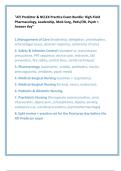
"ATI Predictor & NCLEX Practice Exam Bundle: High-Yield
Pharmacology, Leadership, Med-Surg, Peds/OB, Psych +
Answer Key"
1.Management of Care (leadership, delegation, prioritization,
ethical/legal issues, disaster response, continuity of care)
2. Safety & Infection Control (standard vs. transmission
precautions, PPE sequence, device care, restraints, fall
prevention, fire safety, central lines, sterile technique)
3. Pharmacology (autonomic, cardiac, antibiotics, insulin,
anticoagulants, antidotes, psych meds)
4. Medical-Surgical Nursing I (cardiac + respiratory).
5. Medical-Surgical Nursing II (renal, neuro, endocrine).
6. Pediatric & Obstetric Nursing.
7. Psychiatric Nursing (therapeutic communication, crisis
intervention, depression, schizophrenia, bipolar, anxiety,
substance use, suicide precautions, psychopharmacology)
8. light review + practice set for the final prep day before the
ATI Predictor exam
,Leadership / Delegation (4 items)
Question 1
A charge nurse on a busy medical-surgical unit is making
assignments for the oncoming shift. The team includes one
registered nurse (RN), one licensed practical nurse (LPN), and
one unlicensed assistive personnel (UAP). Which patient is most
appropriate to assign to the LPN?
A. A 45-year-old patient admitted with gastrointestinal bleeding
who has a nasogastric tube to low intermittent suction and
stable vital signs.
B. A 72-year-old patient who is 4 hours post-operative right
total hip arthroplasty requiring frequent neurovascular checks.
C. A 58-year-old patient with new-onset atrial fibrillation who is
awaiting a cardioversion procedure later in the day.
D. An 81-year-old patient with dementia who is exhibiting signs
of delirium and requires constant reorientation.
Topic/Subtopic: Assignment — Matching Staff Competency to
Patient Needs
NCLEX Category: Management of Care / Assignment,
Delegation and Supervision
Cognitive Level: Analysis
Difficulty: 3
Learning Objective: Assign patients to appropriate healthcare
team members based on scope of practice and patient acuity.
Correct Answer: A
Rationale: LPN scope of practice includes monitoring stable
,patients with predictable outcomes and performing procedures
like nasogastric tube irrigation and suction. The patient in
option A is stable with a defined plan of care. Options B, C, and
D require the advanced assessment, critical thinking, and
nursing judgment of an RN due to their high acuity,
unpredictability, and complex psychosocial needs.
Distractor Analysis:
B: Requires frequent, complex RN-level assessment for
potential compartment syndrome or other complications.
C: Requires continuous RN-level monitoring and assessment for
an unstable cardiac rhythm pre-procedure.
D: Requires advanced RN assessment and intervention for acute
confusion in a vulnerable patient.
Test-Taking Tip: Remember that LPNs provide care to stable
patients with predictable outcomes, while RNs manage
unstable patients and those with unpredictable conditions.
Question 2
A registered nurse (RN) is working with an unlicensed assistive
personnel (UAP) on a rehabilitation unit. Which task is within
the scope of practice for the UAP to perform under RN
supervision?
A. Reinforcing teaching on the use of a quad cane for a patient
with left-sided weakness.
B. Assessing a patient's sacral skin for redness after an episode
of incontinence.
, C. Calculating the intake and output for a patient with heart
failure.
D. Applying a prescribed hydrocortisone cream to a patient's
pruritic rash.
Topic/Subtopic: Delegation — UAP Scope of Practice
NCLEX Category: Management of Care / Assignment,
Delegation and Supervision
Cognitive Level: Application
Difficulty: 2
Learning Objective: Identify tasks that are appropriate to
delegate to unlicensed assistive personnel.
Correct Answer: C
Rationale: Measuring and recording intake and output is a
routine, fundamental care task that does not require nursing
judgment and is within the scope of a UAP. Teaching,
assessment, and medication administration are all licensed
nursing functions that cannot be delegated.
Distractor Analysis:
A: Reinforcing teaching requires evaluation of understanding,
which is an RN function.
B: Assessment of skin integrity requires licensed judgment to
identify breakdown or infection.
D: Medication application requires licensed judgment to verify
the correct medication, dose, route, and patient.
Test-Taking Tip: UAPs can perform tasks involving activities of
Pharmacology, Leadership, Med-Surg, Peds/OB, Psych +
Answer Key"
1.Management of Care (leadership, delegation, prioritization,
ethical/legal issues, disaster response, continuity of care)
2. Safety & Infection Control (standard vs. transmission
precautions, PPE sequence, device care, restraints, fall
prevention, fire safety, central lines, sterile technique)
3. Pharmacology (autonomic, cardiac, antibiotics, insulin,
anticoagulants, antidotes, psych meds)
4. Medical-Surgical Nursing I (cardiac + respiratory).
5. Medical-Surgical Nursing II (renal, neuro, endocrine).
6. Pediatric & Obstetric Nursing.
7. Psychiatric Nursing (therapeutic communication, crisis
intervention, depression, schizophrenia, bipolar, anxiety,
substance use, suicide precautions, psychopharmacology)
8. light review + practice set for the final prep day before the
ATI Predictor exam
,Leadership / Delegation (4 items)
Question 1
A charge nurse on a busy medical-surgical unit is making
assignments for the oncoming shift. The team includes one
registered nurse (RN), one licensed practical nurse (LPN), and
one unlicensed assistive personnel (UAP). Which patient is most
appropriate to assign to the LPN?
A. A 45-year-old patient admitted with gastrointestinal bleeding
who has a nasogastric tube to low intermittent suction and
stable vital signs.
B. A 72-year-old patient who is 4 hours post-operative right
total hip arthroplasty requiring frequent neurovascular checks.
C. A 58-year-old patient with new-onset atrial fibrillation who is
awaiting a cardioversion procedure later in the day.
D. An 81-year-old patient with dementia who is exhibiting signs
of delirium and requires constant reorientation.
Topic/Subtopic: Assignment — Matching Staff Competency to
Patient Needs
NCLEX Category: Management of Care / Assignment,
Delegation and Supervision
Cognitive Level: Analysis
Difficulty: 3
Learning Objective: Assign patients to appropriate healthcare
team members based on scope of practice and patient acuity.
Correct Answer: A
Rationale: LPN scope of practice includes monitoring stable
,patients with predictable outcomes and performing procedures
like nasogastric tube irrigation and suction. The patient in
option A is stable with a defined plan of care. Options B, C, and
D require the advanced assessment, critical thinking, and
nursing judgment of an RN due to their high acuity,
unpredictability, and complex psychosocial needs.
Distractor Analysis:
B: Requires frequent, complex RN-level assessment for
potential compartment syndrome or other complications.
C: Requires continuous RN-level monitoring and assessment for
an unstable cardiac rhythm pre-procedure.
D: Requires advanced RN assessment and intervention for acute
confusion in a vulnerable patient.
Test-Taking Tip: Remember that LPNs provide care to stable
patients with predictable outcomes, while RNs manage
unstable patients and those with unpredictable conditions.
Question 2
A registered nurse (RN) is working with an unlicensed assistive
personnel (UAP) on a rehabilitation unit. Which task is within
the scope of practice for the UAP to perform under RN
supervision?
A. Reinforcing teaching on the use of a quad cane for a patient
with left-sided weakness.
B. Assessing a patient's sacral skin for redness after an episode
of incontinence.
, C. Calculating the intake and output for a patient with heart
failure.
D. Applying a prescribed hydrocortisone cream to a patient's
pruritic rash.
Topic/Subtopic: Delegation — UAP Scope of Practice
NCLEX Category: Management of Care / Assignment,
Delegation and Supervision
Cognitive Level: Application
Difficulty: 2
Learning Objective: Identify tasks that are appropriate to
delegate to unlicensed assistive personnel.
Correct Answer: C
Rationale: Measuring and recording intake and output is a
routine, fundamental care task that does not require nursing
judgment and is within the scope of a UAP. Teaching,
assessment, and medication administration are all licensed
nursing functions that cannot be delegated.
Distractor Analysis:
A: Reinforcing teaching requires evaluation of understanding,
which is an RN function.
B: Assessment of skin integrity requires licensed judgment to
identify breakdown or infection.
D: Medication application requires licensed judgment to verify
the correct medication, dose, route, and patient.
Test-Taking Tip: UAPs can perform tasks involving activities of