Unit 2C | Separate to Identify | RESUB Practical Date: 25/1/24
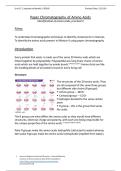
Paper Chromatography of Amino Acids
Identification of amino acids, practical 3
Aims:
To undertake chromatographic techniques to identify components in mixtures.
To identify the amino acids present in Mixture X using paper chromatography.
Introduction
Every protein that exists is made up of the same 20 Amino acids which are
linked together by polypeptide. Polypeptides are long linear chains of amino
acids which are held together by amide bonds.I (Helzner, 2017) Amino Acids are like
the building blocks of all proteins found in every living cell.
Structure:
The structures of the 20 amino acids. They
are all composed of the same three groups
but different side chains (R groups):
▪ Amino group – -NH3+
▪ Carboxyl group – -COO-
▪ Hydrogen-bonded to the same carbon
atom
▪ R group – this is the group that varies
the acids.
1 (BYJUS, n.d.)
The R groups are what differs the amino acids as they would have different
structures, electrical charge and polarity, with each one being responsible for
the unique properties of the amino acids. II (Sigma Aldrich, 2023)
Polar R groups make the amino acids hydrophilic (attracted to water) whereas
Non-polar R groups make the amino acids hydrophobic (repelled from water).
1. Source of diagram: Amino Acid Structure - General Molecular
Structure of Amino Acids (no date) BYJUS. Available at:
https://byjus.com/chemistry/amino-acid-structure/.
(Accessed 29/1/24)
, Unit 2C | Separate to Identify | RESUB Practical Date: 25/1/24
The 20 amino acids are separated into two groups: essential and non-essential.
The essential amino acids are acids which the body cannot make by itself and is
required from certain diets. Non-essential amino acids are acids in which the
body can already produce.
Essential Non-Essential
Isoleucine Alanine
Leucine Asparagine
Methionine Aspartate
Phenylalanine Cysteine
Threonine Glutamate
Tryptophan Glutamine
Valine Glycine
Arginine Proline
Histidine Serine
Lysine Tyrosine
Aspartic Acid:
Aspartic acid is a non-essential amino acid therefore can be produced from
your body. Although it may also be produced from our diets through foods such
as; sugar canes, dairy products and asparagus. It plays a major role in
synthesising proteins and regulating hormones. III (Zoppi, 2020)
Aspartic acid is an alpha amino acid with the formula - C4H7NO4. It has an
acidic side chain.
The R group of aspartic acid is polar so is attracted to eater (hydrophilic).
Leucine:
Leucine is an essential amino acid so is acquired from diets. It can be found in
foods such as; beef, eggs and chicken. It can stimulate protein synthesis and
reduce protein breakdown. Leucine increases the level of insulin in the blood. It
also plays an important role in regulating sugar levels in the blood. IV (Davis, 2019)
Leucine is an alpha amino acid with the formula - C6H13NO2. It has a four-
carbon side chain among the basic amino structure.
Paper Chromatography of Amino Acids
Identification of amino acids, practical 3
Aims:
To undertake chromatographic techniques to identify components in mixtures.
To identify the amino acids present in Mixture X using paper chromatography.
Introduction
Every protein that exists is made up of the same 20 Amino acids which are
linked together by polypeptide. Polypeptides are long linear chains of amino
acids which are held together by amide bonds.I (Helzner, 2017) Amino Acids are like
the building blocks of all proteins found in every living cell.
Structure:
The structures of the 20 amino acids. They
are all composed of the same three groups
but different side chains (R groups):
▪ Amino group – -NH3+
▪ Carboxyl group – -COO-
▪ Hydrogen-bonded to the same carbon
atom
▪ R group – this is the group that varies
the acids.
1 (BYJUS, n.d.)
The R groups are what differs the amino acids as they would have different
structures, electrical charge and polarity, with each one being responsible for
the unique properties of the amino acids. II (Sigma Aldrich, 2023)
Polar R groups make the amino acids hydrophilic (attracted to water) whereas
Non-polar R groups make the amino acids hydrophobic (repelled from water).
1. Source of diagram: Amino Acid Structure - General Molecular
Structure of Amino Acids (no date) BYJUS. Available at:
https://byjus.com/chemistry/amino-acid-structure/.
(Accessed 29/1/24)
, Unit 2C | Separate to Identify | RESUB Practical Date: 25/1/24
The 20 amino acids are separated into two groups: essential and non-essential.
The essential amino acids are acids which the body cannot make by itself and is
required from certain diets. Non-essential amino acids are acids in which the
body can already produce.
Essential Non-Essential
Isoleucine Alanine
Leucine Asparagine
Methionine Aspartate
Phenylalanine Cysteine
Threonine Glutamate
Tryptophan Glutamine
Valine Glycine
Arginine Proline
Histidine Serine
Lysine Tyrosine
Aspartic Acid:
Aspartic acid is a non-essential amino acid therefore can be produced from
your body. Although it may also be produced from our diets through foods such
as; sugar canes, dairy products and asparagus. It plays a major role in
synthesising proteins and regulating hormones. III (Zoppi, 2020)
Aspartic acid is an alpha amino acid with the formula - C4H7NO4. It has an
acidic side chain.
The R group of aspartic acid is polar so is attracted to eater (hydrophilic).
Leucine:
Leucine is an essential amino acid so is acquired from diets. It can be found in
foods such as; beef, eggs and chicken. It can stimulate protein synthesis and
reduce protein breakdown. Leucine increases the level of insulin in the blood. It
also plays an important role in regulating sugar levels in the blood. IV (Davis, 2019)
Leucine is an alpha amino acid with the formula - C6H13NO2. It has a four-
carbon side chain among the basic amino structure.