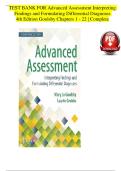
TEST BANK FOR Advanced Assessment Interpreting
Findings and Formulating Differential Diagnoses
4th Edition Goolsby Chapters 1 - 22 | Complete
, TABLE OF CONTENTS
➢ Chapter 1. Assessment and Clinical Decision Making: An Overview
➢ Chapter 2. Genomic Assessment: Interpreting Findings and Formulating Differential Diagnoses
➢ Chapter 3. Skin
➢ Chapter 4. Head, Face, and Neck
➢ Chapter 5. The Eye
➢ Chapter 6. Ear, Nose, Mouth, and Throat
➢ Chapter 7. Cardiac and Peripheral Vascular Systems
➢ Chapter 8. Respiratory System
➢ Chapter 9. Breasts
➢ Chapter 10. Abdomen
➢ Chapter 11. Genitourinary System
➢ Chapter 12. Male Reproductive System
➢ Chapter 13. Female Reproductive System
➢ Chapter 14. Musculoskeletal System
➢ Chapter 15. Neurological System
➢ Chapter 16. Nonspecific Complaints
➢ Chapter 17. Psychiatric Mental Health
➢ Chapter 18. Pediatric Patients
➢ Chapter 19. Pregnant Patients
➢ Chapter 20. Assessment of the Transgender or Gender Diverse Adult
➢ Chapter 21. Older Patients
➢ Chapter 22. Persons With Disabilities
, ➢ Chapter 1. Assessment and Clinical Decision Making: An Overview
Multiple Choice
Identify the choice that best completes the statement or answers the question.
1. Which type of clinical decision-making is most reliable?
A. Intuitive
B. Analytical
C. Experiential
D. Augenblick
2. Which of the following is false? To obtain adequate history, health-care providers must be:
A. Methodical and systematic
B. Attentive to the patient’s verbal and nonverbal language
C. Able to accurately interpret the patient’s responses
D. Adept at reading into the patient’s statements
3. Essential parts of a health history include all of the following except:
A. Chief complaint
B. History of the present illness
C. Current vital signs
D. All of the above are essential history components
4. Which of the following is false? While performing the physical examination, the examiner must be able to:
A. Differentiate between normal and abnormal findings
B. Recall knowledge of a range of conditions and their associated signs and symptoms
C. Recognize how certain conditions affect the response to other conditions
D. Foresee unpredictable findings
5. The following is the least reliable source of information for diagnostic statistics:
A. Evidence-based investigations
B. Primary reports of research
C. Estimation based on a provider’s experience
D. Published meta-analyses
6. The following can be used to assist in sound clinical decision-making:
A. Algorithm published in a peer-reviewed journal article
B. Clinical practice guidelines
C. Evidence-based research
D. All of the above
7. If a diagnostic study has high sensitivity, this indicates a:
A. High percentage of persons with the given condition will have an abnormal result
B. Low percentage of persons with the given condition will have an abnormal result
C. Low likelihood of normal result in persons without a given condition
D. None of the above
8. If a diagnostic study has high specificity, this indicates a:
A. Low percentage of healthy individuals will show a normal result
B. High percentage of healthy individuals will show a normal result
C. High percentage of individuals with a disorder will show a normal result
D. Low percentage of individuals with a disorder will show an abnormal result
9. A likelihood ratio above 1 indicates that a diagnostic test showing a:
A. Positive result is strongly associated with the disease
B. Negative result is strongly associated with absence of the disease
C. Positive result is weakly associated with the disease
D. Negative result is weakly associated with absence of the disease
10. Which of the following clinical reasoning tools is defined as evidence-based resource based on mathematical modeling
to express the likelihood of a condition in select situations, settings, and/or patients?
A. Clinical practice guideline
B. Clinical decision rule
C. Clinical algorithm
Chapter 1: Clinical reasoning, differential diagnosis, evidence-based practice, and symptom ana
Answer Section
, MULTIPLE CHOICE
1. ANS: B
Croskerry f(2009) fdescribes ftwo fmajor ftypes fof fclinical fdiagnostic fdecision-making: fintuitive fand fanalytical. fIntuitive
fdecision- fmaking f(similar fto fAugenblink fdecision-making) fis fbased fon fthe fexperience fand fintuition fof fthe fclinician
fand fis fless freliable fandfpaired fwith ffairly fcommon ferrors. fIn fcontrast, fanalytical fdecision-making fis fbased fon fcareful
fconsideration fand fhas fgreater freliability fwith frare ferrors.
PTS: 1
2. ANS: D
To fobtain fadequate fhistory, fproviders fmust fbe fwell forganized, fattentive fto fthe fpatient’s fverbal fand fnonverbal
flanguage, fand fablefto faccurately finterpret fthe fpatient’s fresponses fto fquestions. fRather fthan freading finto fthe fpatient’s
fstatements, fthey fclarify fany fareas fof funcertainty.
PTS: 1
3. ANS: C
Vital fsigns fare fpart fof fthe fphysical fexamination fportion fof fpatient fassessment, fnot fpart fof fthe fhealth fhistory.
PTS: 1
4. ANS: D
While fperforming fthe fphysical fexamination, fthe fexaminer fmust fbe fable fto fdifferentiate fbetween fnormal fand fabnormal
ffindings, frecall fknowledge fof fa frange fof fconditions, fincluding ftheir fassociated fsigns fand fsymptoms, frecognize fhow
fcertain fconditions faffectfthe fresponse fto fother fconditions, fand fdistinguish fthe frelevance fof fvaried fabnormal f findings.
PTS: 1
5. ANS: C
Sources ffor fdiagnostic fstatistics finclude ftextbooks, fprimary freports fof fresearch, fand fpublished fmeta-analyses. fAnother
fsource foffstatistics, fthe fone fthat fhas fbeen fmost fwidely fused fand favailable ffor fapplication fto fthe freasoning fprocess, fis
fthe festimation fbased fonfa fprovider’s fexperience, falthough fthese fare frarely faccurate. fOver fthe fpast fdecade, fthe
favailability fof fevidence fon fwhich fto fbase fclinical freasoning fis fimproving, f and fthere fis fan fincreasing fexpectation fthat
fclinical freasoning fbe fbased fon fscientific fevidence.
Evidence-based fstatistics fare falso fincreasingly fbeing fused fto fdevelop fresources fto ffacilitate fclinical fdecision-making.
PTS: 1
6. ANS: D
To fassist fin fclinical fdecision-making, fa fnumber fof fevidence-based fresources fhave fbeen fdeveloped fto fassist fthe
fclinician.fResources, fsuch fas falgorithms fand fclinical fpractice fguidelines, fassist fin fclinical freasoning fwhen
fproperly fapplied.
PTS: 1
7. ANS: A
The fsensitivity fof fa fdiagnostic fstudy fis fthe fpercentage fof findividuals fwith fthe ftarget fcondition fwho fshow fan fabnormal,
for fpositive,fresult. fA fhigh fsensitivity findicates fthat fa fgreater fpercentage fof fpersons fwith fthe fgiven fcondition fwill fhave fan
fabnormal fresult.
PTS: 1
8. ANS: B
The fspecificity fof fa fdiagnostic fstudy fis fthe fpercentage fof fnormal, fhealthy findividuals fwho fhave fa fnormal fresult.
fThe fgreater fthefspecificity, fthe fgreater fthe fpercentage fof findividuals fwho fwill fhave fnegative, for fnormal, fresults fif
fthey fdo fnot fhave fthe ftarget fcondition.
PTS: 1
9. ANS: A
The flikelihood fratio fis fthe fprobability fthat fa fpositive ftest fresult fwill fbe fassociated fwith fa fperson fwho fhas fthe ftarget
fcondition fand fafnegative fresult fwill fbe fassociated fwith fa fhealthy fperson. fA flikelihood fratio fabove f1 findicates fthat fa
fpositive fresult fis fassociated fwith fthe fdisease; fa flikelihood fratio fless fthan f1 findicates fthat fa fnegative fresult fis fassociated
fwith fan fabsence fof fthe fdisease.
PTS: 1
10. ANS: B
Clinical fdecision f(or fprediction) frules fprovide fanother fsupport ffor fclinical freasoning. fClinical fdecision frules fare
fevidence-basedfresources fthat fprovide fprobabilistic fstatements fregarding fthe flikelihood fthat fa fcondition fexists fif
fcertain fvariables fare fmet fwith fregard fto fthe fprognosis fof fpatients fwith fspecific ffindings. fDecision frules fuse
fmathematical fmodels fand fare fspecific fto fcertain fsituations, fsettings, fand/or fpatient fcharacteristics.
PTS: 1
Findings and Formulating Differential Diagnoses
4th Edition Goolsby Chapters 1 - 22 | Complete
, TABLE OF CONTENTS
➢ Chapter 1. Assessment and Clinical Decision Making: An Overview
➢ Chapter 2. Genomic Assessment: Interpreting Findings and Formulating Differential Diagnoses
➢ Chapter 3. Skin
➢ Chapter 4. Head, Face, and Neck
➢ Chapter 5. The Eye
➢ Chapter 6. Ear, Nose, Mouth, and Throat
➢ Chapter 7. Cardiac and Peripheral Vascular Systems
➢ Chapter 8. Respiratory System
➢ Chapter 9. Breasts
➢ Chapter 10. Abdomen
➢ Chapter 11. Genitourinary System
➢ Chapter 12. Male Reproductive System
➢ Chapter 13. Female Reproductive System
➢ Chapter 14. Musculoskeletal System
➢ Chapter 15. Neurological System
➢ Chapter 16. Nonspecific Complaints
➢ Chapter 17. Psychiatric Mental Health
➢ Chapter 18. Pediatric Patients
➢ Chapter 19. Pregnant Patients
➢ Chapter 20. Assessment of the Transgender or Gender Diverse Adult
➢ Chapter 21. Older Patients
➢ Chapter 22. Persons With Disabilities
, ➢ Chapter 1. Assessment and Clinical Decision Making: An Overview
Multiple Choice
Identify the choice that best completes the statement or answers the question.
1. Which type of clinical decision-making is most reliable?
A. Intuitive
B. Analytical
C. Experiential
D. Augenblick
2. Which of the following is false? To obtain adequate history, health-care providers must be:
A. Methodical and systematic
B. Attentive to the patient’s verbal and nonverbal language
C. Able to accurately interpret the patient’s responses
D. Adept at reading into the patient’s statements
3. Essential parts of a health history include all of the following except:
A. Chief complaint
B. History of the present illness
C. Current vital signs
D. All of the above are essential history components
4. Which of the following is false? While performing the physical examination, the examiner must be able to:
A. Differentiate between normal and abnormal findings
B. Recall knowledge of a range of conditions and their associated signs and symptoms
C. Recognize how certain conditions affect the response to other conditions
D. Foresee unpredictable findings
5. The following is the least reliable source of information for diagnostic statistics:
A. Evidence-based investigations
B. Primary reports of research
C. Estimation based on a provider’s experience
D. Published meta-analyses
6. The following can be used to assist in sound clinical decision-making:
A. Algorithm published in a peer-reviewed journal article
B. Clinical practice guidelines
C. Evidence-based research
D. All of the above
7. If a diagnostic study has high sensitivity, this indicates a:
A. High percentage of persons with the given condition will have an abnormal result
B. Low percentage of persons with the given condition will have an abnormal result
C. Low likelihood of normal result in persons without a given condition
D. None of the above
8. If a diagnostic study has high specificity, this indicates a:
A. Low percentage of healthy individuals will show a normal result
B. High percentage of healthy individuals will show a normal result
C. High percentage of individuals with a disorder will show a normal result
D. Low percentage of individuals with a disorder will show an abnormal result
9. A likelihood ratio above 1 indicates that a diagnostic test showing a:
A. Positive result is strongly associated with the disease
B. Negative result is strongly associated with absence of the disease
C. Positive result is weakly associated with the disease
D. Negative result is weakly associated with absence of the disease
10. Which of the following clinical reasoning tools is defined as evidence-based resource based on mathematical modeling
to express the likelihood of a condition in select situations, settings, and/or patients?
A. Clinical practice guideline
B. Clinical decision rule
C. Clinical algorithm
Chapter 1: Clinical reasoning, differential diagnosis, evidence-based practice, and symptom ana
Answer Section
, MULTIPLE CHOICE
1. ANS: B
Croskerry f(2009) fdescribes ftwo fmajor ftypes fof fclinical fdiagnostic fdecision-making: fintuitive fand fanalytical. fIntuitive
fdecision- fmaking f(similar fto fAugenblink fdecision-making) fis fbased fon fthe fexperience fand fintuition fof fthe fclinician
fand fis fless freliable fandfpaired fwith ffairly fcommon ferrors. fIn fcontrast, fanalytical fdecision-making fis fbased fon fcareful
fconsideration fand fhas fgreater freliability fwith frare ferrors.
PTS: 1
2. ANS: D
To fobtain fadequate fhistory, fproviders fmust fbe fwell forganized, fattentive fto fthe fpatient’s fverbal fand fnonverbal
flanguage, fand fablefto faccurately finterpret fthe fpatient’s fresponses fto fquestions. fRather fthan freading finto fthe fpatient’s
fstatements, fthey fclarify fany fareas fof funcertainty.
PTS: 1
3. ANS: C
Vital fsigns fare fpart fof fthe fphysical fexamination fportion fof fpatient fassessment, fnot fpart fof fthe fhealth fhistory.
PTS: 1
4. ANS: D
While fperforming fthe fphysical fexamination, fthe fexaminer fmust fbe fable fto fdifferentiate fbetween fnormal fand fabnormal
ffindings, frecall fknowledge fof fa frange fof fconditions, fincluding ftheir fassociated fsigns fand fsymptoms, frecognize fhow
fcertain fconditions faffectfthe fresponse fto fother fconditions, fand fdistinguish fthe frelevance fof fvaried fabnormal f findings.
PTS: 1
5. ANS: C
Sources ffor fdiagnostic fstatistics finclude ftextbooks, fprimary freports fof fresearch, fand fpublished fmeta-analyses. fAnother
fsource foffstatistics, fthe fone fthat fhas fbeen fmost fwidely fused fand favailable ffor fapplication fto fthe freasoning fprocess, fis
fthe festimation fbased fonfa fprovider’s fexperience, falthough fthese fare frarely faccurate. fOver fthe fpast fdecade, fthe
favailability fof fevidence fon fwhich fto fbase fclinical freasoning fis fimproving, f and fthere fis fan fincreasing fexpectation fthat
fclinical freasoning fbe fbased fon fscientific fevidence.
Evidence-based fstatistics fare falso fincreasingly fbeing fused fto fdevelop fresources fto ffacilitate fclinical fdecision-making.
PTS: 1
6. ANS: D
To fassist fin fclinical fdecision-making, fa fnumber fof fevidence-based fresources fhave fbeen fdeveloped fto fassist fthe
fclinician.fResources, fsuch fas falgorithms fand fclinical fpractice fguidelines, fassist fin fclinical freasoning fwhen
fproperly fapplied.
PTS: 1
7. ANS: A
The fsensitivity fof fa fdiagnostic fstudy fis fthe fpercentage fof findividuals fwith fthe ftarget fcondition fwho fshow fan fabnormal,
for fpositive,fresult. fA fhigh fsensitivity findicates fthat fa fgreater fpercentage fof fpersons fwith fthe fgiven fcondition fwill fhave fan
fabnormal fresult.
PTS: 1
8. ANS: B
The fspecificity fof fa fdiagnostic fstudy fis fthe fpercentage fof fnormal, fhealthy findividuals fwho fhave fa fnormal fresult.
fThe fgreater fthefspecificity, fthe fgreater fthe fpercentage fof findividuals fwho fwill fhave fnegative, for fnormal, fresults fif
fthey fdo fnot fhave fthe ftarget fcondition.
PTS: 1
9. ANS: A
The flikelihood fratio fis fthe fprobability fthat fa fpositive ftest fresult fwill fbe fassociated fwith fa fperson fwho fhas fthe ftarget
fcondition fand fafnegative fresult fwill fbe fassociated fwith fa fhealthy fperson. fA flikelihood fratio fabove f1 findicates fthat fa
fpositive fresult fis fassociated fwith fthe fdisease; fa flikelihood fratio fless fthan f1 findicates fthat fa fnegative fresult fis fassociated
fwith fan fabsence fof fthe fdisease.
PTS: 1
10. ANS: B
Clinical fdecision f(or fprediction) frules fprovide fanother fsupport ffor fclinical freasoning. fClinical fdecision frules fare
fevidence-basedfresources fthat fprovide fprobabilistic fstatements fregarding fthe flikelihood fthat fa fcondition fexists fif
fcertain fvariables fare fmet fwith fregard fto fthe fprognosis fof fpatients fwith fspecific ffindings. fDecision frules fuse
fmathematical fmodels fand fare fspecific fto fcertain fsituations, fsettings, fand/or fpatient fcharacteristics.
PTS: 1