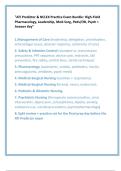
"ATI Predictor & NCLEX Practice Exam Bundle: High-Yield
Pharmacology, Leadership, Med-Surg, Peds/OB, Psych +
Answer Key"
1.Management of Care (leadership, delegation, prioritization,
ethical/legal issues, disaster response, continuity of care)
2. Safety & Infection Control (standard vs. transmission
precautions, PPE sequence, device care, restraints, fall
prevention, fire safety, central lines, sterile technique)
3. Pharmacology (autonomic, cardiac, antibiotics, insulin,
anticoagulants, antidotes, psych meds)
4. Medical-Surgical Nursing I (cardiac + respiratory).
5. Medical-Surgical Nursing II (renal, neuro, endocrine).
6. Pediatric & Obstetric Nursing.
7. Psychiatric Nursing (therapeutic communication, crisis
intervention, depression, schizophrenia, bipolar, anxiety,
substance use, suicide precautions, psychopharmacology)
8. light review + practice set for the final prep day before the
ATI Predictor exam
,1 (Leadership / Delegation — MCQ)
Vignette: A 62-year-old male on a medical-surgical unit (med-
surg) with COPD is receiving oxygen 2 L/min via nasal cannula.
Vitals: RR 22, SpO₂ 92% on 2 L, HR 86, BP 132/76. The unit
charge nurse must assign staff for the afternoon: RN (newly
orienting to unit), experienced RN, LPN (licensed practical
nurse), and UAP (unlicensed assistive personnel). Which task is
most appropriate to assign to the UAP?
A. Teach inhaler technique to the patient.
B. Assist the patient to the bathroom and provide ambulation
assistance.
C. Administer the scheduled albuterol nebulizer treatment.
D. Perform head-to-toe assessment and update the care plan.
Metadata:
Topic/subtopic: Delegation — UAP tasks
NCLEX Client Needs Category & Subcategory: Management of
Care — Assignment/Delegation
Cognitive level (Bloom): Application
Difficulty (1–5): 1
Learning objective: Choose the safe, appropriate task to
delegate to a UAP for a stable med-surg patient.
Answer: B
Rationale (correct — 54 words): Assisting with toileting and
ambulation is within UAP scope when the patient is stable; it
,supports activities of daily living and safety. Teaching,
medication administration, and head-to-toe assessments
require nursing judgment or licensure and must be done by an
RN or LPN as allowed by state scope-of-practice rules.
Incorrect option explanations:
A. Teaching inhaler technique requires nursing education and
evaluation — RN responsibility.
C. Administering nebulized bronchodilators is a licensed nursing
task.
D. Head-to-toe assessment and care plan updates require
nursing judgment and documentation.
Test-taking tip: Delegate routine ADLs and stable patient care
tasks to UAPs; keep assessments and interventions that require
judgment for licensed staff.
2 (Leadership / Delegation — SATA) (Select all that apply — 2
correct)
Vignette: A 44-year-old postoperative client (laparoscopic
cholecystectomy) on the med-surg unit is 12 hours post-op,
stable, pain 4/10 on oral analgesic. The RN needs to allocate
tasks among team members: experienced RN, newly orienting
RN, LPN, and UAP. Which tasks may be delegated to the LPN?
(Select all that apply.) (2 correct)
A. Provide wound dressing change using a prescribed sterile
technique.
, B. Initiate teaching for discharge activity restrictions.
C. Administer scheduled oral pain medication and document
response.
D. Complete initial postoperative head-to-toe nursing
assessment.
Metadata:
Topic/subtopic: Delegation — LPN scope
NCLEX Client Needs Category & Subcategory: Management of
Care — Assignment/Delegation
Cognitive level (Bloom): Application
Difficulty (1–5): 2
Learning objective: Identify appropriate LPN tasks for a stable
postoperative patient.
Answer: A, C
Rationale (correct — 57 words): LPNs commonly perform
focused procedures (wound dressing changes) and administer
and document routine medications under RN supervision per
facility policy. Initiating comprehensive discharge teaching and
performing initial head-to-toe assessments require RN
education and assessment skills; these involve independent
nursing judgment and are not routinely delegated to LPNs.
Incorrect option explanations:
B. Discharge teaching is a comprehensive RN responsibility.
D. Initial comprehensive assessment requires RN critical
thinking and planning.
Pharmacology, Leadership, Med-Surg, Peds/OB, Psych +
Answer Key"
1.Management of Care (leadership, delegation, prioritization,
ethical/legal issues, disaster response, continuity of care)
2. Safety & Infection Control (standard vs. transmission
precautions, PPE sequence, device care, restraints, fall
prevention, fire safety, central lines, sterile technique)
3. Pharmacology (autonomic, cardiac, antibiotics, insulin,
anticoagulants, antidotes, psych meds)
4. Medical-Surgical Nursing I (cardiac + respiratory).
5. Medical-Surgical Nursing II (renal, neuro, endocrine).
6. Pediatric & Obstetric Nursing.
7. Psychiatric Nursing (therapeutic communication, crisis
intervention, depression, schizophrenia, bipolar, anxiety,
substance use, suicide precautions, psychopharmacology)
8. light review + practice set for the final prep day before the
ATI Predictor exam
,1 (Leadership / Delegation — MCQ)
Vignette: A 62-year-old male on a medical-surgical unit (med-
surg) with COPD is receiving oxygen 2 L/min via nasal cannula.
Vitals: RR 22, SpO₂ 92% on 2 L, HR 86, BP 132/76. The unit
charge nurse must assign staff for the afternoon: RN (newly
orienting to unit), experienced RN, LPN (licensed practical
nurse), and UAP (unlicensed assistive personnel). Which task is
most appropriate to assign to the UAP?
A. Teach inhaler technique to the patient.
B. Assist the patient to the bathroom and provide ambulation
assistance.
C. Administer the scheduled albuterol nebulizer treatment.
D. Perform head-to-toe assessment and update the care plan.
Metadata:
Topic/subtopic: Delegation — UAP tasks
NCLEX Client Needs Category & Subcategory: Management of
Care — Assignment/Delegation
Cognitive level (Bloom): Application
Difficulty (1–5): 1
Learning objective: Choose the safe, appropriate task to
delegate to a UAP for a stable med-surg patient.
Answer: B
Rationale (correct — 54 words): Assisting with toileting and
ambulation is within UAP scope when the patient is stable; it
,supports activities of daily living and safety. Teaching,
medication administration, and head-to-toe assessments
require nursing judgment or licensure and must be done by an
RN or LPN as allowed by state scope-of-practice rules.
Incorrect option explanations:
A. Teaching inhaler technique requires nursing education and
evaluation — RN responsibility.
C. Administering nebulized bronchodilators is a licensed nursing
task.
D. Head-to-toe assessment and care plan updates require
nursing judgment and documentation.
Test-taking tip: Delegate routine ADLs and stable patient care
tasks to UAPs; keep assessments and interventions that require
judgment for licensed staff.
2 (Leadership / Delegation — SATA) (Select all that apply — 2
correct)
Vignette: A 44-year-old postoperative client (laparoscopic
cholecystectomy) on the med-surg unit is 12 hours post-op,
stable, pain 4/10 on oral analgesic. The RN needs to allocate
tasks among team members: experienced RN, newly orienting
RN, LPN, and UAP. Which tasks may be delegated to the LPN?
(Select all that apply.) (2 correct)
A. Provide wound dressing change using a prescribed sterile
technique.
, B. Initiate teaching for discharge activity restrictions.
C. Administer scheduled oral pain medication and document
response.
D. Complete initial postoperative head-to-toe nursing
assessment.
Metadata:
Topic/subtopic: Delegation — LPN scope
NCLEX Client Needs Category & Subcategory: Management of
Care — Assignment/Delegation
Cognitive level (Bloom): Application
Difficulty (1–5): 2
Learning objective: Identify appropriate LPN tasks for a stable
postoperative patient.
Answer: A, C
Rationale (correct — 57 words): LPNs commonly perform
focused procedures (wound dressing changes) and administer
and document routine medications under RN supervision per
facility policy. Initiating comprehensive discharge teaching and
performing initial head-to-toe assessments require RN
education and assessment skills; these involve independent
nursing judgment and are not routinely delegated to LPNs.
Incorrect option explanations:
B. Discharge teaching is a comprehensive RN responsibility.
D. Initial comprehensive assessment requires RN critical
thinking and planning.