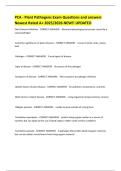
PCA PLANT PATHOGENS Exam 2025 UPDATE PRACTICE
QUESTIONS AND CORRECT VERIFIED ANSWERS(complete
solutions) ASSURED SUCCESS
Biotic factors of plant disease - CORRECT ANSWER-Living organisms (fungi,
| | | | | | | | |
bacteria, viruses)
| |
Obligate parasite - CORRECT ANSWER-unable to grow outside of a living host
| | | | | | | | | | |
Facultative saprophyte - CORRECT ANSWER-prefers living organic matter as a
| | | | | | | | |
source of nutrition but can adapt to the use of dead organic matter under certain
| | | | | | | | | | | | | | |
conditions
|
Facultative parasite - CORRECT ANSWER-A pathogen that prefers dead
| | | | | | | |
inorganic material, but can also obtain nourishment from living organic material
| | | | | | | | | | |
Biotroph - CORRECT ANSWER-Any parasite that cannot survive in a dead host and
| | | | | | | | | | | |
therefore keeps it alive
| | | |
Necrotroph - CORRECT ANSWER-Parasite that kills host cells
| | | | | | |
,Koch's Postulates - CORRECT ANSWER-series of guidelines used to identify the
| | | | | | | | | |
microorganism that causes a specific disease
| | | | | |
Plant Disease Definition - CORRECT ANSWER-Abnormal physiological processes
| | | | | | |
caused by a causal pathogen
| | | | |
Economic significance of plant diseases - CORRECT ANSWER-Losses of yield,
| | | | | | | | |
crops, inputs, land
| | |
Pathogen - CORRECT ANSWER-Causal agent of disease
| | | | | |
Signs of disease - CORRECT ANSWER-Structures of the pathogen
| | | | | | | |
Symptoms of disease - CORRECT ANSWER-Plant response to pathogen infection
| | | | | | | | |
Abiotic factors of plant disease - CORRECT ANSWER-Air pollution, temperature,
| | | | | | | | |
nutrients
|
Three components of disease triangle - CORRECT ANSWER-Causal agent,
| | | | | | | |
environment, host
| |
Role of each component of disease triangle - CORRECT ANSWER-All three must
| | | | | | | | | | |
be present for disease to occur. Environment must favor causal agent. Host
| | | | | | | | | | | |
must favor causal agent.
| | | |
,How humans impact each component of disease triangle - CORRECT ANSWER-
| | | | | | | | | |
Manipulate the environment, host-plant resistance,
| | | | |
preventative/suppressive/erradicative pesticides
| |
Impact of epidemic when one component of disease triangle does not come into
| | | | | | | | | | | |
|contact with the other two components - CORRECT ANSWER-Slows epidemic to
| | | | | | | | | |
|a halt. Disease spread needs all three components interacting
| | | | | | | |
Management strategy to break environment component - CORRECT ANSWER-
| | | | | | | |
Alter planting dates, remove alternative hosts, alter harvest
| | | | | | |
Management strategy to break host component - CORRECT ANSWER-Alternate
| | | | | | | |
crop, host-plant resistance
| | |
Management strategy to break causal agent component - CORRECT ANSWER-
| | | | | | | | |
Pesticide applications |
How can knowledge of plant disease triangle be used in diagnosis? - CORRECT
| | | | | | | | | | | |
ANSWER-Can rule out different pathogens based on host and environment.
| | | | | | | | | |
Epidemiology - CORRECT ANSWER-Branch of medical science concerned with
| | | | | | | |
the incidence, distribution, and control of diseases that affect large numbers
| | | | | | | | | | |
of people.
| |
, Environmental factors that affect epidemics - CORRECT ANSWER-Temperature,
| | | | | | |
humidity, moisture, soil pH, nutrient availability, air movement
| | | | | | | |
Importance of time in the development of an epidemic - CORRECT ANSWER-
| | | | | | | | | | |
Epidemics develop very quickly if conditions are favorable. It is critical to reduce
| | | | | | | | | | | | |
|the rate of infection during susceptible life stages of the plant
| | | | | | | | | |
How does type of reproduction cycle affect development of an epidemic -
| | | | | | | | | | |
CORRECT ANSWER-Polycyclic epidemics can develop much more rapidly than
| | | | | | | | |
monocyclic epidemics because of secondary inoculum production.
| | | | | | |
How does dissemination affect development of an epidemic - CORRECT
| | | | | | | | |
ANSWER-Conditions that increase dissemination will accelerate development
| | | | | | |
of epidemics
| |
Monocyclic disease - CORRECT ANSWER-Disease that only has a primary
| | | | | | | | |
infection cycle
| |
Polycyclic disease - CORRECT ANSWER-Disease that produces a secondary
| | | | | | | |
inoculum, and has a secondary infection cycle in addition to a primary infection
| | | | | | | | | | | | |
cycle
|
Why are monocyclic diseases less likely to result in serious epidemics? -
| | | | | | | | | | |
CORRECT ANSWER-Controlling primary inoculum is much easier than controlling
| | | | | | | | |
QUESTIONS AND CORRECT VERIFIED ANSWERS(complete
solutions) ASSURED SUCCESS
Biotic factors of plant disease - CORRECT ANSWER-Living organisms (fungi,
| | | | | | | | |
bacteria, viruses)
| |
Obligate parasite - CORRECT ANSWER-unable to grow outside of a living host
| | | | | | | | | | |
Facultative saprophyte - CORRECT ANSWER-prefers living organic matter as a
| | | | | | | | |
source of nutrition but can adapt to the use of dead organic matter under certain
| | | | | | | | | | | | | | |
conditions
|
Facultative parasite - CORRECT ANSWER-A pathogen that prefers dead
| | | | | | | |
inorganic material, but can also obtain nourishment from living organic material
| | | | | | | | | | |
Biotroph - CORRECT ANSWER-Any parasite that cannot survive in a dead host and
| | | | | | | | | | | |
therefore keeps it alive
| | | |
Necrotroph - CORRECT ANSWER-Parasite that kills host cells
| | | | | | |
,Koch's Postulates - CORRECT ANSWER-series of guidelines used to identify the
| | | | | | | | | |
microorganism that causes a specific disease
| | | | | |
Plant Disease Definition - CORRECT ANSWER-Abnormal physiological processes
| | | | | | |
caused by a causal pathogen
| | | | |
Economic significance of plant diseases - CORRECT ANSWER-Losses of yield,
| | | | | | | | |
crops, inputs, land
| | |
Pathogen - CORRECT ANSWER-Causal agent of disease
| | | | | |
Signs of disease - CORRECT ANSWER-Structures of the pathogen
| | | | | | | |
Symptoms of disease - CORRECT ANSWER-Plant response to pathogen infection
| | | | | | | | |
Abiotic factors of plant disease - CORRECT ANSWER-Air pollution, temperature,
| | | | | | | | |
nutrients
|
Three components of disease triangle - CORRECT ANSWER-Causal agent,
| | | | | | | |
environment, host
| |
Role of each component of disease triangle - CORRECT ANSWER-All three must
| | | | | | | | | | |
be present for disease to occur. Environment must favor causal agent. Host
| | | | | | | | | | | |
must favor causal agent.
| | | |
,How humans impact each component of disease triangle - CORRECT ANSWER-
| | | | | | | | | |
Manipulate the environment, host-plant resistance,
| | | | |
preventative/suppressive/erradicative pesticides
| |
Impact of epidemic when one component of disease triangle does not come into
| | | | | | | | | | | |
|contact with the other two components - CORRECT ANSWER-Slows epidemic to
| | | | | | | | | |
|a halt. Disease spread needs all three components interacting
| | | | | | | |
Management strategy to break environment component - CORRECT ANSWER-
| | | | | | | |
Alter planting dates, remove alternative hosts, alter harvest
| | | | | | |
Management strategy to break host component - CORRECT ANSWER-Alternate
| | | | | | | |
crop, host-plant resistance
| | |
Management strategy to break causal agent component - CORRECT ANSWER-
| | | | | | | | |
Pesticide applications |
How can knowledge of plant disease triangle be used in diagnosis? - CORRECT
| | | | | | | | | | | |
ANSWER-Can rule out different pathogens based on host and environment.
| | | | | | | | | |
Epidemiology - CORRECT ANSWER-Branch of medical science concerned with
| | | | | | | |
the incidence, distribution, and control of diseases that affect large numbers
| | | | | | | | | | |
of people.
| |
, Environmental factors that affect epidemics - CORRECT ANSWER-Temperature,
| | | | | | |
humidity, moisture, soil pH, nutrient availability, air movement
| | | | | | | |
Importance of time in the development of an epidemic - CORRECT ANSWER-
| | | | | | | | | | |
Epidemics develop very quickly if conditions are favorable. It is critical to reduce
| | | | | | | | | | | | |
|the rate of infection during susceptible life stages of the plant
| | | | | | | | | |
How does type of reproduction cycle affect development of an epidemic -
| | | | | | | | | | |
CORRECT ANSWER-Polycyclic epidemics can develop much more rapidly than
| | | | | | | | |
monocyclic epidemics because of secondary inoculum production.
| | | | | | |
How does dissemination affect development of an epidemic - CORRECT
| | | | | | | | |
ANSWER-Conditions that increase dissemination will accelerate development
| | | | | | |
of epidemics
| |
Monocyclic disease - CORRECT ANSWER-Disease that only has a primary
| | | | | | | | |
infection cycle
| |
Polycyclic disease - CORRECT ANSWER-Disease that produces a secondary
| | | | | | | |
inoculum, and has a secondary infection cycle in addition to a primary infection
| | | | | | | | | | | | |
cycle
|
Why are monocyclic diseases less likely to result in serious epidemics? -
| | | | | | | | | | |
CORRECT ANSWER-Controlling primary inoculum is much easier than controlling
| | | | | | | | |