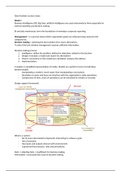
Data Analytics Lecture notes
Week 1
Business Intelligence (BI), Big Data, artificial intelligence are used extensively by firms especially for
internal reporting and decision making.
BI and data warehouses form the foundation of nowadays corporate reporting.
Management = is a process about which organization goals are achieved using resources the
company has.
Decision making = selecting the best solution from more alternatives.
To select the best solution management requires sufficient information.
Decision making process:
1. Intelligence: define the problem, define the objectives related to the decision.
2. Design: formulate a model and search for alternatives
3. Choice: conclusions to the models are calculated, analyses the options.
4. Implementation.
A model is a simplified representation of reality. Models are useful for tests of small ideas.
benefit models:
- manipulating a model is much easier than manipulating a real system.
- Simulation is easier and does not interface with the organization’s daily operations.
- Compression of time, years of operations can be simulated in minutes or seconds.
Design support framework:
What is a system:
- Set of more interrelated components interacting to achieve a goal;
- Has a boundary;
- Has inputs and outputs interact with environment;
- Is governed by processes, rules and procedures.
Data = collecting facts > insufficient for decision making.
Information = processed data used in decision making.
,Concept of decision support systems: interactive computer based systems, which help decision
making utilize data and models to solve unstructured problems.
SQL = structured query language.
Is the basic language to retrieve data, and it is the most popular program.
Two types of systems:
1. Management Information systems;
2. Decision Support systems.
What is a system: a set of two or more interrelated components interacting with each other to
achieve a goal. A system had boundaries, inputs and outputs and interacts with its environment. A
system is governed by processes, rules and procedures.
Examples for components: software, computers, technological platforms and the human who is
making the decision.
Input = data
output = information
interacts with its environment: the data often comes from other information systems.
Data: are facts that are collected, recorded, stored and processed. Insufficient for decision making.
Information: is processed data used in decision making.
Concept of Decision Support Systems (DSS): Interactive computer based systems, which helps
decision makers utilize data and models to solve unstructured problems. It couples the intellectual
resources of individuals with the computational capabilities of the computer to improve the quality
of decisions. Primarily emerged from signs.
Evolution of Decision Support Systems:
Business Intelligence (BI): is an evolution of decision support concepts over time.
Before: executive Information System (EIS/DSS). Mainly designed in order to support top
management.
Now: Everybody’s information system (BI). They can be used by a much broader variety of people
within a organization.
BI systems are enhanced with additional visualizations, alerts, and performance measurement
capabilities. BI combines architectures, tools, databases, analytics tools. Primarily emerged from
industry.
,DSS and BI have in common that they easy enable access to data (and models), and then business
managers are able to analyze it.
BI Architecture, a BI system has four major components:
- A data warehouse with its source data;
- Business analytics: a collection of tools of manipulating, mining and analyzing data;
- Business performance management (BPM) capabilities for monitoring and analyzing
performance;
- A user interface (dashboard).
Differences between DSS and BI
Business Analytics: is a combination of computer technology, management science techniques,
statistics and they are used to solve problems.
We usually differentiate between three types of analytics:
1. Descriptive analytics: is about what happened in the past or about what is happening right
now. So they are part of business reporting, represented as dashboards in scorecards, and it
relies on data warehousing. Primarily used in order to address well defined business
problems and opportunities.
2. Predictive analytics: looks into the future. So it answers questions like what will happen? and
why will it happen? And it uses some techniques like text mining, data mining and
forecasting. The objective is to make projections about future stage and conditions.
3. Prescriptive analytics: this is also looking into the future, and tries to give the decision maker
some guidance on what to do, and why. It uses techniques like optimization, stimulation and
decision modelling. The objective is to find the best possible business decision and
transactions.
, An alternative classification is this strategy who has a fourth type:
Big Data: refers to the growing availability of information in general.
Quite often it is referred to the three V’s. So Big Data is the information asset characterized by such a
high volume, velocity, and variety to require specific technology and analytical methods for its
transformation into value.
What makes Big Data difficult to traditional data is:
1. The volume: we mean volume which is so big that we cannot easily process it with our
traditional database tools. So we need some new techniques to work with it.
2. Velocity: refers to the speed of accumulation of this data. (example with Facebook where a
lot of data comes to the server every day)
3. Variety: when we look at the traditional data storage this was primarily designed in order to
store high structured data. We now see that the majority of the data that is generated is not
really structured. (example of unstructured data is videos or voice recordings). So you cannot
analyze the unstructured data with the same tools as you use for structured data. So Big Data
rely varieties to the data that we have seen before.
Data scientist: a high-ranked professional with the training and curiosity to make discoveries in the
world of big data.
Difference between Business Intelligence and Data Science:
Week 1
Business Intelligence (BI), Big Data, artificial intelligence are used extensively by firms especially for
internal reporting and decision making.
BI and data warehouses form the foundation of nowadays corporate reporting.
Management = is a process about which organization goals are achieved using resources the
company has.
Decision making = selecting the best solution from more alternatives.
To select the best solution management requires sufficient information.
Decision making process:
1. Intelligence: define the problem, define the objectives related to the decision.
2. Design: formulate a model and search for alternatives
3. Choice: conclusions to the models are calculated, analyses the options.
4. Implementation.
A model is a simplified representation of reality. Models are useful for tests of small ideas.
benefit models:
- manipulating a model is much easier than manipulating a real system.
- Simulation is easier and does not interface with the organization’s daily operations.
- Compression of time, years of operations can be simulated in minutes or seconds.
Design support framework:
What is a system:
- Set of more interrelated components interacting to achieve a goal;
- Has a boundary;
- Has inputs and outputs interact with environment;
- Is governed by processes, rules and procedures.
Data = collecting facts > insufficient for decision making.
Information = processed data used in decision making.
,Concept of decision support systems: interactive computer based systems, which help decision
making utilize data and models to solve unstructured problems.
SQL = structured query language.
Is the basic language to retrieve data, and it is the most popular program.
Two types of systems:
1. Management Information systems;
2. Decision Support systems.
What is a system: a set of two or more interrelated components interacting with each other to
achieve a goal. A system had boundaries, inputs and outputs and interacts with its environment. A
system is governed by processes, rules and procedures.
Examples for components: software, computers, technological platforms and the human who is
making the decision.
Input = data
output = information
interacts with its environment: the data often comes from other information systems.
Data: are facts that are collected, recorded, stored and processed. Insufficient for decision making.
Information: is processed data used in decision making.
Concept of Decision Support Systems (DSS): Interactive computer based systems, which helps
decision makers utilize data and models to solve unstructured problems. It couples the intellectual
resources of individuals with the computational capabilities of the computer to improve the quality
of decisions. Primarily emerged from signs.
Evolution of Decision Support Systems:
Business Intelligence (BI): is an evolution of decision support concepts over time.
Before: executive Information System (EIS/DSS). Mainly designed in order to support top
management.
Now: Everybody’s information system (BI). They can be used by a much broader variety of people
within a organization.
BI systems are enhanced with additional visualizations, alerts, and performance measurement
capabilities. BI combines architectures, tools, databases, analytics tools. Primarily emerged from
industry.
,DSS and BI have in common that they easy enable access to data (and models), and then business
managers are able to analyze it.
BI Architecture, a BI system has four major components:
- A data warehouse with its source data;
- Business analytics: a collection of tools of manipulating, mining and analyzing data;
- Business performance management (BPM) capabilities for monitoring and analyzing
performance;
- A user interface (dashboard).
Differences between DSS and BI
Business Analytics: is a combination of computer technology, management science techniques,
statistics and they are used to solve problems.
We usually differentiate between three types of analytics:
1. Descriptive analytics: is about what happened in the past or about what is happening right
now. So they are part of business reporting, represented as dashboards in scorecards, and it
relies on data warehousing. Primarily used in order to address well defined business
problems and opportunities.
2. Predictive analytics: looks into the future. So it answers questions like what will happen? and
why will it happen? And it uses some techniques like text mining, data mining and
forecasting. The objective is to make projections about future stage and conditions.
3. Prescriptive analytics: this is also looking into the future, and tries to give the decision maker
some guidance on what to do, and why. It uses techniques like optimization, stimulation and
decision modelling. The objective is to find the best possible business decision and
transactions.
, An alternative classification is this strategy who has a fourth type:
Big Data: refers to the growing availability of information in general.
Quite often it is referred to the three V’s. So Big Data is the information asset characterized by such a
high volume, velocity, and variety to require specific technology and analytical methods for its
transformation into value.
What makes Big Data difficult to traditional data is:
1. The volume: we mean volume which is so big that we cannot easily process it with our
traditional database tools. So we need some new techniques to work with it.
2. Velocity: refers to the speed of accumulation of this data. (example with Facebook where a
lot of data comes to the server every day)
3. Variety: when we look at the traditional data storage this was primarily designed in order to
store high structured data. We now see that the majority of the data that is generated is not
really structured. (example of unstructured data is videos or voice recordings). So you cannot
analyze the unstructured data with the same tools as you use for structured data. So Big Data
rely varieties to the data that we have seen before.
Data scientist: a high-ranked professional with the training and curiosity to make discoveries in the
world of big data.
Difference between Business Intelligence and Data Science: