

AS Mechanics:
General:
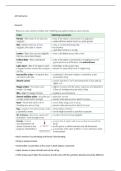
= Rod is tension if accelerating and thrust if decelerating
= String is always tension
= Inextensible: acceleration is the same in both objects connected
= Light: tension is same at both ends of the string
= If the string wasn’t light, the tensions at both ends with the particles attached would be different
, = If the pulley is smooth, this means there is no friction between it and the string. Tension is the
same on both sides of it
= If the pulley is smooth and attached to the end of an inclined plane, the tension will be the same
on both sides of it
= Static means it is unmoving
= Rough means there’s friction against the object (vice versa for smooth)
= Rigid means something cannot be bent. It doesn’t change when forces act on it
= If something is modelled as a particle, it means it doesn’t face air resistance
= Lamina is a 2D object that’s flat and thin
= Beam or a rod is a thin, straight, rigid body
= A wire is inextensible and thin
= You can derive the SUVAT equations from the velocity-time graph. E.g., work out distance under
curve between velocities u and v at t to work out displacement, work out gradient of the velocity
curve by doing (v – u)/t to work out gradient etc. You can rearrange velocity here to get t = (v-u)/a.
Sub this into s = (u + v)/2 * t to get v 2 = u2 + 2as. To get s, you can change v into u + at in the s
equation and rearrange to get s in terms of u and t. To get s in terms of v and t, sub u = v – at into this
equation.
= If you want to derive without the graph, Just remember that v = integral of a. Use initial conditions
t = 0, u = 0 to get v = u + at. S = integral of v. Use initial conditions t = 0, s = 0 to get s = ut + ½(a)(t) 1/2
= If the question asks about justifying a restriction on the values to something, identify the value of
the something at the end boundaries of the domain of values and the behaviour of the thing
between this range.
= ALWAYS give direction of vector quantities. E.g., if you get negative velocity -1 ms -1 at point C,
when the particle was moving from A to B to C, you have to say its velocity at C is 1 ms -1 in the
direction BA. Specifying a velocity needs a speed and direction
= ALWAYS label the starting point in the question (when t=0) and all other relevant information
associated with it
= ‘In the third second of motion’ means between t = 2 and t = 3
= Negative deceleration is acceleration. If the question just asked for negative deceleration, don’t
include the negative sign in front.
= Always specify the type of resistance. E.g., if it’s about projectile motion, mention how there’s air
resistance
= If there’s a plane, resolve forces/speed etc. parallel to the plane
= If a bead is smooth and threaded on a light extensible string, the tension in the string will be the
same on either side of the bead
= If the question asks you to work out how your answer changes if something else changes, calculate
your answer with the condition accounted for and see your answer
General:
= Rod is tension if accelerating and thrust if decelerating
= String is always tension
= Inextensible: acceleration is the same in both objects connected
= Light: tension is same at both ends of the string
= If the string wasn’t light, the tensions at both ends with the particles attached would be different
, = If the pulley is smooth, this means there is no friction between it and the string. Tension is the
same on both sides of it
= If the pulley is smooth and attached to the end of an inclined plane, the tension will be the same
on both sides of it
= Static means it is unmoving
= Rough means there’s friction against the object (vice versa for smooth)
= Rigid means something cannot be bent. It doesn’t change when forces act on it
= If something is modelled as a particle, it means it doesn’t face air resistance
= Lamina is a 2D object that’s flat and thin
= Beam or a rod is a thin, straight, rigid body
= A wire is inextensible and thin
= You can derive the SUVAT equations from the velocity-time graph. E.g., work out distance under
curve between velocities u and v at t to work out displacement, work out gradient of the velocity
curve by doing (v – u)/t to work out gradient etc. You can rearrange velocity here to get t = (v-u)/a.
Sub this into s = (u + v)/2 * t to get v 2 = u2 + 2as. To get s, you can change v into u + at in the s
equation and rearrange to get s in terms of u and t. To get s in terms of v and t, sub u = v – at into this
equation.
= If you want to derive without the graph, Just remember that v = integral of a. Use initial conditions
t = 0, u = 0 to get v = u + at. S = integral of v. Use initial conditions t = 0, s = 0 to get s = ut + ½(a)(t) 1/2
= If the question asks about justifying a restriction on the values to something, identify the value of
the something at the end boundaries of the domain of values and the behaviour of the thing
between this range.
= ALWAYS give direction of vector quantities. E.g., if you get negative velocity -1 ms -1 at point C,
when the particle was moving from A to B to C, you have to say its velocity at C is 1 ms -1 in the
direction BA. Specifying a velocity needs a speed and direction
= ALWAYS label the starting point in the question (when t=0) and all other relevant information
associated with it
= ‘In the third second of motion’ means between t = 2 and t = 3
= Negative deceleration is acceleration. If the question just asked for negative deceleration, don’t
include the negative sign in front.
= Always specify the type of resistance. E.g., if it’s about projectile motion, mention how there’s air
resistance
= If there’s a plane, resolve forces/speed etc. parallel to the plane
= If a bead is smooth and threaded on a light extensible string, the tension in the string will be the
same on either side of the bead
= If the question asks you to work out how your answer changes if something else changes, calculate
your answer with the condition accounted for and see your answer

