Infoskills Test
Module A: Understanding information
Popular, Professional & Scholary sources
Key differences:
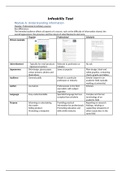
The intended audience affects all aspects of a source, such as the difficulty of information shared, the
overall appearance, the presence and the nature of advertisements and more.
Popular Professional Scholarly
Picture example
Advertisement - Typically for retail products Relevant to profession or No ads
- Sponsored content industry
Appearance Slick design, glossy paper, Same as popular Plain design, black and
colour pictures, photos and white graphics, containing
illustrations charts, graphs and tables.
Audience General public People in a particular Scholar (expert in an
profession or industry academic field, typically
working at university)
Author Journalists Professionals in the field Scholars
Journalists with subject
expertise
Language Easy understandable Specialist language but less Complex and formal
complex than scholarly terminology of an
academic field
Purpose Informing or entertaining Providing practical Reporting on research
the reader information for professionals findings, refuting or
Selling product Promoting education and supporting viewpoints of
Promoting a viewpoint skills within industry other researchers in the
same field
, Formally published sources
Formally published sources (`mainstream publications`) come from a commercial or scholarly
publisher. This type of source is widely available, from bookstores, libraries, supermarkets or
newsstands.
E-books/books (aimed at different target groups):
- Popular books
- Professional/trade books
- Scholarly books
Periodicals (which are published reguraly):
- Popular periodicals
o Newspapers
o Magazines, which may cover serious topics
- Professional/trade periodicals => journals or magazines
- Scholarly periodicals => Journals
Quality of formally published sources?
- Popular & professional sources
o Popular sources vary greatly in quality.
o Professional sources are generally considered credible, but not quite as authoritative
as scholarly sources
- Scholarly sources
o Scholarly journals and books are by far the most authoritative, because quality
control standards in scholarly publishing -> maximum quality and credibility.
Scholarly journal articles have been jugjed by experts in the field prior to
publication (peer review)
Scholarly books are subjected ti a rigorous process of editorial review as well
Published by university presses and recognozed scholarly publishers
Informally published sources
Informally published sources are produced by organizations whose primary activity is NOT publishing.
In other words, these sources are not tied to or controlled by established publishers, who seek profit
on the research or information produced.
Informally published sources come from:
- Universities
- Government departments or agencies
- Non-governmental organizations (NGO`s)
- Research institutes
- Think tanks (research institute providing advice and ideas on specific political or economic
problems)
- Foundations
- Business and industry
- Professional/scholarly associations (organizations that promote a profession/academic
discipline)
Module A: Understanding information
Popular, Professional & Scholary sources
Key differences:
The intended audience affects all aspects of a source, such as the difficulty of information shared, the
overall appearance, the presence and the nature of advertisements and more.
Popular Professional Scholarly
Picture example
Advertisement - Typically for retail products Relevant to profession or No ads
- Sponsored content industry
Appearance Slick design, glossy paper, Same as popular Plain design, black and
colour pictures, photos and white graphics, containing
illustrations charts, graphs and tables.
Audience General public People in a particular Scholar (expert in an
profession or industry academic field, typically
working at university)
Author Journalists Professionals in the field Scholars
Journalists with subject
expertise
Language Easy understandable Specialist language but less Complex and formal
complex than scholarly terminology of an
academic field
Purpose Informing or entertaining Providing practical Reporting on research
the reader information for professionals findings, refuting or
Selling product Promoting education and supporting viewpoints of
Promoting a viewpoint skills within industry other researchers in the
same field
, Formally published sources
Formally published sources (`mainstream publications`) come from a commercial or scholarly
publisher. This type of source is widely available, from bookstores, libraries, supermarkets or
newsstands.
E-books/books (aimed at different target groups):
- Popular books
- Professional/trade books
- Scholarly books
Periodicals (which are published reguraly):
- Popular periodicals
o Newspapers
o Magazines, which may cover serious topics
- Professional/trade periodicals => journals or magazines
- Scholarly periodicals => Journals
Quality of formally published sources?
- Popular & professional sources
o Popular sources vary greatly in quality.
o Professional sources are generally considered credible, but not quite as authoritative
as scholarly sources
- Scholarly sources
o Scholarly journals and books are by far the most authoritative, because quality
control standards in scholarly publishing -> maximum quality and credibility.
Scholarly journal articles have been jugjed by experts in the field prior to
publication (peer review)
Scholarly books are subjected ti a rigorous process of editorial review as well
Published by university presses and recognozed scholarly publishers
Informally published sources
Informally published sources are produced by organizations whose primary activity is NOT publishing.
In other words, these sources are not tied to or controlled by established publishers, who seek profit
on the research or information produced.
Informally published sources come from:
- Universities
- Government departments or agencies
- Non-governmental organizations (NGO`s)
- Research institutes
- Think tanks (research institute providing advice and ideas on specific political or economic
problems)
- Foundations
- Business and industry
- Professional/scholarly associations (organizations that promote a profession/academic
discipline)