Nora is an immature, naïve, imprudent person who, according to
Christine, “(knows) so little of the burdens and troubles of life”.
Write why you agree with either statement based on your reading of
Act 1 (only). Use evidence from the text.
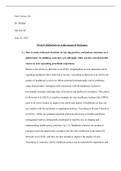
In Henrik Ibsen’s A Doll’s House, Nora is initially portrayed as an immature
and naïve character, described by Christine as someone who “knows so little
of the burdens and troubles of life.” Throughout the play, her actions and
dialogue demonstrate a lack of understanding of financial matters. This is
particularly evident in the beginning of Act 1, where she frivolously spends
money and indulges in materialistic pleasures, believing her husband Torvald
will always provide for her. She gets excited over Torvald’s “heaps and heaps
of money,” and suggests they can “borrow until then” when he reveals his
salary doesn’t come out until a quarter later. Her dialogue highlights her
simple thinking towards the subject matters revolving money. What’s more,
her decision to forge her father’s signature to secure the loan for Torvald’s
medical treatment also highlights her imprudence. While her actions stem
from a desire to save her husband, she doesn’t fully understand the legal or
ethical implications of her forgery. She says, “Is it imprudent to save your
husband’s life?,” revealing her simplistic view of morality and legality.
However, as the play progresses, Nora’s character is revealed to be more
complex than she initially appears. Although she is portrayed as an
imprudent person through her frivolous spending and lack of financial
responsibility, her orchestrated plan to hide the loan from Torvald reveals
that she is, in some ways, prudent. Towards the end of Act 1, when Krogstad
visits and Torvald questions if anyone has been at the house, Nora quickly
deflects his suspicion by bringing up the upcoming costume ball and
discussing the tarantella dance she plans to perform. This use of the
tarantella becomes a recurring method of distraction, as in Act 2, Nora uses
it again to delay Torvald from Krogstad’s letter. When Torvald heads toward
the mailbox, Nora frantically insists on practicing the dance, pleading with
phrases such as “I can’t get on a bit without you to help me; I have
absolutely forgotten the whole thing (p47),” and “I can’t dance tomorrow if I
don’t practice with you now. (p48)” The repetition of “I can’t” emphasizes
her supposed helplessness, which she knows will appeal to Torvald’s sense of
authority and draw his attention entirely to her needs. Moreover, tying the
practice directly to the success of the next day’s performance creaets a false
Christine, “(knows) so little of the burdens and troubles of life”.
Write why you agree with either statement based on your reading of
Act 1 (only). Use evidence from the text.
In Henrik Ibsen’s A Doll’s House, Nora is initially portrayed as an immature
and naïve character, described by Christine as someone who “knows so little
of the burdens and troubles of life.” Throughout the play, her actions and
dialogue demonstrate a lack of understanding of financial matters. This is
particularly evident in the beginning of Act 1, where she frivolously spends
money and indulges in materialistic pleasures, believing her husband Torvald
will always provide for her. She gets excited over Torvald’s “heaps and heaps
of money,” and suggests they can “borrow until then” when he reveals his
salary doesn’t come out until a quarter later. Her dialogue highlights her
simple thinking towards the subject matters revolving money. What’s more,
her decision to forge her father’s signature to secure the loan for Torvald’s
medical treatment also highlights her imprudence. While her actions stem
from a desire to save her husband, she doesn’t fully understand the legal or
ethical implications of her forgery. She says, “Is it imprudent to save your
husband’s life?,” revealing her simplistic view of morality and legality.
However, as the play progresses, Nora’s character is revealed to be more
complex than she initially appears. Although she is portrayed as an
imprudent person through her frivolous spending and lack of financial
responsibility, her orchestrated plan to hide the loan from Torvald reveals
that she is, in some ways, prudent. Towards the end of Act 1, when Krogstad
visits and Torvald questions if anyone has been at the house, Nora quickly
deflects his suspicion by bringing up the upcoming costume ball and
discussing the tarantella dance she plans to perform. This use of the
tarantella becomes a recurring method of distraction, as in Act 2, Nora uses
it again to delay Torvald from Krogstad’s letter. When Torvald heads toward
the mailbox, Nora frantically insists on practicing the dance, pleading with
phrases such as “I can’t get on a bit without you to help me; I have
absolutely forgotten the whole thing (p47),” and “I can’t dance tomorrow if I
don’t practice with you now. (p48)” The repetition of “I can’t” emphasizes
her supposed helplessness, which she knows will appeal to Torvald’s sense of
authority and draw his attention entirely to her needs. Moreover, tying the
practice directly to the success of the next day’s performance creaets a false