A proposed model for effective negotiation skill development
Introduction. Bendersky and McGinn, 2010; Lax and Sebenius, 1986). Weingart et al. (1990,
p. 7) go as far as to say that negotiation research has drawn significant attention “because the
topic has direct relevance to the development of managerial skills.”
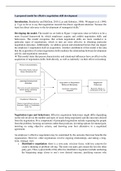
Developing the model. The model we set forth in Figure 1 represents what we believe to be a
more focused framework by which employees acquire and exhibit negotiation skills and
behaviours. The model recognizes that certain negotiation skills are more conducive to
particular types of negotiations, which in turn are more effective in obtaining particular
negotiation outcomes. Additionally, we address person and situational factors that can impact
the employee’s negotiation skill set acquisition. Another contribution of this model is the idea
that the acquisition of certain negotiation skills mediates the relationship between development
activity and negotiation outcomes.
→ This model states that person characteristics and situational influences have an effect on the
acquisition of negotiation skills, both directly, as well as indirectly via their effect on learning.
Negotiation types and behaviours. Effective negotiation behaviours might differ depending
on the role involved, the number and types of issues being negotiated, and the outcomes desired
from the negotiation. Five components of principled negotiation include separating the people
from the problem, focusing on interests rather than positions, inventing options for mutual gain,
insisting on using objective criteria, and knowing your best alternative to a negotiated
agreement.
An employee’s effective negotiation may be constituted by the outcome that most benefits the
organization. However, other negotiations involve ongoing relationships, and taking a long-
term, strategic view.
• Distributive negotiation: there is a zero-sum, win-lose focus, with less concern for
creative thinking or problem solving. The more one party gets means the less the other
party gets. Thus, typical skills of the effective distributive negotiator include anchoring
the bargaining range closer to one’s own desired outcome, justifying reasons why
, his/her offer is reasonable, and emphasizing advantages held over the other party.
Distributive negotiations are aimed at maximizing one’s own gains, is focussed on the
short term, and is based on people taking positions. Strategically, negotiators in
distributive contexts should calculate a resistance point, set goals, and make ambitious
opening offers.
• Integrative negotiations: the integrative negotiator is geared toward looking for
opportunities for mutual gain. In order to accomplish their objectives, effective
integrative negotiators will exhibit skills such as asking questions of the other party to
uncover their interests (rather than discussing positions) and priorities, identifying trade-
offs and making multi-issue offers, and building trust through a problem-solving
approach aimed at creating satisfactory outcomes for both parties. These negotiations
require greater information exchange due to multiple issues being negotiated. Multiple
issues are involved, and the primary focus is on finding an optimal configuration of
those issues. Resources have differing values to each part. In order for parties to feel
good about sharing information, trust is helpful in reducing the risk that shared
information will be used for distributive ends. Building effective relationships with
counterparts facilitates this trust. Thus, integrative negotiations are more characterized
by concern for relationships.
It is important to note that organizations need to discern which skills correlate to the outcomes
they desire. A distributive strategy should be used by the party that has the upper hand and has
no intention of doing future business with the other party. An integrative strategy is appropriate
when the other party has the upper hand and future business, or a continued relationship is
desired.
In practice, most negotiations are neither purely integrative nor purely distributive but are
“mixed-motive”. Being adaptable sometimes being called upon to negotiate distributive and to
negotiate integrative at other times, recognizing which is called for in a given situation. This
adaptive skill set is most difficult to learn.
Negotiation learning and development experiences. Our model is focused on skill
acquisition, which we believe is most saliently manifested through actual behaviour, not just
knowing the correct behaviour. In other words, we do not adopt the cognitivist approach to
learning where an individual knows the effective negotiation behaviour; we adopt the
behaviourist approach where an individual exhibits learning by actually performing the
effective behaviours in actual negotiation contexts. Additionally, we rely heavily on social and
situational learning as support for the effectiveness of particular learning activities, such as
observational and experiential learning as well as mentoring.
Negotiation skill sets fall along a continuum of complexity, where distributive skills will require
the least development, integrative skills will require more development, and adaptable skills
will require the greatest development.
Didactic learning (principles based, textbook learning), information revelation(revealing the
“ideal” strategy based on the other party’s interests and outcomes from previous negotiations),
analogical learning (drawing parallels from a well-understood domain to a novel problem),
and observational learning (modelling others ’behaviours). Analogical learning and
observational learning led to both parties obtaining more favourable outcomes in a negotiation
compared to the other two learning styles. The analogies, or connections, encourage employees
Introduction. Bendersky and McGinn, 2010; Lax and Sebenius, 1986). Weingart et al. (1990,
p. 7) go as far as to say that negotiation research has drawn significant attention “because the
topic has direct relevance to the development of managerial skills.”
Developing the model. The model we set forth in Figure 1 represents what we believe to be a
more focused framework by which employees acquire and exhibit negotiation skills and
behaviours. The model recognizes that certain negotiation skills are more conducive to
particular types of negotiations, which in turn are more effective in obtaining particular
negotiation outcomes. Additionally, we address person and situational factors that can impact
the employee’s negotiation skill set acquisition. Another contribution of this model is the idea
that the acquisition of certain negotiation skills mediates the relationship between development
activity and negotiation outcomes.
→ This model states that person characteristics and situational influences have an effect on the
acquisition of negotiation skills, both directly, as well as indirectly via their effect on learning.
Negotiation types and behaviours. Effective negotiation behaviours might differ depending
on the role involved, the number and types of issues being negotiated, and the outcomes desired
from the negotiation. Five components of principled negotiation include separating the people
from the problem, focusing on interests rather than positions, inventing options for mutual gain,
insisting on using objective criteria, and knowing your best alternative to a negotiated
agreement.
An employee’s effective negotiation may be constituted by the outcome that most benefits the
organization. However, other negotiations involve ongoing relationships, and taking a long-
term, strategic view.
• Distributive negotiation: there is a zero-sum, win-lose focus, with less concern for
creative thinking or problem solving. The more one party gets means the less the other
party gets. Thus, typical skills of the effective distributive negotiator include anchoring
the bargaining range closer to one’s own desired outcome, justifying reasons why
, his/her offer is reasonable, and emphasizing advantages held over the other party.
Distributive negotiations are aimed at maximizing one’s own gains, is focussed on the
short term, and is based on people taking positions. Strategically, negotiators in
distributive contexts should calculate a resistance point, set goals, and make ambitious
opening offers.
• Integrative negotiations: the integrative negotiator is geared toward looking for
opportunities for mutual gain. In order to accomplish their objectives, effective
integrative negotiators will exhibit skills such as asking questions of the other party to
uncover their interests (rather than discussing positions) and priorities, identifying trade-
offs and making multi-issue offers, and building trust through a problem-solving
approach aimed at creating satisfactory outcomes for both parties. These negotiations
require greater information exchange due to multiple issues being negotiated. Multiple
issues are involved, and the primary focus is on finding an optimal configuration of
those issues. Resources have differing values to each part. In order for parties to feel
good about sharing information, trust is helpful in reducing the risk that shared
information will be used for distributive ends. Building effective relationships with
counterparts facilitates this trust. Thus, integrative negotiations are more characterized
by concern for relationships.
It is important to note that organizations need to discern which skills correlate to the outcomes
they desire. A distributive strategy should be used by the party that has the upper hand and has
no intention of doing future business with the other party. An integrative strategy is appropriate
when the other party has the upper hand and future business, or a continued relationship is
desired.
In practice, most negotiations are neither purely integrative nor purely distributive but are
“mixed-motive”. Being adaptable sometimes being called upon to negotiate distributive and to
negotiate integrative at other times, recognizing which is called for in a given situation. This
adaptive skill set is most difficult to learn.
Negotiation learning and development experiences. Our model is focused on skill
acquisition, which we believe is most saliently manifested through actual behaviour, not just
knowing the correct behaviour. In other words, we do not adopt the cognitivist approach to
learning where an individual knows the effective negotiation behaviour; we adopt the
behaviourist approach where an individual exhibits learning by actually performing the
effective behaviours in actual negotiation contexts. Additionally, we rely heavily on social and
situational learning as support for the effectiveness of particular learning activities, such as
observational and experiential learning as well as mentoring.
Negotiation skill sets fall along a continuum of complexity, where distributive skills will require
the least development, integrative skills will require more development, and adaptable skills
will require the greatest development.
Didactic learning (principles based, textbook learning), information revelation(revealing the
“ideal” strategy based on the other party’s interests and outcomes from previous negotiations),
analogical learning (drawing parallels from a well-understood domain to a novel problem),
and observational learning (modelling others ’behaviours). Analogical learning and
observational learning led to both parties obtaining more favourable outcomes in a negotiation
compared to the other two learning styles. The analogies, or connections, encourage employees