
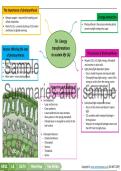
The importance of photosynthesis
• Releases oxygen – required for breathing and Energy production
cellular respiration.
• Photosynthesis is the process whereby plants
• Plants fix CO2 – prevents build-up of CO2 which
convert sunlight energy into sugar.
contributes to global warming.
T4: Energy
Factors affecting the rate transformations
of photosynthesis to sustain life (A) The process of photosynthesis
• Requires CO2, H2O, light energy, chlorophyll
•
•
•
•
Sample
More light = more photosynthesis.
More CO2 = higher photosynthetic rate.
Optimum temp. for most plants = 10-30°C.
More water = more photosynthesis.
and enzymes in plant cells.
• Light phase/light-dependent phase:
- Occurs inside the grana and requires light.
- Chlorophyll traps light energy – some of the
energy is used to form the energy carrier
Summaries after sample Formation and storage of (ATP – adenosine triphosphate).
- Some of the energy splits water molecules –
food in chloroplasts forms energised hydrogen and oxygen.
• Leaf adaptions:
- Large surface area. • Dark phase/light-independent phase:
- Clear epidermis. - Occurs in the stroma and doesn’t require
- Lower epidermis has many stomata. light.
- Many spaces in the spongy mesophyll. - CO2 combines with energised hydrogen –
- Palisade layer in mesophyll is vertical to the forms glucose.
leaf surface. - Requires the energised hydrogen atoms and
the ATP from the light phase.
• Chloroplast features:
- Double membrane.
- Chlorophyll.
- Stroma.
- Thylakoids.
- Grana.
GR11 LS S2:T4 Mind Map Via Afrika Copyright © www.summariessa.co.za (DO NOT COPY)
,Sample
Summaries after sample
, Cellular respiration and breathing
Mammal
Cellular respiration, gaseous
• Many alveoli. exchange, breathing
• Single layer of flattened epithelial cells.
• Alveoli walls kept moist by water diffusing • Cellular respiration – chemical process that occurs in
from surrounding cells. cells, in which oxygen breaks down glucose to produce
• Inspiration (inhaling) and expiration energy, CO2 and H2O.
(exhalation). • Breathing/ventilation – physical process where oxygen-
• Lungs protected by rib cage. rich air is inhaled, and CO2 is released by an organism.
• Gaseous exchange – diffusion of oxygen and CO2 across
respiratory surfaces of an organism.
T7: Gaseous
Bony fish
Sample
•
•
•
Gills made of filaments covered in feathery
structures.
Gill filament is very thin.
Water keeps gills wet.
exchange (A)
•
•
The need for gaseous exchange
Required to get oxygen and release CO2 as a
waste product.
Cellular respiration requires oxygen to produce
•
Summaries after sample
Water flows in the opposite direction to energy.
blood for maximum oxygen uptake.
• Each gill has a muscular flap.
Requirements of efficient gas
exchange organs
Insect Annelid
• Large surface area, thin, moist, good transport
• Long, thin body.
• Many branches in tracheal system. system and protection.
• Body wall covered by thin cuticle.
• Thin-walled tracheal system.
• Skin is always moist due to mucus
• Valves protect spiracles and close to
secretion and body fluids.
conserve water at fluid-filled intercellular
• Epidermal layer of blood capillaries close Dicotyledonous plant
tracheoles.
to skin.
• Ventilates through tracheal system by
• Epidermis helps exchange gas directly • Have loosely packed spongy cells to increase exchange.
diffusion of respiratory gases.
into tissues. • Gas diffuses straight into leaf cells.
• Specialised gas exchange system transports
• Bark, epidermis and cuticle slow down water loss.
directly to tissues.
• Leaves are exposed to air.
• Gases enter through stomata.
GR11 LS S2:T7 Mind Map Via Afrika Copyright © www.summariessa.co.za (DO NOT COPY)
, Sample
Summaries after sample
• Releases oxygen – required for breathing and Energy production
cellular respiration.
• Photosynthesis is the process whereby plants
• Plants fix CO2 – prevents build-up of CO2 which
convert sunlight energy into sugar.
contributes to global warming.
T4: Energy
Factors affecting the rate transformations
of photosynthesis to sustain life (A) The process of photosynthesis
• Requires CO2, H2O, light energy, chlorophyll
•
•
•
•
Sample
More light = more photosynthesis.
More CO2 = higher photosynthetic rate.
Optimum temp. for most plants = 10-30°C.
More water = more photosynthesis.
and enzymes in plant cells.
• Light phase/light-dependent phase:
- Occurs inside the grana and requires light.
- Chlorophyll traps light energy – some of the
energy is used to form the energy carrier
Summaries after sample Formation and storage of (ATP – adenosine triphosphate).
- Some of the energy splits water molecules –
food in chloroplasts forms energised hydrogen and oxygen.
• Leaf adaptions:
- Large surface area. • Dark phase/light-independent phase:
- Clear epidermis. - Occurs in the stroma and doesn’t require
- Lower epidermis has many stomata. light.
- Many spaces in the spongy mesophyll. - CO2 combines with energised hydrogen –
- Palisade layer in mesophyll is vertical to the forms glucose.
leaf surface. - Requires the energised hydrogen atoms and
the ATP from the light phase.
• Chloroplast features:
- Double membrane.
- Chlorophyll.
- Stroma.
- Thylakoids.
- Grana.
GR11 LS S2:T4 Mind Map Via Afrika Copyright © www.summariessa.co.za (DO NOT COPY)
,Sample
Summaries after sample
, Cellular respiration and breathing
Mammal
Cellular respiration, gaseous
• Many alveoli. exchange, breathing
• Single layer of flattened epithelial cells.
• Alveoli walls kept moist by water diffusing • Cellular respiration – chemical process that occurs in
from surrounding cells. cells, in which oxygen breaks down glucose to produce
• Inspiration (inhaling) and expiration energy, CO2 and H2O.
(exhalation). • Breathing/ventilation – physical process where oxygen-
• Lungs protected by rib cage. rich air is inhaled, and CO2 is released by an organism.
• Gaseous exchange – diffusion of oxygen and CO2 across
respiratory surfaces of an organism.
T7: Gaseous
Bony fish
Sample
•
•
•
Gills made of filaments covered in feathery
structures.
Gill filament is very thin.
Water keeps gills wet.
exchange (A)
•
•
The need for gaseous exchange
Required to get oxygen and release CO2 as a
waste product.
Cellular respiration requires oxygen to produce
•
Summaries after sample
Water flows in the opposite direction to energy.
blood for maximum oxygen uptake.
• Each gill has a muscular flap.
Requirements of efficient gas
exchange organs
Insect Annelid
• Large surface area, thin, moist, good transport
• Long, thin body.
• Many branches in tracheal system. system and protection.
• Body wall covered by thin cuticle.
• Thin-walled tracheal system.
• Skin is always moist due to mucus
• Valves protect spiracles and close to
secretion and body fluids.
conserve water at fluid-filled intercellular
• Epidermal layer of blood capillaries close Dicotyledonous plant
tracheoles.
to skin.
• Ventilates through tracheal system by
• Epidermis helps exchange gas directly • Have loosely packed spongy cells to increase exchange.
diffusion of respiratory gases.
into tissues. • Gas diffuses straight into leaf cells.
• Specialised gas exchange system transports
• Bark, epidermis and cuticle slow down water loss.
directly to tissues.
• Leaves are exposed to air.
• Gases enter through stomata.
GR11 LS S2:T7 Mind Map Via Afrika Copyright © www.summariessa.co.za (DO NOT COPY)
, Sample
Summaries after sample

