8/22/25, 3:58 PM WGU D441 HESI Pharmacology V1 |
Quizlet
WGU D441 PROCTORED HESI PHARMACOLOGY GHV1 EXAM | EXPLORE
NEW 100 QUESTIONS AND ANSWERS WITH RATIONALES | 2025-2026
UPDATE | 100% CORRECT.
Correct
Incorrect
WGU D441 PROCTORED HESI PHARMACOLOGY GHV1
100 Correct terms
Questions and answers
1 of 100
Term
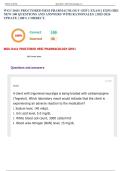
A client with trigeminal neuralgia is being treated with carbamazepine
(Tegretol). Which laboratory result would indicate that the client is
experiencing an adverse reaction to the medication?
1. Sodium level, 140 mEq/L
2. Uric acid level, 5.0 mg/dL
3. White blood cell count, 3000 cells/mm3
4. Blood urea nitrogen (BUN) level, 15 mg/dL
,8/22/25, 3:58 PM WGU D441 HESI Pharmacology V1 |
Quizlet
Give this one a go later!
3. Monitor for signs of bleeding.
Rationale:
Tissue plasminogen activator is a thrombolytic. Hemorrhage is a complication of any
type of thrombolytic medication. The client is monitored for bleeding. Monitoring
for renal failure and monitoring the client's psychosocial status are important but
are not the most critical interventions. Heparin is given after thrombolytic therapy,
but the question is not asking about follow-up medications.
3. White blood cell count, 3000 cells/mm3
Rationale:Adverse effects of carbamazepine (Tegretol) appear as blood
dyscrasias, including aplastic anemia, agranulocytosis, thrombocytopenia,
leukopenia, cardiovascular disturbances, thrombophlebitis, dysrhythmias, and
dermatological effects. Options 1, 2, and 4 identify normal laboratory values.
4. One hour before meals and at bedtime
Rationale:
Sucralfate is a gastric protectant. The medication should be scheduled for
administration 1 hour before meals and at bedtime. The medication is timed to allow
it to form a protective coating over the ulcer before food intake stimulates gastric
acid production and mechanical irritation. The other options are incorrect.
4. Suction equipment
Rationale:
Acetylcysteine can be given orally or by nasogastric tube to treat acetaminophen
overdose, or it may be given by inhalation for use as a mucolytic. The nurse
administering this medication as a mucolytic should have suction equipment
available in case the client cannot manage to clear the increased volume of
liquefied secretions.
,8/22/25, 3:58 PM WGU D441 HESI Pharmacology V1 |
Quizlet
Don't know?
2 of 100
Term
A home care nurse visits a client recently diagnosed with diabetes
mellitus who is taking Humulin NPH insulin daily. The client asks the
nurse how to store the unopened vials of insulin. The nurse tells the
client to:
1. Freeze the insulin.
2. Refrigerate the insulin.
3. Store the insulin in a dark, dry place.
4. Keep the insulin at room temperature
Give this one a go later!
2. 4 to 12 hours after administration
Rationale:
Humulin NPH is an intermediate-acting insulin. The onset of action is 1.5 hours, it
peaks in 4 to 12 hours, and its duration of action is 24 hours. Hypoglycemic
reactions most likely occur during peak time.
, 8/22/25, 3:58 PM WGU D441 HESI Pharmacology V1 |
Quizlet
2. Refrigerate the insulin.
Rationale:
Insulin in unopened vials should be stored under refrigeration until needed.
Vials should not be frozen. When stored unopened under refrigeration, insulin
can be used up to the expiration date on the vial. Options 1, 3, and 4 are
incorrect.
2. Axilla
Rationale:
Topical corticosteroids can be absorbed into the systemic circulation. Absorption is
higher from regions where the skin is especially permeable (scalp, axilla, face,
eyelids, neck, perineum, genitalia), and lower from regions in which permeability is
poor (back, palms, soles).
1. Seizure disorders
Rationale:Clients with seizure disorders may have a lowered seizure threshold when
baclofen is administered. Concurrent therapy may require an increase in the
anticonvulsive medication. The disorders in options 2, 3, and 4 are not a concern
when the client is taking baclofen.
Don't know?
3 of 100
Term
A nurse is caring for a client who is receiving an intravenous (IV)
infusion of an antineoplastic medication. During the infusion, the client
complains of pain at the insertion site. During an inspection of the site,
the nurse notes redness and swelling and that the rate of infusion of
Quizlet
WGU D441 PROCTORED HESI PHARMACOLOGY GHV1 EXAM | EXPLORE
NEW 100 QUESTIONS AND ANSWERS WITH RATIONALES | 2025-2026
UPDATE | 100% CORRECT.
Correct
Incorrect
WGU D441 PROCTORED HESI PHARMACOLOGY GHV1
100 Correct terms
Questions and answers
1 of 100
Term
A client with trigeminal neuralgia is being treated with carbamazepine
(Tegretol). Which laboratory result would indicate that the client is
experiencing an adverse reaction to the medication?
1. Sodium level, 140 mEq/L
2. Uric acid level, 5.0 mg/dL
3. White blood cell count, 3000 cells/mm3
4. Blood urea nitrogen (BUN) level, 15 mg/dL
,8/22/25, 3:58 PM WGU D441 HESI Pharmacology V1 |
Quizlet
Give this one a go later!
3. Monitor for signs of bleeding.
Rationale:
Tissue plasminogen activator is a thrombolytic. Hemorrhage is a complication of any
type of thrombolytic medication. The client is monitored for bleeding. Monitoring
for renal failure and monitoring the client's psychosocial status are important but
are not the most critical interventions. Heparin is given after thrombolytic therapy,
but the question is not asking about follow-up medications.
3. White blood cell count, 3000 cells/mm3
Rationale:Adverse effects of carbamazepine (Tegretol) appear as blood
dyscrasias, including aplastic anemia, agranulocytosis, thrombocytopenia,
leukopenia, cardiovascular disturbances, thrombophlebitis, dysrhythmias, and
dermatological effects. Options 1, 2, and 4 identify normal laboratory values.
4. One hour before meals and at bedtime
Rationale:
Sucralfate is a gastric protectant. The medication should be scheduled for
administration 1 hour before meals and at bedtime. The medication is timed to allow
it to form a protective coating over the ulcer before food intake stimulates gastric
acid production and mechanical irritation. The other options are incorrect.
4. Suction equipment
Rationale:
Acetylcysteine can be given orally or by nasogastric tube to treat acetaminophen
overdose, or it may be given by inhalation for use as a mucolytic. The nurse
administering this medication as a mucolytic should have suction equipment
available in case the client cannot manage to clear the increased volume of
liquefied secretions.
,8/22/25, 3:58 PM WGU D441 HESI Pharmacology V1 |
Quizlet
Don't know?
2 of 100
Term
A home care nurse visits a client recently diagnosed with diabetes
mellitus who is taking Humulin NPH insulin daily. The client asks the
nurse how to store the unopened vials of insulin. The nurse tells the
client to:
1. Freeze the insulin.
2. Refrigerate the insulin.
3. Store the insulin in a dark, dry place.
4. Keep the insulin at room temperature
Give this one a go later!
2. 4 to 12 hours after administration
Rationale:
Humulin NPH is an intermediate-acting insulin. The onset of action is 1.5 hours, it
peaks in 4 to 12 hours, and its duration of action is 24 hours. Hypoglycemic
reactions most likely occur during peak time.
, 8/22/25, 3:58 PM WGU D441 HESI Pharmacology V1 |
Quizlet
2. Refrigerate the insulin.
Rationale:
Insulin in unopened vials should be stored under refrigeration until needed.
Vials should not be frozen. When stored unopened under refrigeration, insulin
can be used up to the expiration date on the vial. Options 1, 3, and 4 are
incorrect.
2. Axilla
Rationale:
Topical corticosteroids can be absorbed into the systemic circulation. Absorption is
higher from regions where the skin is especially permeable (scalp, axilla, face,
eyelids, neck, perineum, genitalia), and lower from regions in which permeability is
poor (back, palms, soles).
1. Seizure disorders
Rationale:Clients with seizure disorders may have a lowered seizure threshold when
baclofen is administered. Concurrent therapy may require an increase in the
anticonvulsive medication. The disorders in options 2, 3, and 4 are not a concern
when the client is taking baclofen.
Don't know?
3 of 100
Term
A nurse is caring for a client who is receiving an intravenous (IV)
infusion of an antineoplastic medication. During the infusion, the client
complains of pain at the insertion site. During an inspection of the site,
the nurse notes redness and swelling and that the rate of infusion of