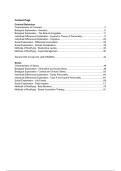
Content Page
Criminal Behaviour
Characteristics of Criminals………………………....……………………….………….…....…….3
Biological Explanation - Genetics…………………………………….…………………….………6
Biological Explanation - The Role of Amygdala.………………………....………………...……11
Individual Differences Explanation - Eysenck’s Theory of Personality……………..……....…17
Individual Differences Explanation - Cognitive…………………………………………......……22
Social Explanation - Differential Association………...…………..………..………………..……25
Social Explanation - Gender Socialisation………...…………………..…..………………..……29
Methods of Modifying - Restorative Justice………...………………..……………………..……33
Methods of Modifying - Anger Management………...………………..……………..……..……36
General A03 Constructor (with DRAINS) ……………….………..……………………..……….42
Stress
Characteristics of Stress....………………………….…….………………………………....…….46
Biological Explanation - Adrenaline and Acute Stress.…………………….……………………49
Biological Explanation - Cortisol and Chronic Stress………………………....…………...……55
Individual Differences Explanation - Hardy Personality………………….........................……60
Individual Differences Explanation - Type A and Type B Personality....………………………64
Social Explanation - Life Events………...………………..………………..……………………...68
Social Explanation - Daily Hassles………...……………………..………………..……………..71
Methods of Modifying - Beta Blockers………...………………..………………..……………….75
Methods of Modifying - Stress Inoculation Therapy………...………………..…………..……..81
,Criminal Behaviour
Characteristics (A01)
(A01 and A03)
Biological Explanations of Criminal Behaviour
● Genetics
● Role of the amygdala
Individual Differences Explanations
- Eysenck’s criminal personality
- Cognitive explanation
Social Psychological Explanations
- Differential association
- Gender socialisation
Methods of Modifying Behaviour
- Restorative Justice
- Anger management
Evaluate on effectiveness, ethics and social implications (A03)
Crimes
1) Robbery - Property predatory
2) Bribery/fraud - Property fraudulent
3) Assault on another (murder) - Interpersonal violence (general)
4) Assault (with sexual elements) - Interpersonal violence (sexual)
5) Prostitution/ Drugs - Transactional vice
6) Loitering/ rioting - Order disruption
7) Anything else - Folk / Mundane crime
,Characteristics of Criminals
Definition: Everyone agrees that there is a detrimental or harmful effect (physical,
psychological, financial) on a victim and the criminal knows what they are doing is wrong or
illegal
Farr and Gibbons (1990) 7 Types of Crimes
Property predatory crime: Persons involved in attempting to or actually taking the personal
property of others without permission (theft, robbery)
Property fraudulent crime: Persons involved in deceit/manipulation with purpose of
converting property or services of others to their own (fraud, bribery)
Interpersonal violence (general): Persons are involved in actions that threaten or cause
actual personal harm
Interpersonal violence (sexual): Persons involved in actions that threaten or cause actual
personal harm and contain a sexual element (rape, incest)
Transactional vice: Persons involved in actions in 'victimless' offences where there is a
willing exchange of goods/services (prostitution, drug sales)
Order disruption: Persons involved in actions with no direct victim but concern is raised
about potential victims (loitering, rioting)
Folk/Mundane crime: Persons involved in actions ranging from minor violations (unlicensed
fishing, load restrictions, commercial vehicles)
Characteristics of Criminals
● Holmes and Holmes (2002) reported that many serial killers shared the
characteristics of being white, male and between the ages of 25-34.
● They also tended to be intelligent or at least ‘street smart’ and were considered to
be ‘charming and charismatic’.
● However, other researchers such as Aamodt (2012) noted that the mean IQ of serial
killers was recorded at 95.1 (just below average), but there was also a range from 57
to 165.
● This suggests that the IQ distribution of serial murderers can be just as dispersed
as the general population.
● Usually sensation seeking, have a lack of remorse or guilt, impulsivity, have a need
for control and predatory behaviour
● Uses charm, manipulation, intimidation, and occasionally violence to control others
Serial Murder Symposium held in 2005, Robert Morton (Eds) noted that:
‘Attendees … agreed that there is no generic profile of a serial murderer. Serial killers differ
in many ways, including their motivations for killing and their behaviour at the crime scene.
However, attendees did identify certain traits common to some serial murderers, including
,sensation seeking, a lack of remorse or guilt, impulsivity, the need for control, and predatory
behaviour. These traits and behaviours are consistent with the psychopathic personality
disorder…Psychopathy is a personality disorder manifested in people who use a mixture of
charm, manipulation, intimidation, and occasionally violence to control others, in order to
satisfy their own selfish needs…All psychopaths do not become serial murderers. Rather,
serial murderers may possess some or many of the traits consistent with psychopathy.
Psychopaths who commit serial murder do not value human life and are extremely callous in
their interactions with their victims.’
Subtypes of Serial Killers
Visionary Serial Killers: Visionary serial killers are motivated to kill by voices or visions.
These individuals can be both lucid and then on occasion also lose touch with reality. They
frequently report that their actions are due to orders from God or the Devil. During the
commission of their crime, they usually kill quickly and don’t engage in ‘staging’ at crime
scenes. They are usually declared insane or incompetent to stand trial.
Mission Serial Killers: Mission serial killers believe they have a calling to eliminate a
certain group of people.
This sort of killer is in touch with reality apart from their self-imposed need to eradicate
certain groups. In the commission of their crimes, the mission serial killer may stalk a
potential victim and generally displays an organised typology.
Hedonistic Serial Killers: Hedonistic serial killers have two subtypes, lust/thrill and
comfort orientated.
For the lust/thrill killer, there is an established link between sexual gratification and violence,
for them murder is erotic. The lust/thrill killer tends to have a distinct process that they follow,
and the crimes are protracted.
The comfort oriented killer kills for personal gain, such as property or money. The
comfort-orientated killers are the only type of serial killer where the perpetrator is more likely
to be female.
Both tend to be geographically mobile, and hence hard to catch.
Power Control Serial Killers: Power control serial killers derive sexual gratification from
dominating and controlling the life of another.
They may be a sociopath and they choose to live by their own rules, but they are aware of
the norms and values of the society in which they live.
This serial killer tries to derive the most gratification by prolonging their crimes and although
they may use weapons, they often experience a strong compulsion to strangle their victims.
,Characteristics of Fraudsters
Fraud is the most common form of criminal behaviour in the UK. The ONS reported (up to
the year ending March 2020) 3,675,000 incidents.
Fraud can be perpetrated against individuals, but it can also be perpetrated against
organisations, such as companies and charities.
Action Fraud outlines fraud as
‘when trickery is used to gain a dishonest advantage, which is often financial, over another
person … There are many words used to describe fraud: Scam, con, swindle, extortion,
sham, double-cross, hoax, cheat, ploy, ruse, hoodwink, confidence trick.’
Fraud against individuals was estimated by the National Fraud Authority in 2013 to cost £9
billion every year, and this was considered to be an underestimate since victims of fraud do
not always report it to the police.
Most individual victims of fraud tend to be elderly or vulnerable in some way.
In a 2009 report, the National Fraud Authority noted that many fraudsters demonstrated
characteristics similar to that of the usual entrepreneur, specifically ‘risk taking, the need to
achieve, the need to be the locus of control, over-optimism and the desire for
autonomy’. In fact, the term ‘scampreneur’ has been coined to describe these individuals.
Fraud can also be perpetrated against organisations, such as companies.
In 2016, KPMG reported the findings of a survey of KPMG Forensic professionals who had
investigated cases of fraud perpetrated by 750 fraudsters from over 81 countries, between
March 2013 and August 2015. From this sample they reported that the characteristics of a
‘typical fraudster’ included:
● between the ages of 36 and 55 (69 percent of fraudsters investigated)
● predominantly male (79 percent), with the proportion of women on the rise at 17
percent, up from 13 percent in 2010
● a threat from within (65 percent are employed by the company)
● holds an executive or director level position (35 percent)
● employed in the organization for at least six years (38 percent)
● described as an autocratic individual (18 percent) and are three times as likely to be
regarded as friendly
● esteemed, describing themselves as well-respected in their organization
, ● likely to have colluded with others (62 percent of frauds, down just slightly from 70
percent in the 2013 survey)
● motivated by personal gain (60 percent), greed (36 percent) and the sense of
‘because I can’ (27 percent).
Biological Explanation - Genetics
Genes determine physical features such as hair and eye colour, but there is increasing
evidence that the genes we inherit from our parents can also determine psychological traits
such as our personality, abilities, and even what mental illnesses we may suffer from.
Any genetic explanation in psychology contributes to the nature-nurture debate.
Twin Studies
One of the earliest twin studies into criminal behaviour was
Rosanoff et al (1934)
● Studied 97 twin pairs
● Finding male concordance rates of 22/33 Monozygotic twins (67%) and 3/23
Dizygotic twins (13%).
Raine (1993)
● Reviewed the literature comparing the delinquent behaviour of twins
● Found the average concordance rate was higher for MZ twins (52%) than DZ twins
(21%).
● A later meta-analysis by Ishikawa and Raine (2002) found a concordance rate for
criminality of 44% for MZ twins and 21.6% for DZ twins.
They seem to suggest that genes play a part in criminal behaviour but not entirely, or else
the percentages would be closer to 100%.
A03
Dalgard and Kringlen (1976)
● Studied 49 male MZ and 89 same-sex male DZ pairs, finding no statistically
significant concordance rate difference using either a “broad” or “strict” definition of
crime.
● The MZ twin concordance rate for broadly defined crime was 22%, and 26% for
strictly defined crime.
● On the basis of these results and of the more similar environments experienced by
identical twins, the authors concluded, “These findings support the view that
hereditary factors are of no significant importance in the aetiology (cause) of common
crime.”
Criminal Behaviour
Characteristics of Criminals………………………....……………………….………….…....…….3
Biological Explanation - Genetics…………………………………….…………………….………6
Biological Explanation - The Role of Amygdala.………………………....………………...……11
Individual Differences Explanation - Eysenck’s Theory of Personality……………..……....…17
Individual Differences Explanation - Cognitive…………………………………………......……22
Social Explanation - Differential Association………...…………..………..………………..……25
Social Explanation - Gender Socialisation………...…………………..…..………………..……29
Methods of Modifying - Restorative Justice………...………………..……………………..……33
Methods of Modifying - Anger Management………...………………..……………..……..……36
General A03 Constructor (with DRAINS) ……………….………..……………………..……….42
Stress
Characteristics of Stress....………………………….…….………………………………....…….46
Biological Explanation - Adrenaline and Acute Stress.…………………….……………………49
Biological Explanation - Cortisol and Chronic Stress………………………....…………...……55
Individual Differences Explanation - Hardy Personality………………….........................……60
Individual Differences Explanation - Type A and Type B Personality....………………………64
Social Explanation - Life Events………...………………..………………..……………………...68
Social Explanation - Daily Hassles………...……………………..………………..……………..71
Methods of Modifying - Beta Blockers………...………………..………………..……………….75
Methods of Modifying - Stress Inoculation Therapy………...………………..…………..……..81
,Criminal Behaviour
Characteristics (A01)
(A01 and A03)
Biological Explanations of Criminal Behaviour
● Genetics
● Role of the amygdala
Individual Differences Explanations
- Eysenck’s criminal personality
- Cognitive explanation
Social Psychological Explanations
- Differential association
- Gender socialisation
Methods of Modifying Behaviour
- Restorative Justice
- Anger management
Evaluate on effectiveness, ethics and social implications (A03)
Crimes
1) Robbery - Property predatory
2) Bribery/fraud - Property fraudulent
3) Assault on another (murder) - Interpersonal violence (general)
4) Assault (with sexual elements) - Interpersonal violence (sexual)
5) Prostitution/ Drugs - Transactional vice
6) Loitering/ rioting - Order disruption
7) Anything else - Folk / Mundane crime
,Characteristics of Criminals
Definition: Everyone agrees that there is a detrimental or harmful effect (physical,
psychological, financial) on a victim and the criminal knows what they are doing is wrong or
illegal
Farr and Gibbons (1990) 7 Types of Crimes
Property predatory crime: Persons involved in attempting to or actually taking the personal
property of others without permission (theft, robbery)
Property fraudulent crime: Persons involved in deceit/manipulation with purpose of
converting property or services of others to their own (fraud, bribery)
Interpersonal violence (general): Persons are involved in actions that threaten or cause
actual personal harm
Interpersonal violence (sexual): Persons involved in actions that threaten or cause actual
personal harm and contain a sexual element (rape, incest)
Transactional vice: Persons involved in actions in 'victimless' offences where there is a
willing exchange of goods/services (prostitution, drug sales)
Order disruption: Persons involved in actions with no direct victim but concern is raised
about potential victims (loitering, rioting)
Folk/Mundane crime: Persons involved in actions ranging from minor violations (unlicensed
fishing, load restrictions, commercial vehicles)
Characteristics of Criminals
● Holmes and Holmes (2002) reported that many serial killers shared the
characteristics of being white, male and between the ages of 25-34.
● They also tended to be intelligent or at least ‘street smart’ and were considered to
be ‘charming and charismatic’.
● However, other researchers such as Aamodt (2012) noted that the mean IQ of serial
killers was recorded at 95.1 (just below average), but there was also a range from 57
to 165.
● This suggests that the IQ distribution of serial murderers can be just as dispersed
as the general population.
● Usually sensation seeking, have a lack of remorse or guilt, impulsivity, have a need
for control and predatory behaviour
● Uses charm, manipulation, intimidation, and occasionally violence to control others
Serial Murder Symposium held in 2005, Robert Morton (Eds) noted that:
‘Attendees … agreed that there is no generic profile of a serial murderer. Serial killers differ
in many ways, including their motivations for killing and their behaviour at the crime scene.
However, attendees did identify certain traits common to some serial murderers, including
,sensation seeking, a lack of remorse or guilt, impulsivity, the need for control, and predatory
behaviour. These traits and behaviours are consistent with the psychopathic personality
disorder…Psychopathy is a personality disorder manifested in people who use a mixture of
charm, manipulation, intimidation, and occasionally violence to control others, in order to
satisfy their own selfish needs…All psychopaths do not become serial murderers. Rather,
serial murderers may possess some or many of the traits consistent with psychopathy.
Psychopaths who commit serial murder do not value human life and are extremely callous in
their interactions with their victims.’
Subtypes of Serial Killers
Visionary Serial Killers: Visionary serial killers are motivated to kill by voices or visions.
These individuals can be both lucid and then on occasion also lose touch with reality. They
frequently report that their actions are due to orders from God or the Devil. During the
commission of their crime, they usually kill quickly and don’t engage in ‘staging’ at crime
scenes. They are usually declared insane or incompetent to stand trial.
Mission Serial Killers: Mission serial killers believe they have a calling to eliminate a
certain group of people.
This sort of killer is in touch with reality apart from their self-imposed need to eradicate
certain groups. In the commission of their crimes, the mission serial killer may stalk a
potential victim and generally displays an organised typology.
Hedonistic Serial Killers: Hedonistic serial killers have two subtypes, lust/thrill and
comfort orientated.
For the lust/thrill killer, there is an established link between sexual gratification and violence,
for them murder is erotic. The lust/thrill killer tends to have a distinct process that they follow,
and the crimes are protracted.
The comfort oriented killer kills for personal gain, such as property or money. The
comfort-orientated killers are the only type of serial killer where the perpetrator is more likely
to be female.
Both tend to be geographically mobile, and hence hard to catch.
Power Control Serial Killers: Power control serial killers derive sexual gratification from
dominating and controlling the life of another.
They may be a sociopath and they choose to live by their own rules, but they are aware of
the norms and values of the society in which they live.
This serial killer tries to derive the most gratification by prolonging their crimes and although
they may use weapons, they often experience a strong compulsion to strangle their victims.
,Characteristics of Fraudsters
Fraud is the most common form of criminal behaviour in the UK. The ONS reported (up to
the year ending March 2020) 3,675,000 incidents.
Fraud can be perpetrated against individuals, but it can also be perpetrated against
organisations, such as companies and charities.
Action Fraud outlines fraud as
‘when trickery is used to gain a dishonest advantage, which is often financial, over another
person … There are many words used to describe fraud: Scam, con, swindle, extortion,
sham, double-cross, hoax, cheat, ploy, ruse, hoodwink, confidence trick.’
Fraud against individuals was estimated by the National Fraud Authority in 2013 to cost £9
billion every year, and this was considered to be an underestimate since victims of fraud do
not always report it to the police.
Most individual victims of fraud tend to be elderly or vulnerable in some way.
In a 2009 report, the National Fraud Authority noted that many fraudsters demonstrated
characteristics similar to that of the usual entrepreneur, specifically ‘risk taking, the need to
achieve, the need to be the locus of control, over-optimism and the desire for
autonomy’. In fact, the term ‘scampreneur’ has been coined to describe these individuals.
Fraud can also be perpetrated against organisations, such as companies.
In 2016, KPMG reported the findings of a survey of KPMG Forensic professionals who had
investigated cases of fraud perpetrated by 750 fraudsters from over 81 countries, between
March 2013 and August 2015. From this sample they reported that the characteristics of a
‘typical fraudster’ included:
● between the ages of 36 and 55 (69 percent of fraudsters investigated)
● predominantly male (79 percent), with the proportion of women on the rise at 17
percent, up from 13 percent in 2010
● a threat from within (65 percent are employed by the company)
● holds an executive or director level position (35 percent)
● employed in the organization for at least six years (38 percent)
● described as an autocratic individual (18 percent) and are three times as likely to be
regarded as friendly
● esteemed, describing themselves as well-respected in their organization
, ● likely to have colluded with others (62 percent of frauds, down just slightly from 70
percent in the 2013 survey)
● motivated by personal gain (60 percent), greed (36 percent) and the sense of
‘because I can’ (27 percent).
Biological Explanation - Genetics
Genes determine physical features such as hair and eye colour, but there is increasing
evidence that the genes we inherit from our parents can also determine psychological traits
such as our personality, abilities, and even what mental illnesses we may suffer from.
Any genetic explanation in psychology contributes to the nature-nurture debate.
Twin Studies
One of the earliest twin studies into criminal behaviour was
Rosanoff et al (1934)
● Studied 97 twin pairs
● Finding male concordance rates of 22/33 Monozygotic twins (67%) and 3/23
Dizygotic twins (13%).
Raine (1993)
● Reviewed the literature comparing the delinquent behaviour of twins
● Found the average concordance rate was higher for MZ twins (52%) than DZ twins
(21%).
● A later meta-analysis by Ishikawa and Raine (2002) found a concordance rate for
criminality of 44% for MZ twins and 21.6% for DZ twins.
They seem to suggest that genes play a part in criminal behaviour but not entirely, or else
the percentages would be closer to 100%.
A03
Dalgard and Kringlen (1976)
● Studied 49 male MZ and 89 same-sex male DZ pairs, finding no statistically
significant concordance rate difference using either a “broad” or “strict” definition of
crime.
● The MZ twin concordance rate for broadly defined crime was 22%, and 26% for
strictly defined crime.
● On the basis of these results and of the more similar environments experienced by
identical twins, the authors concluded, “These findings support the view that
hereditary factors are of no significant importance in the aetiology (cause) of common
crime.”