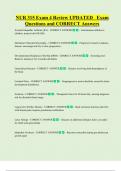
NUR 315 Exam 4 Review UPDATED Exam
Questions and CORRECT Answers
Juvenile Idiopathic Arthritis (JIA) - CORRECT ANSWER - Autoimmune arthritis in
children; treated with NSAIDs
Duchenne's Muscular Dystrophy - CORRECT ANSWER - Progressive muscle weakness
disease; encourage activity to slow progression
Developmental Dysplasia of the Hip (DDH) - CORRECT ANSWER - Screening tool:
Barlow's maneuver for 2-month-old infants
Generalized Seizures - CORRECT ANSWER - Seizures involving both hemispheres of
the brain
Cerebral Palsy - CORRECT ANSWER - Nonprogressive motor disability caused by brain
development disturbance
Scoliosis - CORRECT ANSWER - Therapeutic brace for 20 hours/day; nursing diagnosis:
risk for disturbed body image
Legg-Calve-Perthes Disease - CORRECT ANSWER - Buck extension traction; pale foot
with absent pulse requires practitioner notification
Latex Allergy - CORRECT ANSWER - Educate on additional allergies (kiwi, avocado)
for child with spina bifida
Idiopathic Scoliosis - CORRECT ANSWER - Becomes noticeable during pre-adolescent
growth spurt
, Absence Seizure - CORRECT ANSWER - Twitching eyes and smacking lips; observed in
a 4-year-old
Fractured Arm - CORRECT ANSWER - Teaching: Elevate cast when resting and sitting
up
Febrile Seizures - CORRECT ANSWER - Comforting to know most children outgrow by
6 years old
Bacterial Meningitis - CORRECT ANSWER - Diagnosis: elevated protein count and low
glucose count in cerebrospinal fluid
Hydrocephalus - CORRECT ANSWER - Postoperative care: do not place child in semi-
fowler's position
Fractured Hip - CORRECT ANSWER - Monitor for venous stasis leading to thrombi or
emboli formation
Head Circumference - CORRECT ANSWER - Call physician immediately for significant
decrease in head circumference
Guillain-Barre Syndrome (GBS) - CORRECT ANSWER - Priority: assess respiratory
efforts
Meckel's Diverticulum - CORRECT ANSWER - Priority: assess respiratory
status/maintain airway postoperatively
Pertussis (Whooping Cough) - CORRECT ANSWER - Contagiousness greatest before
paroxysmal stage; initiate droplet precautions
Enuresis - CORRECT ANSWER - Reverting behavior pattern may be due to stress
Questions and CORRECT Answers
Juvenile Idiopathic Arthritis (JIA) - CORRECT ANSWER - Autoimmune arthritis in
children; treated with NSAIDs
Duchenne's Muscular Dystrophy - CORRECT ANSWER - Progressive muscle weakness
disease; encourage activity to slow progression
Developmental Dysplasia of the Hip (DDH) - CORRECT ANSWER - Screening tool:
Barlow's maneuver for 2-month-old infants
Generalized Seizures - CORRECT ANSWER - Seizures involving both hemispheres of
the brain
Cerebral Palsy - CORRECT ANSWER - Nonprogressive motor disability caused by brain
development disturbance
Scoliosis - CORRECT ANSWER - Therapeutic brace for 20 hours/day; nursing diagnosis:
risk for disturbed body image
Legg-Calve-Perthes Disease - CORRECT ANSWER - Buck extension traction; pale foot
with absent pulse requires practitioner notification
Latex Allergy - CORRECT ANSWER - Educate on additional allergies (kiwi, avocado)
for child with spina bifida
Idiopathic Scoliosis - CORRECT ANSWER - Becomes noticeable during pre-adolescent
growth spurt
, Absence Seizure - CORRECT ANSWER - Twitching eyes and smacking lips; observed in
a 4-year-old
Fractured Arm - CORRECT ANSWER - Teaching: Elevate cast when resting and sitting
up
Febrile Seizures - CORRECT ANSWER - Comforting to know most children outgrow by
6 years old
Bacterial Meningitis - CORRECT ANSWER - Diagnosis: elevated protein count and low
glucose count in cerebrospinal fluid
Hydrocephalus - CORRECT ANSWER - Postoperative care: do not place child in semi-
fowler's position
Fractured Hip - CORRECT ANSWER - Monitor for venous stasis leading to thrombi or
emboli formation
Head Circumference - CORRECT ANSWER - Call physician immediately for significant
decrease in head circumference
Guillain-Barre Syndrome (GBS) - CORRECT ANSWER - Priority: assess respiratory
efforts
Meckel's Diverticulum - CORRECT ANSWER - Priority: assess respiratory
status/maintain airway postoperatively
Pertussis (Whooping Cough) - CORRECT ANSWER - Contagiousness greatest before
paroxysmal stage; initiate droplet precautions
Enuresis - CORRECT ANSWER - Reverting behavior pattern may be due to stress