NTs and Pathways
Reviewed
PATHWAYS
Descending
mostly motor, also innervation of glands
corticocerebellar (cerebral cortex to cerebellum):
1. cerebro-olivary-cerebellar pathway
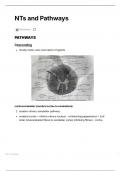
cerebral cortex > inferior olivary nucleus - crinkled bag appearance > 2nd
order olivocerebellar fibres to cerebellar cortex (climbing fibres) - contra
NTs and Pathways 1
, 2. cerebro-pontine-cerebellar pathway
cerebral cortex ipsilaterally > pontine nuclei > 2nd order pontocerebellar fibres
horizontally through mid ped to cerebellar cortex (mossy fibres) - contra
3. cerebro-reticulo-cerebellar pathway
cerebral cortex to reticular formation > 2nd order to cerebellar cortex (mossy
fibres) - ipsi
NTs and Pathways 2
, cerebellum > motor
motor control centres (basal ganglia and cerebellum) = upper motor neurones
> higher control onto lower motor (alpha)
1. dentate nuclei (lateral cerebrocerebellum) > areas 4/6 (primary/premotor) >
motor planning
2. interposed (globose and embeliform) nuclei (paravermal) > lateral descending
systems > motor execution
3. fastigial nuclei (vermal spinocerebellum) > medial descending systems (eg.
vestibulospinal tract) > motor execution
4. vestibulocerebellum > vestibular nuclei (medulla/pons) > balance and eye
movement
motor
complicated movements originate in primary motor cortex (lateral pathways),
less complicated from brainstem (ventromedial pathways)
NTs and Pathways 3
, 1. corticospinal tract
function = voluntary motor control, skilled movement (direct pathway)
location = lateral and anterior funiculus
lesions = rostral to decussation > CONTRA, caudal > IPSI/bi
pathway = primary motor cortex (only one to originate here) > through
thalamus, posterior limb of internal capsule, basal ganglia, pons > at medullary
pyramids 85% decussate and enter lateral tract > other 15% decussate at level
of LMN and found in anterior tract (lateral to ventral fissure) > synapse onto
lower motor neurone cell body in grey matter of cord > out to muscle
2. reticulospinal tract (medial)
function = posture (indirect pathway) , repeated movements eg. walking, limb
extension, subconscious reflex, eye movement, resp muscles (medial
facilitates, lateral inhibits)
location = ventral horn (medullary) and medial anterior funiculus (pontine)
NTs and Pathways 4
Reviewed
PATHWAYS
Descending
mostly motor, also innervation of glands
corticocerebellar (cerebral cortex to cerebellum):
1. cerebro-olivary-cerebellar pathway
cerebral cortex > inferior olivary nucleus - crinkled bag appearance > 2nd
order olivocerebellar fibres to cerebellar cortex (climbing fibres) - contra
NTs and Pathways 1
, 2. cerebro-pontine-cerebellar pathway
cerebral cortex ipsilaterally > pontine nuclei > 2nd order pontocerebellar fibres
horizontally through mid ped to cerebellar cortex (mossy fibres) - contra
3. cerebro-reticulo-cerebellar pathway
cerebral cortex to reticular formation > 2nd order to cerebellar cortex (mossy
fibres) - ipsi
NTs and Pathways 2
, cerebellum > motor
motor control centres (basal ganglia and cerebellum) = upper motor neurones
> higher control onto lower motor (alpha)
1. dentate nuclei (lateral cerebrocerebellum) > areas 4/6 (primary/premotor) >
motor planning
2. interposed (globose and embeliform) nuclei (paravermal) > lateral descending
systems > motor execution
3. fastigial nuclei (vermal spinocerebellum) > medial descending systems (eg.
vestibulospinal tract) > motor execution
4. vestibulocerebellum > vestibular nuclei (medulla/pons) > balance and eye
movement
motor
complicated movements originate in primary motor cortex (lateral pathways),
less complicated from brainstem (ventromedial pathways)
NTs and Pathways 3
, 1. corticospinal tract
function = voluntary motor control, skilled movement (direct pathway)
location = lateral and anterior funiculus
lesions = rostral to decussation > CONTRA, caudal > IPSI/bi
pathway = primary motor cortex (only one to originate here) > through
thalamus, posterior limb of internal capsule, basal ganglia, pons > at medullary
pyramids 85% decussate and enter lateral tract > other 15% decussate at level
of LMN and found in anterior tract (lateral to ventral fissure) > synapse onto
lower motor neurone cell body in grey matter of cord > out to muscle
2. reticulospinal tract (medial)
function = posture (indirect pathway) , repeated movements eg. walking, limb
extension, subconscious reflex, eye movement, resp muscles (medial
facilitates, lateral inhibits)
location = ventral horn (medullary) and medial anterior funiculus (pontine)
NTs and Pathways 4