Falconry Exam with Answers
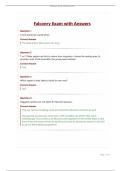
Falconry Exam with Answers
Question 1
A bird should be coped when...
Correct Answer
The beak and/or talons grow too long
Question 2
T or F? Male raptors are first to return from migration, choose the nesting area, &
provides most of the food after the young have hatched
Correct Answer
True
Question 3
Which raptor is least likely to build its own nest?
Correct Answer
Jack
Question 4
Haggards (adults) are not taken for falconry because...
Correct Answer
They are nature's breeding stock and should be allowed to function as such
(Young birds of prey have more than a 70% mortality rate before they reach
breeding age. The consensus of falconers and regulators in the United States is that
those birds that have survived to adulthood should be allowed to remain in the wild
as part of the breeding population.)
Page 1 of 23
, Falconry Exam with Answers
Question 5
Hawks belonging to the genus Accipiter are also known as....
Correct Answer
short wings
Question 6
A raptor tends to reach full size . . .
Correct Answer
when they leave the nest
Question 7
Which species of raptor does not exhibit sexual dimorphism . . . Kestrel, red-tailed
hawk, peregrine, or none of the above?
Correct Answer
None of the above are correct
Question 8
A relaxed hawk is likely to . . .
Correct Answer
Preen; raise and tuck one foot; rouse
Question 9
Which of the following does not describe a portion of a raptors wing? Coverts, alula,
cere, or sceondaries.
Correct Answer
Cere
Page 2 of 23
, Falconry Exam with Answers
Question 10
Which of the following terms does not fit with the others? Talon, train, tarsus, or
hallux?
Correct Answer
Train
Question 11
The terms "passage," "imprint," and "chamber" describe...
Correct Answer
how the raptor was raised
Question 12
All "raptors" includes species of the order or orders...
Correct Answer
Strigiformes and Falconiformes
Question 13
Desertion of the nest by adult raptors is most likely to occur...
Correct Answer
just prior to egg laying -- Once the eggs are laid, most raptors, though not all, are
likely to stick with their clutch, despite disturbances.
Question 14
True or false: If the first clutch of eggs is destroyed soon after being laid, many hawks
and falcons will lay a second clutch.
Correct Answer
True. -- This tendency has been used by raptor propagators to maximize the
progeny of breeding pairs. The system is called "double clutching." Caution: some
raptors, if disturbed on eggs in the wild, will abandon their nests and close down
their reproductive systems for the season.
Page 3 of 23
Falconry Exam with Answers
Question 1
A bird should be coped when...
Correct Answer
The beak and/or talons grow too long
Question 2
T or F? Male raptors are first to return from migration, choose the nesting area, &
provides most of the food after the young have hatched
Correct Answer
True
Question 3
Which raptor is least likely to build its own nest?
Correct Answer
Jack
Question 4
Haggards (adults) are not taken for falconry because...
Correct Answer
They are nature's breeding stock and should be allowed to function as such
(Young birds of prey have more than a 70% mortality rate before they reach
breeding age. The consensus of falconers and regulators in the United States is that
those birds that have survived to adulthood should be allowed to remain in the wild
as part of the breeding population.)
Page 1 of 23
, Falconry Exam with Answers
Question 5
Hawks belonging to the genus Accipiter are also known as....
Correct Answer
short wings
Question 6
A raptor tends to reach full size . . .
Correct Answer
when they leave the nest
Question 7
Which species of raptor does not exhibit sexual dimorphism . . . Kestrel, red-tailed
hawk, peregrine, or none of the above?
Correct Answer
None of the above are correct
Question 8
A relaxed hawk is likely to . . .
Correct Answer
Preen; raise and tuck one foot; rouse
Question 9
Which of the following does not describe a portion of a raptors wing? Coverts, alula,
cere, or sceondaries.
Correct Answer
Cere
Page 2 of 23
, Falconry Exam with Answers
Question 10
Which of the following terms does not fit with the others? Talon, train, tarsus, or
hallux?
Correct Answer
Train
Question 11
The terms "passage," "imprint," and "chamber" describe...
Correct Answer
how the raptor was raised
Question 12
All "raptors" includes species of the order or orders...
Correct Answer
Strigiformes and Falconiformes
Question 13
Desertion of the nest by adult raptors is most likely to occur...
Correct Answer
just prior to egg laying -- Once the eggs are laid, most raptors, though not all, are
likely to stick with their clutch, despite disturbances.
Question 14
True or false: If the first clutch of eggs is destroyed soon after being laid, many hawks
and falcons will lay a second clutch.
Correct Answer
True. -- This tendency has been used by raptor propagators to maximize the
progeny of breeding pairs. The system is called "double clutching." Caution: some
raptors, if disturbed on eggs in the wild, will abandon their nests and close down
their reproductive systems for the season.
Page 3 of 23