

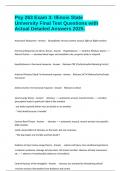
Psy 263 Exam 3: Illinois State
University Final Test Questions with
Actual Detailed Answers 2025.
Autonomic Responses - Answer Sympathetic nervous system arousal: fight or flight reaction
Hormonal Responses to Stress, threat - Answer Hypothalamus —> Anterior Pituitary Gland —>
Adrenal Cortex —> elevates blood sugar and metabolic rate, prepares body to respond
Hypothalamus in hormonal response - Answer Releases CRF (Corticotrophin Releasing Factor)
Anterior Pituitary Gland i'm hormonal response - Answer Releases ACTH (AdrenoCorticoTropic
Hormone)
Adrenal Cortex i'm hormonal response - Answer Releases Cortisol
James-Lange theory - Answer -stimulus —> autonomic arousal, muscle tension —> emotion
(perception leads to particular label of the emotion
- our body responds before we can decide on an emotion
- "i feel afraid because i tremble"
Cannon-Bard Theory - Answer - stimulus —> autonomic arousal, muscle tension (not specific)
AND emotion
-both caused effect of stimulus on the brain, but not conscious
- "the dog makes me tremble and feel afraid")
Evidence to favor James-Lange theory - Answer -spinal cord injury: less emotional experience
-Locked-in syndrome: damage to brain stem, NO motor function. Absence of body movement,
etc. —> absence of emotionality (absence of sensation)
Central Nucleus of the Amygdala - Answer -neurons are activated by threatening stimuli
-receives sensory information from thalamus and cortex
, Emotional Expression (Ekman) - Answer - Innate, i learned set of facial muscle movements
- sadness, happiness, disgust, anger
- cross-cultural studies, studies with blind (near-sighted) children [we all have similar facial
expressions for certain emotions]
- left half of face more expressive (right hemisphere)
Facial Emotional Recognition - Answer Right frontal cortex and amygdala important
Orbitofrontal Cortex - Answer Damage >> indifference, inappropriate social behavior, lack of
restraint and inhibitions, decreased emotionality, decreased planning and forethought
Prefrontal Lobotomy, Leucotomy - Answer - Moniz, Freeman, and Watts
- psychiatric patients
- damage to frontal lobes, especially orbitofrontal cortex
Aggression - Answer - Serotonin: low levels or decreased turnover —> aggressiveness
- Testosterone: high levels —> aggressiveness
Stimulus - Answer Form of energy (in the environment)
Sensation - Answer Transformation of energy from a stimulus into neuronal energy
- transduction: process of sensation in sensory neurons
Perception - Answer Interpretation and organization of sensation by the mind (or brain)
-psychological process: individualized
Sound waves - Answer -amplitude >> loudness
-frequency >> pitch (Humans: 20-20,000 cycles per second [Hz])
-complexity >> timbre
University Final Test Questions with
Actual Detailed Answers 2025.
Autonomic Responses - Answer Sympathetic nervous system arousal: fight or flight reaction
Hormonal Responses to Stress, threat - Answer Hypothalamus —> Anterior Pituitary Gland —>
Adrenal Cortex —> elevates blood sugar and metabolic rate, prepares body to respond
Hypothalamus in hormonal response - Answer Releases CRF (Corticotrophin Releasing Factor)
Anterior Pituitary Gland i'm hormonal response - Answer Releases ACTH (AdrenoCorticoTropic
Hormone)
Adrenal Cortex i'm hormonal response - Answer Releases Cortisol
James-Lange theory - Answer -stimulus —> autonomic arousal, muscle tension —> emotion
(perception leads to particular label of the emotion
- our body responds before we can decide on an emotion
- "i feel afraid because i tremble"
Cannon-Bard Theory - Answer - stimulus —> autonomic arousal, muscle tension (not specific)
AND emotion
-both caused effect of stimulus on the brain, but not conscious
- "the dog makes me tremble and feel afraid")
Evidence to favor James-Lange theory - Answer -spinal cord injury: less emotional experience
-Locked-in syndrome: damage to brain stem, NO motor function. Absence of body movement,
etc. —> absence of emotionality (absence of sensation)
Central Nucleus of the Amygdala - Answer -neurons are activated by threatening stimuli
-receives sensory information from thalamus and cortex
, Emotional Expression (Ekman) - Answer - Innate, i learned set of facial muscle movements
- sadness, happiness, disgust, anger
- cross-cultural studies, studies with blind (near-sighted) children [we all have similar facial
expressions for certain emotions]
- left half of face more expressive (right hemisphere)
Facial Emotional Recognition - Answer Right frontal cortex and amygdala important
Orbitofrontal Cortex - Answer Damage >> indifference, inappropriate social behavior, lack of
restraint and inhibitions, decreased emotionality, decreased planning and forethought
Prefrontal Lobotomy, Leucotomy - Answer - Moniz, Freeman, and Watts
- psychiatric patients
- damage to frontal lobes, especially orbitofrontal cortex
Aggression - Answer - Serotonin: low levels or decreased turnover —> aggressiveness
- Testosterone: high levels —> aggressiveness
Stimulus - Answer Form of energy (in the environment)
Sensation - Answer Transformation of energy from a stimulus into neuronal energy
- transduction: process of sensation in sensory neurons
Perception - Answer Interpretation and organization of sensation by the mind (or brain)
-psychological process: individualized
Sound waves - Answer -amplitude >> loudness
-frequency >> pitch (Humans: 20-20,000 cycles per second [Hz])
-complexity >> timbre

