Aromatic Chemistry
Structure of Beneze
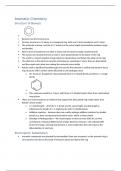
Benzene has the formula C6H6
Its basic structure is 6 C atoms in a hexagonal ring, with one H atom bonded to each C atom
The molecule is planar, and the 6 C-C bonds are the same length (intermediate between single
and double)
Each C atom is bonded to two other C atoms and a H atom by single covalent bonds
This leaves one unused electron on each C atom perpendicular to the plane of the ring
The result is a ring of negative charge (electron cloud) above and below the plane of the ring
The electrons in the electron cloud do not belong to a particular C atom, they are delocalised,
and thus repel each other less making the molecule more stable
Kekule made a significant breakthrough and was the first chemist to realise that benzene had a
ring structure with 6 carbon atoms all joined to one hydrogen atom
o He, however, thought the ring contained three C=C double bonds and three C–C single
bonds
o
o This molecule would be a ‘triene’ with three C=C double bonds rather than a delocalised
ring system
There are some key pieces of evidence that support the delocalised ring model rather than
Kekule’s triene model
o C–C bond length – all of the C–C bonds are the same length, and this length is
inbetween the length of C–C single bonds and C=C double bonds
o Addition reactions – benzene does not readily undergo addition reactions (no double
bonds) e.g. does not decolourise bromine water, whilst a triene would
o Enthalpy of hydrogenation – We would expect a triene to react with 3H 2 to form
cyclohexane, releasing 360kJ/mol of energy. Benzene, however, only released 208
kJ/mol of energy, showing that benzene is more stable than the triene due to the
delocalisation of electrons
Electrophilic Substitution
Aromatic compounds are attacked by electrophiles (lone pair acceptors) as the aromatic ring is
very electron rich due to the cloud of electrons above and below the ring
, They undergo substitution reactions where H atoms on the ring are replaced, but do not
undergo addition reactions as they would lose their delocalisation and extra stability in the
process
Nitration
Reagent – Concentrated HNO3 and concentrated H2SO4
50oC
H atom on benzene ring is replaced by NO 2 (nitro) group
Aromatic nitro compounds are used to make aromatic amines and explosives (TNT)
Overall equation:
Generation of electrophile (NO2+ nitronium ion):
HNO3 + 2H2SO4 -> NO2+ + 2HSO4– + H3O+
Mechanism:
Friedel-Crafts Acylation
Reagent – Acyl chloride or acid anhydride and AlCl 3
Anhydrous to prevent reaction of AlCl3 with water (vigorous)
H atom on benzene ring is replaced by RCO (acyl) group
Product – Aromatic ketones
Extremely useful in adding C atoms to aromatic rings, valuable in organic synthesis
Acyl Chloride
Overall equation:
Generation of electrophile:
Structure of Beneze
Benzene has the formula C6H6
Its basic structure is 6 C atoms in a hexagonal ring, with one H atom bonded to each C atom
The molecule is planar, and the 6 C-C bonds are the same length (intermediate between single
and double)
Each C atom is bonded to two other C atoms and a H atom by single covalent bonds
This leaves one unused electron on each C atom perpendicular to the plane of the ring
The result is a ring of negative charge (electron cloud) above and below the plane of the ring
The electrons in the electron cloud do not belong to a particular C atom, they are delocalised,
and thus repel each other less making the molecule more stable
Kekule made a significant breakthrough and was the first chemist to realise that benzene had a
ring structure with 6 carbon atoms all joined to one hydrogen atom
o He, however, thought the ring contained three C=C double bonds and three C–C single
bonds
o
o This molecule would be a ‘triene’ with three C=C double bonds rather than a delocalised
ring system
There are some key pieces of evidence that support the delocalised ring model rather than
Kekule’s triene model
o C–C bond length – all of the C–C bonds are the same length, and this length is
inbetween the length of C–C single bonds and C=C double bonds
o Addition reactions – benzene does not readily undergo addition reactions (no double
bonds) e.g. does not decolourise bromine water, whilst a triene would
o Enthalpy of hydrogenation – We would expect a triene to react with 3H 2 to form
cyclohexane, releasing 360kJ/mol of energy. Benzene, however, only released 208
kJ/mol of energy, showing that benzene is more stable than the triene due to the
delocalisation of electrons
Electrophilic Substitution
Aromatic compounds are attacked by electrophiles (lone pair acceptors) as the aromatic ring is
very electron rich due to the cloud of electrons above and below the ring
, They undergo substitution reactions where H atoms on the ring are replaced, but do not
undergo addition reactions as they would lose their delocalisation and extra stability in the
process
Nitration
Reagent – Concentrated HNO3 and concentrated H2SO4
50oC
H atom on benzene ring is replaced by NO 2 (nitro) group
Aromatic nitro compounds are used to make aromatic amines and explosives (TNT)
Overall equation:
Generation of electrophile (NO2+ nitronium ion):
HNO3 + 2H2SO4 -> NO2+ + 2HSO4– + H3O+
Mechanism:
Friedel-Crafts Acylation
Reagent – Acyl chloride or acid anhydride and AlCl 3
Anhydrous to prevent reaction of AlCl3 with water (vigorous)
H atom on benzene ring is replaced by RCO (acyl) group
Product – Aromatic ketones
Extremely useful in adding C atoms to aromatic rings, valuable in organic synthesis
Acyl Chloride
Overall equation:
Generation of electrophile: