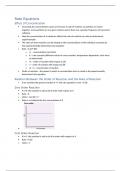
Rate Equations
Effect of Concentration
Increasing the concentration causes an increase in rate of reaction, as particles are closer
together, more particles are in a given volume and so there are a greater frequency of successful
collisions
How the concentration of a substance affects the rate of reaction can only be determined
experimentally
The rates of most reactions can be related to the concentrations of the individual reactants by
the experiementally determined rate equation
Rate = k [A]m [B]n
o [ ] – concentration (mol dm3)
o K – rate constant (different value for every reaction, temperature dependent, units must
be determind)
o m – order of reaction with respect to [A]
o n – order of reaction with respect to [B]
o m + n – overall order of reaction
Order of reaction – the power to which a concentration term is raised in the experimentally
determined rate equation
Relation Between the Order of Reaction and the Rate of Reaction
If we consider the general reaction X->Y, the rate equation is rate = k [X] n
Zero Order Reaction
If n=0, the reaction is said to be 0 order with respect to X
Rate = k
Units = mol dm-3 s-1
Rate is not affected by the concentration of X
First Order Reaction
If n=1, the reaction is said to be first order with respect to X
Rate = k [X]
Units = s-1
, Rate is directly proportional to [X]
Second Order Reaction
If n=2, the reaction is said to be second order with respect to X
Rate = k [X]2
Units = mol2 dm-6 s-1
Rate is proportional to [X]2
Initial Rates Method
The orders of a reaction can be determined experimentally using the initial rates method
The reaction is set up and the concentration of the reactant monitored over time
The concentration of reactant decreases over time as it gets used up in the reaction
Once the reaction is complete, a graph can be produced of the concentration of the reactant
against time
o Can be used to find the initial rate of reaction by calculating the gradient at the curve at
time=0
o
The experiment is then repeated several times using different initial concentrations f reagents
Effect of Concentration
Increasing the concentration causes an increase in rate of reaction, as particles are closer
together, more particles are in a given volume and so there are a greater frequency of successful
collisions
How the concentration of a substance affects the rate of reaction can only be determined
experimentally
The rates of most reactions can be related to the concentrations of the individual reactants by
the experiementally determined rate equation
Rate = k [A]m [B]n
o [ ] – concentration (mol dm3)
o K – rate constant (different value for every reaction, temperature dependent, units must
be determind)
o m – order of reaction with respect to [A]
o n – order of reaction with respect to [B]
o m + n – overall order of reaction
Order of reaction – the power to which a concentration term is raised in the experimentally
determined rate equation
Relation Between the Order of Reaction and the Rate of Reaction
If we consider the general reaction X->Y, the rate equation is rate = k [X] n
Zero Order Reaction
If n=0, the reaction is said to be 0 order with respect to X
Rate = k
Units = mol dm-3 s-1
Rate is not affected by the concentration of X
First Order Reaction
If n=1, the reaction is said to be first order with respect to X
Rate = k [X]
Units = s-1
, Rate is directly proportional to [X]
Second Order Reaction
If n=2, the reaction is said to be second order with respect to X
Rate = k [X]2
Units = mol2 dm-6 s-1
Rate is proportional to [X]2
Initial Rates Method
The orders of a reaction can be determined experimentally using the initial rates method
The reaction is set up and the concentration of the reactant monitored over time
The concentration of reactant decreases over time as it gets used up in the reaction
Once the reaction is complete, a graph can be produced of the concentration of the reactant
against time
o Can be used to find the initial rate of reaction by calculating the gradient at the curve at
time=0
o
The experiment is then repeated several times using different initial concentrations f reagents