Defining crime
Crime - Activities that break the law in a particular country. They are illegal activities.
Deviance - Behaviour that is different from the normal expectations of society and often viewed as
‘bad’ or ‘wrong’. All crime is deviant, but not all deviance is illegal.
Social order - The state of social stability and solidarity of most modern societies. Where citizens
agree on and share similar values, morals and norms as well as a sense of belonging. Maintained by
agents of social control.
Social control - Refers to the need to regulate the behaviour of citizens of a society to make sure
they conform to laws and rules so social order is kept.
Formal social control - A lawful way reinforcing behaviour. Carried out by police, prisons,
courts, government, armed forces etc.
Informal social control - A way of reinforcing behaviour that society expects of individuals.
Carried out by agencies such as family, education, peer group, media and religion.
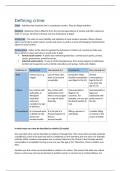
Relativity of: Deviant Act Non-deviant Act Criminal Act Non-criminal Act
Time Certain slurs e.g. Lots of these slurs During the 1920s, Alcohol
'nigger'. were at one point alcohol consumption consumption is
acceptable. was illegal in the US. legal in the US
now (over the
age of 21).
Culture Eye contact with Eye contact with Homosexuality is Homosexuality is
authorities in authorities in the illegal in 64 legal and
Aboriginal West is encouraged countries. For celebrated with
Australian as a sign of active example, you can get pride events in
cultures is listening. the death penalty in the UK.
considered a sign Iran.
of defiance.
Circumstance It is frowned upon It is the job of a Killing a person in A soldier killing
in Britain to talk financial advisor to cold blood. an enemy in the
about your discuss course of battle.
income/wealth. income/wealth.
In what ways can crime be described as relative (10 marks)
One way that crime can be described as relative is through time. This means that acts that would be
considered a crime in the past may not be considered a crime anymore and vice versa. For example,
until the 1920s, alcohol consumption was a criminal offence in the US but in the US today alcohol
consumption is acceptable (as long as you are over the age of 21). Therefore, crime is relative over
time.
Another way that crime can be described as relative is in culture. This means that what one culture
deems a crime may not even be deviant in another country or at least not a criminal offence. For
,example, in Islamic societies, women exposing their legs is a crime but this is acceptable in Western
societies - women wear shorts and mini-skirts without thinking twice. Thus, crime is relative
between cultures.
A further way that crime can be described as relative is by circumstance. This means that there may
be a context taken into account of what is legally a crime in other contexts that would make it
acceptable. For example, killing a person in cold blood is considered murder and would get the
criminal a prison sentence but if a solider kills an enemy in the course of battle this is a norm and to
be expected so is not considered a crime. Therefore, crime is relative by circumstance.
Measuring crime
Official Crime Statistics:
Police, court and prison records.
Crime Survey for England and Wales – victim self-report studies.
All of these are collated by the government home office and published by ONS (Office for National
Statistics).
Non-official crime statistics:
Islington Crime Survey carried out by Centre for Criminology, London. Focuses on smaller
geographical areas and looks at the impact of crime committed on victims.
Statistics may be unrealistic because..
The victim chooses not to report out of fear.
The victim cannot report as they are also part of criminal activity.
The victim is unaware what is considered a crime.
Complaint referred.
Type of Explanation Strengths Limitations
measurement
Police All police recorded crime Easy to access and The Dark Figure of Crime
Recorded in England and Wales - have already been - the term used for all
Crime Figures Northern Ireland and complied. unrecorded crime. This
Scotland are published Up-to-date and could be due to the
separately. They are standardised - time amount of police
supplied from 43 lag between discretion over whether
territorial police forces of incident and to record a crime which
England and Wales, plus reporting tends to has been reported or
the British Transport be short, providing whether it was
Police, via the Home an indication of reported/detected in the
Office to the Office for emerging trends. first place. For example,
National Statistics. They No ethical Mumsnet (2012) found
are sometimes used as a problems. that 83% of those who
defensive measure of the They provide had been raped or
amount of crime which 'whole counts', sexually assaulted didn't
has taken police, but only rather than report it to the police.
include crime which the estimates that are Half said embarrassment
police become aware of subject to sampling and shame would keep
,and then record. variation - the them from reporting it
whole country is and two thirds said they
included. They also would hesitate because
go back many of low conviction rates.
years, so patterns An example of this is
and trends can be rape victim Lindsay
identified. Armstrong, 17,
committed suicide after
she was told to hold up
her underwear in court
even though her
attacker was found
guilty.
Police Discretion - there
are practices by the
police that compromise
the accuracy of statistics.
Pressure on the police to
meet crime reduction
targets may lead to
some crimes
'disappearing' in the
figures or being
downgraded. The
manipulation of police
recorded crime statistics
include coughing
(offenders encouraged
to admit to many
offences in return for a
reduced sentence),
cuffing ('no-criming' -
initially recorded and
then removed from
statistics later), skewing
(putting resources into
some areas but not
others) and stop and
searches and arrests for
the stereotypical 'typical
criminal'.
Patrick (2013) - analysed
data from the
Metropolitan Police and
found that even serious
sexual offences were
routinely 'no-crimed'
and burglary was
regularly a downgraded
offence.
Public Administration
, Committee (2014) - 'the
attitudes and behaviour
which led to the
misrecording of crime
have become ingrained,
including within senior
leadership'.
Definitions, laws, police
counting rules and
public
perception/awareness
change, making statistics
not strictly comparable
over time.
Not a complete picture
of each crime - some
information is not
collected like the
employment status or
family background of the
offender.
Victim Survey Currently carried out by The CSEW has a Victimless crimes or
- The Crime the British Market nationally crimes where the 'victim'
Survey for Research Bureau on representative is a large corporation
England and behalf of the Home sample of around will not appear.
Wales (CSEW) Office, it mainly involves 35,000 adults and In the past only people
face-to-face structured 3,000 children per over 16 were asked but
interviews in the year. now people over 10 are
respondents' homes. The respondent included, usually as part
Respondents are asked rate is relatively of their parents' survey.
about property and high e.g. 75% in The CSEW only surveys a
personal crimes they've 2013. sample so overall trends
experienced as well as The survey is are an estimate which
their attitudes about weighted to adjust may not be
crime related topics e.g. for possible non- representative
anti-social behaviour and response bias to (especially for rare
the effectiveness of the ensure crimes).
police. The CSEW tends to representativeness. Still misses 25% of
show that crime is much responses which could
higher than the police potentially be important.
figures suggest, for some
crimes up to 4 times
higher.
Other Victim The Islington Crime Other victim Often will be subject to
Surveys Survey (Jones, Maclean surveys often focus limitations above.
and Young, 1986) was more on specific Young (1988) argues a
first conducted by the geographical areas 'dark figure' is also
Centre for Criminology in than the CSEW and present in victim surveys
inner city London. It potentially on the as it relies on individuals'
Crime - Activities that break the law in a particular country. They are illegal activities.
Deviance - Behaviour that is different from the normal expectations of society and often viewed as
‘bad’ or ‘wrong’. All crime is deviant, but not all deviance is illegal.
Social order - The state of social stability and solidarity of most modern societies. Where citizens
agree on and share similar values, morals and norms as well as a sense of belonging. Maintained by
agents of social control.
Social control - Refers to the need to regulate the behaviour of citizens of a society to make sure
they conform to laws and rules so social order is kept.
Formal social control - A lawful way reinforcing behaviour. Carried out by police, prisons,
courts, government, armed forces etc.
Informal social control - A way of reinforcing behaviour that society expects of individuals.
Carried out by agencies such as family, education, peer group, media and religion.
Relativity of: Deviant Act Non-deviant Act Criminal Act Non-criminal Act
Time Certain slurs e.g. Lots of these slurs During the 1920s, Alcohol
'nigger'. were at one point alcohol consumption consumption is
acceptable. was illegal in the US. legal in the US
now (over the
age of 21).
Culture Eye contact with Eye contact with Homosexuality is Homosexuality is
authorities in authorities in the illegal in 64 legal and
Aboriginal West is encouraged countries. For celebrated with
Australian as a sign of active example, you can get pride events in
cultures is listening. the death penalty in the UK.
considered a sign Iran.
of defiance.
Circumstance It is frowned upon It is the job of a Killing a person in A soldier killing
in Britain to talk financial advisor to cold blood. an enemy in the
about your discuss course of battle.
income/wealth. income/wealth.
In what ways can crime be described as relative (10 marks)
One way that crime can be described as relative is through time. This means that acts that would be
considered a crime in the past may not be considered a crime anymore and vice versa. For example,
until the 1920s, alcohol consumption was a criminal offence in the US but in the US today alcohol
consumption is acceptable (as long as you are over the age of 21). Therefore, crime is relative over
time.
Another way that crime can be described as relative is in culture. This means that what one culture
deems a crime may not even be deviant in another country or at least not a criminal offence. For
,example, in Islamic societies, women exposing their legs is a crime but this is acceptable in Western
societies - women wear shorts and mini-skirts without thinking twice. Thus, crime is relative
between cultures.
A further way that crime can be described as relative is by circumstance. This means that there may
be a context taken into account of what is legally a crime in other contexts that would make it
acceptable. For example, killing a person in cold blood is considered murder and would get the
criminal a prison sentence but if a solider kills an enemy in the course of battle this is a norm and to
be expected so is not considered a crime. Therefore, crime is relative by circumstance.
Measuring crime
Official Crime Statistics:
Police, court and prison records.
Crime Survey for England and Wales – victim self-report studies.
All of these are collated by the government home office and published by ONS (Office for National
Statistics).
Non-official crime statistics:
Islington Crime Survey carried out by Centre for Criminology, London. Focuses on smaller
geographical areas and looks at the impact of crime committed on victims.
Statistics may be unrealistic because..
The victim chooses not to report out of fear.
The victim cannot report as they are also part of criminal activity.
The victim is unaware what is considered a crime.
Complaint referred.
Type of Explanation Strengths Limitations
measurement
Police All police recorded crime Easy to access and The Dark Figure of Crime
Recorded in England and Wales - have already been - the term used for all
Crime Figures Northern Ireland and complied. unrecorded crime. This
Scotland are published Up-to-date and could be due to the
separately. They are standardised - time amount of police
supplied from 43 lag between discretion over whether
territorial police forces of incident and to record a crime which
England and Wales, plus reporting tends to has been reported or
the British Transport be short, providing whether it was
Police, via the Home an indication of reported/detected in the
Office to the Office for emerging trends. first place. For example,
National Statistics. They No ethical Mumsnet (2012) found
are sometimes used as a problems. that 83% of those who
defensive measure of the They provide had been raped or
amount of crime which 'whole counts', sexually assaulted didn't
has taken police, but only rather than report it to the police.
include crime which the estimates that are Half said embarrassment
police become aware of subject to sampling and shame would keep
,and then record. variation - the them from reporting it
whole country is and two thirds said they
included. They also would hesitate because
go back many of low conviction rates.
years, so patterns An example of this is
and trends can be rape victim Lindsay
identified. Armstrong, 17,
committed suicide after
she was told to hold up
her underwear in court
even though her
attacker was found
guilty.
Police Discretion - there
are practices by the
police that compromise
the accuracy of statistics.
Pressure on the police to
meet crime reduction
targets may lead to
some crimes
'disappearing' in the
figures or being
downgraded. The
manipulation of police
recorded crime statistics
include coughing
(offenders encouraged
to admit to many
offences in return for a
reduced sentence),
cuffing ('no-criming' -
initially recorded and
then removed from
statistics later), skewing
(putting resources into
some areas but not
others) and stop and
searches and arrests for
the stereotypical 'typical
criminal'.
Patrick (2013) - analysed
data from the
Metropolitan Police and
found that even serious
sexual offences were
routinely 'no-crimed'
and burglary was
regularly a downgraded
offence.
Public Administration
, Committee (2014) - 'the
attitudes and behaviour
which led to the
misrecording of crime
have become ingrained,
including within senior
leadership'.
Definitions, laws, police
counting rules and
public
perception/awareness
change, making statistics
not strictly comparable
over time.
Not a complete picture
of each crime - some
information is not
collected like the
employment status or
family background of the
offender.
Victim Survey Currently carried out by The CSEW has a Victimless crimes or
- The Crime the British Market nationally crimes where the 'victim'
Survey for Research Bureau on representative is a large corporation
England and behalf of the Home sample of around will not appear.
Wales (CSEW) Office, it mainly involves 35,000 adults and In the past only people
face-to-face structured 3,000 children per over 16 were asked but
interviews in the year. now people over 10 are
respondents' homes. The respondent included, usually as part
Respondents are asked rate is relatively of their parents' survey.
about property and high e.g. 75% in The CSEW only surveys a
personal crimes they've 2013. sample so overall trends
experienced as well as The survey is are an estimate which
their attitudes about weighted to adjust may not be
crime related topics e.g. for possible non- representative
anti-social behaviour and response bias to (especially for rare
the effectiveness of the ensure crimes).
police. The CSEW tends to representativeness. Still misses 25% of
show that crime is much responses which could
higher than the police potentially be important.
figures suggest, for some
crimes up to 4 times
higher.
Other Victim The Islington Crime Other victim Often will be subject to
Surveys Survey (Jones, Maclean surveys often focus limitations above.
and Young, 1986) was more on specific Young (1988) argues a
first conducted by the geographical areas 'dark figure' is also
Centre for Criminology in than the CSEW and present in victim surveys
inner city London. It potentially on the as it relies on individuals'