UNIT 14A
What is the functional group
A functional group is a group of atoms with unique chemical properties no matter the
atoms in the molecule. Atoms in a functional group are linked to each other and the
molecule through covalent bonds.
Carbonyl Groups
A carbonyl group is made of double bonded oxygen atoms, linking in a carbon atom.
Aldehydes
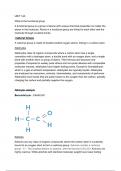
Aldehydes class of organic compounds where a carbon atom has a single
connection with a hydrogen atom, a double bond with an oxygen atom, and a single
bond with another atom or group of atoms. Their formula and structure and
properties Compared to weakly polar ethers and non-polar alkanes with comparable
molecular masses, aldehydes have higher boiling points. Except for formaldehyde,
which is a gas at ambient temperature, aldehydes are typically liquids. Aldehydes
are employed as monomers, solvents, intermediates, and components of perfumes.
Aldehydes have bonds that are pulled closer to the oxygen than the carbon, partially
charging the carbon and partially negative the oxygen.
Aldehyde example
Benzaldehyde - C6H5CHO
Ketones
Ketones are any class of organic compounds where the carbon atom is covalently
bound to an oxygen atom to form a carbonyl group. Ketones contain a carbonyl
group −C−. The simplest ketone is acetone, with the formula (CH₃)₂CO. Ketones are
highly reactive. While alcohols with identical molecular weight have lower boiling
,points than ketones, ketones have greater boiling points than non-polar molecules
,because of the carbonyl oxygen atom, ketones may weakly form hydrogen bonds
with water.
Ketone example
Acetone –C3H6O
Differences
Ketones are less reactive than aldehydes. Aldehydes have the carbonyl group joined
to at least one hydrogen atom. Two carbon groups are joined to the carbonyl group
in ketones. Larger molecules have greater boiling temperatures for aldehydes and
ketones, which are liquids. The boiling point of methanal, often known as
formaldehyde, is -21°C. The main difference between an aldehyde and ketone,
despite having a carbon atom in the core, is found in their unique chemical
structures. While ketones are recognised for having double alkyl bonds on both
sides, aldehydes combine to form an alkyl on one side and a hydrogen atom on the
other.
Carboxylic Acids
, The presence of a carboxyl group (-COOH) distinguishes the family of chemical
molecules known as carboxylic acids. Carboxylic acids are both acidic and polar due
to this functional group, which is made up of a carbonyl group (C=O) joined to a
hydroxyl group (OH). Because carbon and oxygen have different electronegativity,
the C=O bond is polar, which makes the carbonyl carbon electrophilic . As the
hydroxyl group's O-H bond is polar, carboxylic acids may form hydrogen bonds,
which increases their acidity. Weak acids are carboxylic acids. Resonance stabilises
the carboxylate ion that develops during dissociation. The acidity of carboxylic acids
is increased by this resonance stabilisation. The presence of groups on the
hydrocarbon chain that donate or remove electrons influences how acidic carboxylic
acids are. They can establish hydrogen bonds with water molecules, lower
carboxylic acids than those having fewer than five carbons which are soluble in
water. nonpolar liquids, carboxylic acids can create dimers by forming hydrogen
bonds with other carboxylic acid molecules. Their boiling temperatures are
considerably higher than those of other compounds with comparable molecular
weights due to their capacity to form hydrogen bonds.
Carboxylic Acid example
Formic acid
HCOOH
Non-Carbonyl Groups
A group without a carbonyl group—a carbon atom double-bonded to an oxygen
atom—is known as a non-carbonyl group. No carbonyl group is present as there is
only one link between carbon and oxygen in alcohols. An oxygen atom bound to a
hydrogen atom is known as a hydroxyl group (-OH), and it is present in alcohols.
Alcohols
What is the functional group
A functional group is a group of atoms with unique chemical properties no matter the
atoms in the molecule. Atoms in a functional group are linked to each other and the
molecule through covalent bonds.
Carbonyl Groups
A carbonyl group is made of double bonded oxygen atoms, linking in a carbon atom.
Aldehydes
Aldehydes class of organic compounds where a carbon atom has a single
connection with a hydrogen atom, a double bond with an oxygen atom, and a single
bond with another atom or group of atoms. Their formula and structure and
properties Compared to weakly polar ethers and non-polar alkanes with comparable
molecular masses, aldehydes have higher boiling points. Except for formaldehyde,
which is a gas at ambient temperature, aldehydes are typically liquids. Aldehydes
are employed as monomers, solvents, intermediates, and components of perfumes.
Aldehydes have bonds that are pulled closer to the oxygen than the carbon, partially
charging the carbon and partially negative the oxygen.
Aldehyde example
Benzaldehyde - C6H5CHO
Ketones
Ketones are any class of organic compounds where the carbon atom is covalently
bound to an oxygen atom to form a carbonyl group. Ketones contain a carbonyl
group −C−. The simplest ketone is acetone, with the formula (CH₃)₂CO. Ketones are
highly reactive. While alcohols with identical molecular weight have lower boiling
,points than ketones, ketones have greater boiling points than non-polar molecules
,because of the carbonyl oxygen atom, ketones may weakly form hydrogen bonds
with water.
Ketone example
Acetone –C3H6O
Differences
Ketones are less reactive than aldehydes. Aldehydes have the carbonyl group joined
to at least one hydrogen atom. Two carbon groups are joined to the carbonyl group
in ketones. Larger molecules have greater boiling temperatures for aldehydes and
ketones, which are liquids. The boiling point of methanal, often known as
formaldehyde, is -21°C. The main difference between an aldehyde and ketone,
despite having a carbon atom in the core, is found in their unique chemical
structures. While ketones are recognised for having double alkyl bonds on both
sides, aldehydes combine to form an alkyl on one side and a hydrogen atom on the
other.
Carboxylic Acids
, The presence of a carboxyl group (-COOH) distinguishes the family of chemical
molecules known as carboxylic acids. Carboxylic acids are both acidic and polar due
to this functional group, which is made up of a carbonyl group (C=O) joined to a
hydroxyl group (OH). Because carbon and oxygen have different electronegativity,
the C=O bond is polar, which makes the carbonyl carbon electrophilic . As the
hydroxyl group's O-H bond is polar, carboxylic acids may form hydrogen bonds,
which increases their acidity. Weak acids are carboxylic acids. Resonance stabilises
the carboxylate ion that develops during dissociation. The acidity of carboxylic acids
is increased by this resonance stabilisation. The presence of groups on the
hydrocarbon chain that donate or remove electrons influences how acidic carboxylic
acids are. They can establish hydrogen bonds with water molecules, lower
carboxylic acids than those having fewer than five carbons which are soluble in
water. nonpolar liquids, carboxylic acids can create dimers by forming hydrogen
bonds with other carboxylic acid molecules. Their boiling temperatures are
considerably higher than those of other compounds with comparable molecular
weights due to their capacity to form hydrogen bonds.
Carboxylic Acid example
Formic acid
HCOOH
Non-Carbonyl Groups
A group without a carbonyl group—a carbon atom double-bonded to an oxygen
atom—is known as a non-carbonyl group. No carbonyl group is present as there is
only one link between carbon and oxygen in alcohols. An oxygen atom bound to a
hydrogen atom is known as a hydroxyl group (-OH), and it is present in alcohols.
Alcohols