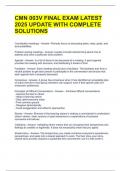
CMN 003V FINAL EXAM LATEST
2025 UPDATE WITH COMPLETE
SOLUTIONS
Coordination meetings - Answer- Primarily focus on discussing tasks, roles, goals, and
accountabilities.
Problem-solving meetings - Answer- Usually include brainstorming about how to
address and solve a particular work problem.
Agenda - Answer- Is a list of items to be discussed at a meeting. A good agenda
provides the meeting with structure, and distributing it ahead of time
Facilitator - Answer- Each meeting should have a facilitator. The facilitator acts from a
neutral position to get each person to participate in the conversation and ensure that
each agenda item is properly discussed.
Consensus - Answer- A group has consensus when it has identified an acceptable plan
of action that all or most group members can support, even if that specific plan isn't
everyone's preference.
Principles of Difficult Conversations - Answer- - Embrace difficult conversations
- Assume the best in others
- Adopt a learning stance
- Stay calm/overcome noise
- Find common ground
- Disagree diplomatically
- Avoid exaggeration and either/or approaches
Stories - Answer- Element of the learning stance is making a commitment to understand
others' stories—their versions of past interactions or explanations of business
successes and failures.
Validating - Answer- Validating others means that you recognize their perspectives and
feelings as credible or legitimate. It does not necessarily mean that you agree.
Shared story - Answer- The shared story you create combines everyone's experiences,
perspectives, and goals into a shared approach to work. The their story-your story-
shared story process requires a substantial time commitment, but it is well worth it.
, Abilities - Answer- Are skills and knowledge you can apply to accomplishing work tasks,
such as using accounting software or conducting marketing surveys.
Attributes - Answer- Are personal traits or characteristics. In the job application process,
employers are often looking for more than your abilities.
Networking - Answer- Sees it as a proactive approach to building professional
relationships to achieve shared company, career, and professional development goals.
Informational interview - Answer- You speak with a successful and accomplished
professional to seek out career advice. It is an excellent opportunity to learn about
career choices and career paths.
Chronological résumés - Answer- Present the information grouped by work and
education over time( The most common and generally preferred format, especially for
young professionals)
Functional résumés - Answer- Present the information in terms of key skills.
Solicited cover letter - Answer- Is a cover letter for an open position that a company
advertises.
Unsolicited cover letter - Answer- States your interest in working for a company that is
not actively requesting job applications
Types of Interviews - Answer- 1. Appraisal interview
2. Problem-solving interview
3. Exit interview
4. Counseling interview
5. Service-oriented interview
6. Persuasive interview
7. Survey interview
8. Selection interview
Goal Setting and Intentionality - Answer- Clarify your professional goals for the short
term (one to two years) and long term (five to ten years),
Identifying your career goals helps you accomplish several things in the job search
process - Answer- 1) it helps you frame your résumé and cover letter to project your
career hopes.
2) it helps you evaluate how well your abilities and attributes prepare you for your
desired career
3) it shows employers that you are serious, because well-defined career goals imply
seriousness in your approach to work.
2025 UPDATE WITH COMPLETE
SOLUTIONS
Coordination meetings - Answer- Primarily focus on discussing tasks, roles, goals, and
accountabilities.
Problem-solving meetings - Answer- Usually include brainstorming about how to
address and solve a particular work problem.
Agenda - Answer- Is a list of items to be discussed at a meeting. A good agenda
provides the meeting with structure, and distributing it ahead of time
Facilitator - Answer- Each meeting should have a facilitator. The facilitator acts from a
neutral position to get each person to participate in the conversation and ensure that
each agenda item is properly discussed.
Consensus - Answer- A group has consensus when it has identified an acceptable plan
of action that all or most group members can support, even if that specific plan isn't
everyone's preference.
Principles of Difficult Conversations - Answer- - Embrace difficult conversations
- Assume the best in others
- Adopt a learning stance
- Stay calm/overcome noise
- Find common ground
- Disagree diplomatically
- Avoid exaggeration and either/or approaches
Stories - Answer- Element of the learning stance is making a commitment to understand
others' stories—their versions of past interactions or explanations of business
successes and failures.
Validating - Answer- Validating others means that you recognize their perspectives and
feelings as credible or legitimate. It does not necessarily mean that you agree.
Shared story - Answer- The shared story you create combines everyone's experiences,
perspectives, and goals into a shared approach to work. The their story-your story-
shared story process requires a substantial time commitment, but it is well worth it.
, Abilities - Answer- Are skills and knowledge you can apply to accomplishing work tasks,
such as using accounting software or conducting marketing surveys.
Attributes - Answer- Are personal traits or characteristics. In the job application process,
employers are often looking for more than your abilities.
Networking - Answer- Sees it as a proactive approach to building professional
relationships to achieve shared company, career, and professional development goals.
Informational interview - Answer- You speak with a successful and accomplished
professional to seek out career advice. It is an excellent opportunity to learn about
career choices and career paths.
Chronological résumés - Answer- Present the information grouped by work and
education over time( The most common and generally preferred format, especially for
young professionals)
Functional résumés - Answer- Present the information in terms of key skills.
Solicited cover letter - Answer- Is a cover letter for an open position that a company
advertises.
Unsolicited cover letter - Answer- States your interest in working for a company that is
not actively requesting job applications
Types of Interviews - Answer- 1. Appraisal interview
2. Problem-solving interview
3. Exit interview
4. Counseling interview
5. Service-oriented interview
6. Persuasive interview
7. Survey interview
8. Selection interview
Goal Setting and Intentionality - Answer- Clarify your professional goals for the short
term (one to two years) and long term (five to ten years),
Identifying your career goals helps you accomplish several things in the job search
process - Answer- 1) it helps you frame your résumé and cover letter to project your
career hopes.
2) it helps you evaluate how well your abilities and attributes prepare you for your
desired career
3) it shows employers that you are serious, because well-defined career goals imply
seriousness in your approach to work.