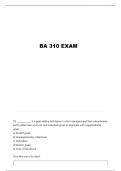
32. __________________ is a goal-setting technique in which managers and their subordinates
jointly determine work unit and individual goals in alignment with organizational
goals.
a) SMART goals
b) Management-by-objectives
c) Motivation
d) Stretch goals
e) none of the above
Give this one a try later!
, b) Management-by-objectives
7. The Boston Tea Party was a response to which of the following British policies? a)
monopolistic business practices b) attempts to limit religious freedoms c) attempts to
limit the rights of indigenous people d) all of the above e) none of the above
Give this one a try later!
a) monopolistic business practices
31. Which of the following is/are not among the strategies for managing "go-getter"
employees?
a) empowerment
b) assigning independent work or work with other go-getters
c) close supervision
d) all of the above
e) none of the above
Give this one a try later!
c) close supervision
5. Ethics training should be introduced to employees during which of the following
stages of employment? a) orientation b) six-month review c) one-year anniversary d)
as soon as an ethical dilemma occurs e) none of the above
Give this one a try later!
, a) orientation
15. Cognitive dissonance occurs when an individual considers _______________________, which
creates an unpleasant state of mind. a) punishment versus reward b) inconsistent or
contradictory attitudes and beliefs c) the stages of moral development d) all of the
above e) none of the above
Give this one a try later!
b) inconsistent of contradictory attitudes and beliefs
31. The 1935 passage of which law legally obligated employers to negotiate with duly
elected unions and codified regulations governing the process for forming a union?
a) the National Labor Relations Act (NLRA) b) the Sherman Antitrust Act (SAA) c) the
Taft Hartley Act (TFA) d) the National Strike Act (NSA) e) none of the above
Give this one a try later!
a) the Nation Labor Relations Act (NLRA)
7. Social psychologists French and Raven have differentiated among five types of
power bases individuals can have based on which aspect?
a) status in the organization
b) level of seniority
c) relationship to others in the organization
d) all of the above
e) none of the above
Give this one a try later!
, c) relationship to others in the organization
26. _________________ can be a major obstacle to code effectiveness, which suggests
communication and integration of the codes is key. a) social pressure b) management
adoption c) written policies d) all of the above e) none of the above
Give this one a try later!
a) social pressure
3. According to recent research by the Ethics Resource Center, which percentage of
respondents who observed ethical misconduct did not report it?
a) 77%
b) 57%
c) 37%
d) 17%
e) none of the above
Give this one a try later!
c) 37%
13. The position in an organization charged with broad oversight of ethical
performance is the:
a) ombudsperson
b) ethics & compliance officer
c) manager
d) CEO
e) none of the above
jointly determine work unit and individual goals in alignment with organizational
goals.
a) SMART goals
b) Management-by-objectives
c) Motivation
d) Stretch goals
e) none of the above
Give this one a try later!
, b) Management-by-objectives
7. The Boston Tea Party was a response to which of the following British policies? a)
monopolistic business practices b) attempts to limit religious freedoms c) attempts to
limit the rights of indigenous people d) all of the above e) none of the above
Give this one a try later!
a) monopolistic business practices
31. Which of the following is/are not among the strategies for managing "go-getter"
employees?
a) empowerment
b) assigning independent work or work with other go-getters
c) close supervision
d) all of the above
e) none of the above
Give this one a try later!
c) close supervision
5. Ethics training should be introduced to employees during which of the following
stages of employment? a) orientation b) six-month review c) one-year anniversary d)
as soon as an ethical dilemma occurs e) none of the above
Give this one a try later!
, a) orientation
15. Cognitive dissonance occurs when an individual considers _______________________, which
creates an unpleasant state of mind. a) punishment versus reward b) inconsistent or
contradictory attitudes and beliefs c) the stages of moral development d) all of the
above e) none of the above
Give this one a try later!
b) inconsistent of contradictory attitudes and beliefs
31. The 1935 passage of which law legally obligated employers to negotiate with duly
elected unions and codified regulations governing the process for forming a union?
a) the National Labor Relations Act (NLRA) b) the Sherman Antitrust Act (SAA) c) the
Taft Hartley Act (TFA) d) the National Strike Act (NSA) e) none of the above
Give this one a try later!
a) the Nation Labor Relations Act (NLRA)
7. Social psychologists French and Raven have differentiated among five types of
power bases individuals can have based on which aspect?
a) status in the organization
b) level of seniority
c) relationship to others in the organization
d) all of the above
e) none of the above
Give this one a try later!
, c) relationship to others in the organization
26. _________________ can be a major obstacle to code effectiveness, which suggests
communication and integration of the codes is key. a) social pressure b) management
adoption c) written policies d) all of the above e) none of the above
Give this one a try later!
a) social pressure
3. According to recent research by the Ethics Resource Center, which percentage of
respondents who observed ethical misconduct did not report it?
a) 77%
b) 57%
c) 37%
d) 17%
e) none of the above
Give this one a try later!
c) 37%
13. The position in an organization charged with broad oversight of ethical
performance is the:
a) ombudsperson
b) ethics & compliance officer
c) manager
d) CEO
e) none of the above