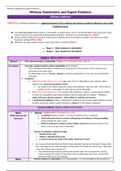
Witness Statements & Expert Evidence
Witness Statements and Expert Evidence
Witness evidence
CPR32.4(1): A witness statement is a signed statement of the evidence the witness would be allowed to give orally
if called to do so.
The court can control which evidence is admissible, on which issues, how it is presented before the court and to what
extent it may be cross-examined by giving specific directions, limited in cross examination etc. CPR32.1
Any fact which needs to be proved is to be proved at trial by way of oral evidence in public (1(a) (and at any other
hearing in writing) CPR32.2(1)(b)
Witnesses can give evidence by any means (video link is common) CPR32.3
Stage 1 – What evidence is admissible?
Stage 2 – How should it be formatted?
STAGE 1: What evidence is admissible?
Relevant Only relevant evidence is admissible: O’Brian v CC South Wales Police 2005 HL
Not opinion Generally, opinion evidence will be inadmissible (in Civil Cases).
o This is because the function of a witness is to relay facts; it is then for the court to draw its own
conclusions from these facts.
o So, statements such as, “he was a chancer” would be inadmissible. It is for the court to draw that
conclusion
Exceptions:
o s3(2) of the Civil Evidence Act 1972 makes clear that it is admissible to give evidence which
amounts to a ‘personal perception of facts.’
E.g. speed; if the witness states the vehicle was driving at “about 60 mph”, this is only an
opinion, but it is a perception of a fact and so may be admissible.
o s3(1) of the Civil Evidence Act 1972 provides that a witnesses’ opinion “on any relevant matter
on which he is qualified to give expert evidence shall be admissible in evidence”. Therefore,
expert witnesses CAN give opinions – when called as a witness, not hearsay
o In professional negligence claims, a defendant is allowed to give his own expert opinion on what
he did or did not do which is said to amount to negligence in his witness statement.
Hearsay Evidence? Require additional formalities.
Oral or written statement made outside the courtroom repeated to the court in order to prove the truth of the matter stated in court.
Step 1: “Hearsay”: s1(2)(a) of the Civil Evidence Act 1995
Define hearsay and o A statement (oral or written – any representation of fact or opinion)
statement o Made otherwise than by a person while giving oral evidence in the proceedings
(made outside the court room)
o Which is tendered as evidence of the matters stated (presented to court to show
that it is true, not just that it was made)
Hearsay is a therefore statement made:
Outside of the court,
Which is repeated to the court
In order to prove the truth of the matter stated out of court
E.g. Louise arrives later home to find her house burgled. A passer-by she doesn’t known tells
her ‘I saw three boys in their late teens running down the street five minutes ago. They were
yobs. One of them was carrying a TV’
The statement was made by a third party outside court and is repeated in court by
Louise to prove the truth of it (that boys were running away from scene, not that the
passer-by told her so). It is hearsay.
Step 2: Hearsay evidence is admissible in a civil proceedings – it is not excluded on the grounds it is
1
Witness Statements and Expert Evidence
Witness evidence
CPR32.4(1): A witness statement is a signed statement of the evidence the witness would be allowed to give orally
if called to do so.
The court can control which evidence is admissible, on which issues, how it is presented before the court and to what
extent it may be cross-examined by giving specific directions, limited in cross examination etc. CPR32.1
Any fact which needs to be proved is to be proved at trial by way of oral evidence in public (1(a) (and at any other
hearing in writing) CPR32.2(1)(b)
Witnesses can give evidence by any means (video link is common) CPR32.3
Stage 1 – What evidence is admissible?
Stage 2 – How should it be formatted?
STAGE 1: What evidence is admissible?
Relevant Only relevant evidence is admissible: O’Brian v CC South Wales Police 2005 HL
Not opinion Generally, opinion evidence will be inadmissible (in Civil Cases).
o This is because the function of a witness is to relay facts; it is then for the court to draw its own
conclusions from these facts.
o So, statements such as, “he was a chancer” would be inadmissible. It is for the court to draw that
conclusion
Exceptions:
o s3(2) of the Civil Evidence Act 1972 makes clear that it is admissible to give evidence which
amounts to a ‘personal perception of facts.’
E.g. speed; if the witness states the vehicle was driving at “about 60 mph”, this is only an
opinion, but it is a perception of a fact and so may be admissible.
o s3(1) of the Civil Evidence Act 1972 provides that a witnesses’ opinion “on any relevant matter
on which he is qualified to give expert evidence shall be admissible in evidence”. Therefore,
expert witnesses CAN give opinions – when called as a witness, not hearsay
o In professional negligence claims, a defendant is allowed to give his own expert opinion on what
he did or did not do which is said to amount to negligence in his witness statement.
Hearsay Evidence? Require additional formalities.
Oral or written statement made outside the courtroom repeated to the court in order to prove the truth of the matter stated in court.
Step 1: “Hearsay”: s1(2)(a) of the Civil Evidence Act 1995
Define hearsay and o A statement (oral or written – any representation of fact or opinion)
statement o Made otherwise than by a person while giving oral evidence in the proceedings
(made outside the court room)
o Which is tendered as evidence of the matters stated (presented to court to show
that it is true, not just that it was made)
Hearsay is a therefore statement made:
Outside of the court,
Which is repeated to the court
In order to prove the truth of the matter stated out of court
E.g. Louise arrives later home to find her house burgled. A passer-by she doesn’t known tells
her ‘I saw three boys in their late teens running down the street five minutes ago. They were
yobs. One of them was carrying a TV’
The statement was made by a third party outside court and is repeated in court by
Louise to prove the truth of it (that boys were running away from scene, not that the
passer-by told her so). It is hearsay.
Step 2: Hearsay evidence is admissible in a civil proceedings – it is not excluded on the grounds it is
1